Showing posts with label YA. Show all posts

Thursday, July 31, 2025

Book Review: I Crawl Through It


Book Review: I Crawl Through It by AS King 

Goodreads Description: Four teenagers are on the verge of exploding. The anxieties they face at every turn have nearly pushed them to the point of surrender: senseless high-stakes testing, the lingering damage of past trauma, the buried grief and guilt of tragic loss. They are desperate to cope, but no one is listening.

So they will lie. They will split in two. They will turn inside out. They will even build an invisible helicopter to fly themselves far away…but nothing releases the pressure. Because, as they discover, the only way to truly escape their world is to fly right into it.

The genius of acclaimed author A.S. King reaches new heights in this groundbreaking work of surrealist fiction; it will mesmerize readers with its deeply affecting exploration of how we crawl through traumatic experience—and find the way out.

My Review: This book is certainly a product of its time. It was published in 2015, when internet meme culture began to shift away from XD rawr randomness, mustaches, and hipster irony. The book uses this "randomness" meme culture as a metaphor to explore domestic trauma, mental health, and the struggles of growing up, but it feels like a "fellow kids" moment, as King doesn't seem to have a clear grasp of the culture she's emulating. 

This book's approach to trauma is... interesting, to say the least. It features a cast of protagonists that are all coping with their personal traumas, though even after finishing the book, it's hard to tell what each character is actually dealing with. The book cloaks the reality of what happens in surrealism, and then relies on that surrealism to convey the emotional fallout and coping methods of each character; how they "crawl through it," if you will. But either King is scared of naming the traumas outright -- perhaps that would shatter the denial-like illusion -- or she has little understanding of how to express traumatic experiences through surrealism due to a lack of personal experience -- or both. Because of that, the surreal elements lack metaphorical significance to the events at play. Everything feels disjointed and purposeless -- random without any understanding of what made "randomness" meme culture work. Some of the metaphors used did connect back to the subject in a powerful way, such as China turning herself inside out as a response to anxiety, but so many elements feel completely disconnected. Several characters escape to a "genius-land" on an invisible helicopter, and while I could see the intention behind this subplot (escaping the stressors of reality through an imaginary paradise), the metaphor completely falls apart once they arrive and it fails to communicate anything meaningful about escapism, the myth of genius, academic/career pressures placed on youth, etc. 

It's a shame, because surrealist fiction can effectively express the confusion and intensity of traumatic emotions, but King doesn't dive deep enough into the emotions to achieve that. It's just randomness for randomness' sake, with no thought behind the arrangement of surrealist elements. There's no emotional gut punch here, no interesting metaphorical take on life, or even cool magical realism vibes. The book pretends to be deep, but it's shallower than the kiddy pool. 

TL;DR: All in all, 1/5 stars. Painfully underwhelming. 

Sunday, July 20, 2025

Book Review: Code Name Verity


Book Review: Code Name Verity by Elizabeth Wein 

Goodreads Description: Two young women from totally different backgrounds are thrown together during World War II: one a working-class girl from Manchester, the other a Scottish aristocrat, one a pilot, the other a wireless operator. Yet whenever their paths cross, they complement each other perfectly and before long become devoted friends.

But then a vital mission goes wrong, and one of the friends has to bail out of a faulty plane over France. She is captured by the Gestapo and becomes a prisoner of war. The story begins in “Verity’s” own words, as she writes her account for her captors.

My Review: Classifying this book as YA was a bit of a strange choice. While the coming of age and friendship aspects are very YA, the voice feels off. The book spends a lot of time on female war pilots -- how they lived, worked, and were promoted -- to the point where it slows down the narrative. It adds to the historical accuracy at the cost of pacing, and makes me think this book would fit better in the adult market. It often reads like a report more than a novel, and while that works with the WW2 setting, it doesn't really jive with a teenage voice. Wein does insert some obvious teenage moments to make the characters feel younger, but these moments stick out, and read like they were added later in order to age the manuscript down. 

Other than that, the book is fairly solid. The framing of "Let me tell you how I ended up in this situation" is a little cliche, but Wein shakes it up by focusing the story on Maddie, the pilot back home, rather than Verity, the spy captured by the Nazis. This creates an air of mystery around Verity and her circumstances, as we only learn about her through the way she tells the story of her friend. Honestly, my biggest gripe with this book is that it's not sapphic. There's a weird romantic tension between the two main girls that I wish would have been expanded on. It would have deepened the stakes and tension while also exploring queerness during the time period. I have no problem with friendship stories -- in fact I love them, and wish there were more -- but these girls did not read like friends. Friendships feel more genuine to me when there's a sense of unconditionality - when people know that they can fully be themselves, because the other person loves them for who they are. Yet with romantic interest, there's always a bit of tension and the players are more cautious, because they can sense something powerful building, and they have no idea what's going to happen to their relationship when that "something" comes to light. In every scene with Maddie and Verity, I could feel the weight of that romantic tension, but it never boils over into anything real, leaving me rather unsatisfied by the end. It felt like eating a dish that was missing a key ingredient.
 
All in all, if you're a history buff, then absolutely snatch this up. If you're not interested in WW2 history, you're not missing much by passing on this one. 

TL;DR: 3/5 stars. A deep dive into WW2 pilots in novel form. 

Friday, January 5, 2024

Book Review: Cinder


Book Review: Cinder by Marissa Meyer 

Goodreads Description: Humans and androids crowd the raucous streets of New Beijing. A deadly plague ravages the population. From space, a ruthless Lunar people watch, waiting to make their move. No one knows that Earth’s fate hinges on one girl. . . . Cinder, a gifted mechanic, is a cyborg.

She’s a second-class citizen with a mysterious past, reviled by her stepmother and blamed for her stepsister’s illness. But when her life becomes intertwined with the handsome Prince Kai’s, she suddenly finds herself at the center of an intergalactic struggle, and a forbidden attraction. Caught between duty and freedom, loyalty and betrayal, she must uncover secrets about her past in order to protect her world’s future.

My Review: I picked up Cinder about 10 years ago when the book released, so this review has been a long time coming. As the cover and title suggest, Cinder is a steampunk retelling of Cinderella, set in a futuristic New Beijing filled with cyborgs and robots. It expands the original story by introducing a deadly plague that's crippled the globe and tense intergalactic politics centered around a possible royal marriage. In the midst of all this lives Cinder, who works as a mechanic in a Tatooine-like market in order to buy herself a new ankle and car to escape her abusive family.

Let's start with the positives: Meyer's characterization is on point. The chemistry between Cinder and Prince Kai is POPPING. They're both strong, charismatic individuals with their own lives and motivations who end up crossing paths again and again until it leads to something more. It's a satisfying change from YA books where the love interest seems to have no life outside the main character. I was also pleasantly surprised by the political drama between the Lunar kingdom and the people of Earth/New Beijing. Meyer simplified world politics into a handful of state powers to create an us-vs-them structure between Earthlings and Lunars, while still showing how New Beijing is under pressure from other states to make peace with the aliens. This simplified political drama feels perfect for YA readers transitioning from younger fantasy stories towards adult "romantasy," with court drama, politics, and inter-cultural clashes. Despite that, the line between Earthlings and Lunars was depicted as very black and white. Meyer describes how Lunars are savage, totalitarian, and oppressive to their own peoples, committing genocides and using mind control without hesitation. While there is some evidence that "not all Lunars" are evil, the book doesn't do enough to show that good and evil are not tied to one's race. It's trying to play out a more adult political drama, yet falls back on a childish good guys and bad guys dichotomy that feels out of step with what the rest of the book is trying to do. 

While the book does make an effort to avoid the "love at first sight" trope, it steers headlong into "not like other girls." In the years since this book was written, a lot has been said about the "not like other girls" girl who presents herself as "one of the guys" while putting down girls with traditionally feminine interests. This trope ultimately perpetuates misogyny by pitting women against each other while arguing femininity is somehow inferior. Cinder uncritically leans into this trope -- she puts down other girls for wanting to go to the ball, she implies other girls are vapid while she's smart because she cares about mechanics, she resists Prince Kai's flirting and somehow this is supposed to make her cool, etc., etc. This book could have thoughtfully deconstructed and subverted the trope, as Cinder's condescension could have been seen as a defense mechanism for the insecurity she feels about her cyborg parts, but instead the book uncritically embraces the trope without any awareness for the misogyny being perpetuated. In the wake of feminism's sisterhood movement, this book feels both cringey and dated. 

As far as plot goes, I was disappointed by how predictable it was. The book is a retelling, so I expected a certain degree of predictability, but the new parts of the story that Meyer added-- the plague, the politics with a different state, the Lunar people's magic (or lack thereof) -- were so predictable that it was a struggle to stay focused. There was no attempt to subvert expectations - it was almost cliched in the way it did exactly what you thought it would, yet the narration ups the drama by trying to make these incredibly mundane plot twists seem shocking. Perhaps it's my years of reading that make this book so predictable, because Cinder isn't bad at what it does. If you want something that plays into your exact expectations for a teen princess story, then Cinder is it, but unfortunately, that's all it is. 

The final letdown for this book was its lackluster sense of setting. Despite being a steampunk world set in a futuristic Beijing, little effort was put into worldbuilding. We get some description of cramped alleyways, concrete, or tall skyscrapers, but other than that, the world is largely blank. Meyer relies on the droid characters and Cinder's cyborg parts to expand the steampunk elements, yet only utilizes them aesthetically and makes no effort to show how their addition influences the world. Steampunk cities are often infused with so much personality that they become characters themselves, yet New Beijing is almost entirely flavourless. Sadly, this is probably Cinder's biggest missed opportunity.

Despite my complaints, Cinder is an incredibly solid story with some decent writing, great characterization, and decent political drama. While I found the book a little boring and Cinder's Alt Girl routine tiresome, the book never became a drag to read. It would likely be a hit for teen girls who are graduating from books like Anna and the French Kiss and moving towards Strange the Dreamer or A Court of Thorns and Roses. 

TL;DR: 3/5 stars. A solid steampunk Cinderella retelling that errs on the side of predictable and anti-feminist. 

Sunday, December 24, 2023

Book Review: Every Heart a Doorway


Book Review: Every Heart a Doorway by Seanan McGuire 

Goodreads Description: Children have always disappeared under the right conditions; slipping through the shadows under a bed or at the back of a wardrobe, tumbling down rabbit holes and into old wells, and emerging somewhere... else.

But magical lands have little need for used-up miracle children.

Nancy tumbled once, but now she’s back. The things she’s experienced... they change a person. The children under Miss West’s care understand all too well. And each of them is seeking a way back to their own fantasy world.

But Nancy’s arrival marks a change at the Home. There’s a darkness just around each corner, and when tragedy strikes, it’s up to Nancy and her new-found schoolmates to get to the heart of the matter.

No matter the cost.

My Review: Portal fantasies have a long history in children's fiction, but what happens when the portals close and we have to head on home? How do you go back to ordinary after experiencing the extraordinary? Seanan McGuire explores these questions by looking at the psychological effects of losing the one place we really belong. 

When teenagers return from their portal worlds, they’re often confused, lost, and desperate to return to their fantasy worlds, leading parents and friends to think they’ve gone mad. That’s where Eleanor West comes in. A left behind herself, Eleanor has opened a home for children who have walked between worlds to save them from mental institutions or abuse at the hands of their families. Funnily enough, the school Eleanor constructs functions much like a residential treatment facility. The kids live there, they go to school, but they also attend therapy-like sessions where they discuss the worlds they came from, process their experiences, and attempt to move on. While the story doesn't focus on this therapy aspect (as there's a murder mystery afoot), it was refreshing to see therapy represented in a positive light, especially with the fantasy elements layered in. Many writers vilify the therapy process for cheap drama (the One Flew Over the Cuckoo's nest effect), but Eleanor's home is represented as a safe space, possibly the only one available to them in our world. The teachers/counsellors are gentle and supportive, the environment facilitates healing, and characters are able to self-actualize by being true to themselves, rather than forcing themselves to fit a world that doesn't accept them. It would’ve been cool to see more of this, but there is a murder to solve, so I can’t fault the book from moving on. 

The book also focuses a lot on family – both the found families characters discover within the school, and the original families that may love but never truly understand or accept them. The way the story represents letting go of original and abusive families in order to find love and acceptance in a found family is quite queer. Of course, the book is very queer just based on representation – it has trans, asexual, and gender non-conforming characters – it pretty much covers the whole rainbow, but the approach to otherness and belonging takes on a very queer perspective that many will find comforting. The promise of a world that unconditionally accepts and loves you for who you are is a very tempting premise to queer kids growing up in a world that tells them they're inherently wrong, weird, and disgusting. 

The main character, Nancy, has some of the typical traits of plain or invisible YA protagonists. Some YA protags are Bella Swan clones, with little to no personality (aside from being 'nice') so they can be used as blank slates for readers to project themselves onto. While Nancy does fall into this category of boring, blank main characters, McGuire changes things up by creating relevant plot and character reasons for why Nancy is such a wall flower. Nancy's perfect portal world was the land of the dead, where she spent a lot of time impersonating a statue and aspiring to be unmoving and unfeeling. When she arrives back in the real world, she finds it difficult to reconnect to her body and emotions, triggering catatonic-like behaviours. McGuire's interpretation of the "bland wall flower" is a fascinating deconstruction of a writing trend, but ultimately I still found myself bored and annoyed with Nancy's lack of motivation or personality. I wish she had been a secondary character and allowed someone with more agency to take on the main role. 

All in all, this was a beautiful story with many fascinating aspects that I could probably blather on about for another few paragraphs. I'm not usually a fan of school stories anymore, since they often feel formulaic to me, but the heart at the center of this story -- that queer nonsense about belonging and otherness-- hits the nail so hard on the head that it's an instant win. This book has a way of seeing the unseen, acknowledging that deep desire for love and acceptance, and promising that it's out there, just waiting for you, if you're brave enough to go out and look for it.  

TL;DR: All in all, 4/5 stars. A beautifully queer story that centers around a tense murder mystery.  

Friday, September 29, 2023

Book Review: Firekeeper's Daughter


Book Review: Firekeeper's Daughter by Angeline Boulley 

Goodreads Description: As a biracial, unenrolled tribal member and the product of a scandal, Daunis Fontaine has never quite fit in—both in her hometown and on the nearby Ojibwe reservation. When her family is struck by tragedy, Daunis puts her dreams on hold to care for her fragile mother. The only bright spot is meeting Jamie, the charming new recruit on her brother’s hockey team.

After Daunis witnesses a shocking murder that thrusts her into a criminal investigation, she agrees to go undercover. But the deceptions—and deaths—keep piling up and soon the threat strikes too close to home. How far will she go to protect her community if it means tearing apart the only world she’s ever known?

My Review: Alright, peeps, I've got a good one for you today. This was, hands down, the best YA novel I've read in years. Every element was expertly handled, from the characters, to the plot, to its believability, all the way to its spectacular ending. Best of all, it doesn't reinvent the wheel when it comes to YA fiction - it honours many well-loved tropes while also breathing new life into these plot elements through a fresh Anishinaabe perspective.

Firekeeper's Daughter is a crime story done right. Many YA crime novels struggle with believability and don't fully justify why teenagers are the leads in criminal investigations when the police are RIGHT THERE. Why would an adult put a child in danger when there are so many other options they could take? For this story, it's the isolation and insular Ojibway community that justifies Daunis' involvement in the undercover case. The police have already introduced an Indigenous undercover cop pretending to be a teenager to get into the crime ring, but due to the community's culture, the police can't get close enough to the suspects to gather evidence. Daunis, however, is someone who can get them in - not only is she Indigenous with direct ties to the community, but she also has direct ties to the suspects, the land, and is well-versed in chemistry. The plot kicks off with the murder of Daunis' best friend, which reveals that on Daunis' reserve, someone has built a drug trafficking ring that stretches across multiple states. A group has been synthesizing powerful meth with an unknown compound, likely a plant that grows around the reservation, and it's the intersection of culture, intelligence, and her social positioning in the community that gives Daunis the edge in solving the case. I loved that this book took the labour out of my suspension of disbelief. 

Daunis has become one of my favourite YA heroines, possibly ever. She's got a distinct personality that resists falling into the "good girl/good student" trope that plagues many YA heroines. Daunis may be smart and more or less on the straight and narrow, but she resists black and white binaries -- she drinks and parties with her friends, she isn't scared of the meth users in her community, even if she doesn't partake, and she has no guilt over using prescription pain medications to cope with hard times. The book doesn't problematize her substance use or riskier behaviours, and instead treats them as a couple of dots on the diverse pointillism painting that is Daunis. Many YA novels seem preoccupied with "right" and "wrong" behaviours, especially from the main character, and end up pushing puritans ideals of the Madonna-whore complex, even if they don't mean to. Most often, they lean towards the "good girl" trope, where the MC wouldn't dream of drinking or drugs, though some protagonists do lean into their problematic behaviours and the narrative is quick to reinforce these behaviours as wrong, dangerous, or shameful. Firekeeper's Daughter avoids all of that moralizing by showing that these points of Daunis' character, whether it's something "good" like her intelligence or "bad" like her substance use, never end up defining her.

Boulley's masterful character crafting skills go beyond her main character -- everyone in this book was so realistic and well-rounded, but they also engage with character tropes in fascinating ways. Boulley is also quite subtle about this character depth, introducing small moments that don't stand out, but add layers to the roles we're used to seeing. Lily, the best friend with the big personality, becomes more than just the side-kick. Boulley contrasts the strong parts of her personality with gentler moments and circumstances while still honouring the original trope. Lily is loud but small, protector but also victim, and the wise one whose always getting into trouble. Jamie, the new love interest in town, also engages with traditional tropes in an interesting way. He is very much the Bland Boyfriend trope - a seemingly perfect man with no personality outside of the protagonist, yet Boulley gives us plot reasons for why he's like this. The fact that he's largely disconnected from his roots also becomes a major point in their relationship later in the story, which is a fascinating twist on what's usually just lazy writing. The Fake Boyfriend trope also plays a part in the story, but unlike most versions of this trope, it doesn't feel contrived, which is saying something for a trope that's best described as, "There were a thousand other ways out of this situation, why did you pick this one?" 

All in all, a really riveting book that takes what's familiar and beloved about YA and elevates it to new levels. The writing is crisp, clear, and beautiful, with many lines oozing wisdom and maturity. The way plot elements collide with aspects of Indigenous culture and spirituality is proof that you can take a story that's been done a thousand times and completely transform it with a diverse setting and perspective. If you only pick up one book this year, make it this one. I can't recommend it enough. 

TL;DR: 5/5 stars. The best YA crime novel out there. Period. 

Tuesday, November 15, 2022

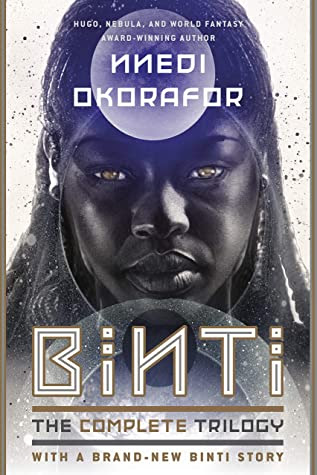
Book Review: Binti


Book Review: Binti: The Complete Trilogy by Nnedi Okorafor 

Goodreads Description: In her Hugo- and Nebula-winning novella, Nnedi Okorafor introduced us to Binti, a young Himba girl with the chance of a lifetime: to attend the prestigious Oomza University. Despite her family's concerns, Binti's talent for mathematics and her aptitude with astrolabes make her a prime candidate to undertake this interstellar journey.

But everything changes when the jellyfish-like Medusae attack Binti's spaceship, leaving her the only survivor. Now, Binti must fend for herself, alone on a ship full of the beings who murdered her crew, with five days until she reaches her destination.

There is more to the history of the Medusae--and their war with the Khoush--than first meets the eye. If Binti is to survive this voyage and save the inhabitants of the unsuspecting planet that houses Oomza Uni, it will take all of her knowledge and talents to broker the peace.


My Review: Okay, I'll be the one to say it. You know what's wrong with sci-fi? Not enough magic in it. 

Okorafor took on the challenge to blend the two genres in her space opera novellas about a human woman accepted into an intergalactic university - the first of her tribe to leave her humble Himba home and sharpen her skills alongside multiple races in an intergalactic university. For Binti, her math skills aren't just about numbers, they're a type of magic that allows her to understand other life forms and influence the universe. The novellas employ a soft magic system that's purposefully vague on its limitations, but appears to mainly facilitate communication between Binti and the wider universe. Math, as they say, is the universal language. 

In the west, science fiction and fantasy genres seem to inhabit opposite ends of the spectrum - mimicking the divide between religion and science outside of fiction. Religion and science are seen as dissonant forces, like oil and water, fascists and freedom, or the gays and a monochrome color scheme. Okorafor, however, takes a very different approach. The Binti novellas showcase a more African perspective by representing science and magic as two heads of the same coin. These novellas don't seek to separate and categorize, but to harmonize the various pieces of our world into one complete image. Math is a language. Science is only a technical definition of magic. The currents that run through machines also run through humans. We are made of stardust. This fusion of ideas unleashes a torrent of new opportunities for a genre that, like science itself, isolates pieces from the whole -- making itself smaller in an attempt to isolate truth. The Binti novellas are antithesis to that, and therefore a breath of fresh air for the genre. These novellas tackle the whole of human experience, yet lean on soft magic and vague technological explanations to enhance the mysticism of life -- that not everything can be known or seen, even when taking in the whole picture. 

Okorafor has stated that the Binti novellas are not young adult, but the novellas very much read like YA works -- coming of age narratives, leaving home/parents to exert independence, a school setting, the focus on action over introspection, the flavour of 'chosen one' that follows Binti throughout her adventures, etc. There's an innocence to these books that is incredibly heart-warming and makes these works accessible to both the young and young at heart. The way conflict is resolved over the works also adds to a more innocent/YA style, as each problem is resolved with relatively few complications. This is likely due to the novella format, as if these stories were combined into a single novel, it would prompt more escalation before resolution. This trend breaks by the end, as the conflict from Home and The Night Masquerade bleed into one another to make for a more triumphant climax. 

These stories tackle a variety of very human topics while taking us beyond the stars - racism, xenophobia, diaspora, transhumanism, trauma, etc. Binti spends most of the text reeling from the traumatic massacre that takes place in the first novella, which forces her to dig deep into her identity to create an internal stability and find resiliency. Several characters remark on Binti's unstoppable tenacity, yet Binti's healing remains at the forefront of the story, creating a balance between strength and pain that felt true to the human experience. The interactions between human and alien cultures also felt true to human psychology, as opposed to sci-fi's tendency to view culture clashing only through a militaristic lens. The first novella leans in that direction, as the Meduse at first appear quite militaristic in their willingness to complete a suicide mission for honor, their formidable war history, hive-mind structure, etc., yet the Meduse culture is rounded out as the novellas progress, creating a more nuanced picture of their reactions to other cultures. The university offers the perfect setting to explore xenophobia, as characters from very different races and backgrounds have to co-operate with each other, creating a setting that closely mirrors our own western society. Instead of the savage environment that sci-fi loves, where racism and xenophobia are expressed in kill-or-be-killed scenarios, a setting where different creatures have to co-operate and learn from one another or risk expulsion or jail, opens opportunities to show the nuances of our own experience reflected back under a fantastical metaphor. It's easy to see why these stories collected their share of Hugo and Nebulas. 

The only reason why I couldn't give the book full stars was I found a weird number of plot holes or confusing choices throughout, but particularly in the first novella. Some things are lightly contradicted later, and some moments felt weak without a proper explanation. Binti is used as a translator for the Meduse, yet when they arrive at the University, it's discovered Meduse is commonly-spoken. She knows what forests smell like, despite only reading about them. Okwu begins the story happy to die for a mission it knows it cannot win, yet in subsequent novellas, says it wouldn't fight a war it couldn't win. Little inconsistencies like this that may be due to the novellas being written at different times and them compiled into this book at a later date. 

All in all, what an amazing story. The only other complaint I have is there isn't more, and I hope Okorafor will write more novellas in Binti's world, should the ideas be there. I highly suggest picking up a copy, especially if you're a fan of science fiction, young adult, or just a damn good story. 

TL;DR: 4/5 stars. A beautifully human space opera that carries readers to the stars and then back home again. 

Wednesday, September 28, 2022

Book Review: Magical Boy


Book Review: Magical Boy by The Kao

Goodreads Description: Although he was assigned female at birth, Max is your average trans man trying to get through high school as himself. But on top of classes, crushes, and coming out, Max's life is turned upside down when his mom reveals an eons old family secret: he's descended from a long line of Magical Girls tasked with defending humanity from a dark, ancient evil! With a sassy feline sidekick and loyal gang of friends by his side, can Max take on his destiny, save the world, and become the next Magical Boy? A hilarious and heartfelt riff on the magical girl genre made popular by teen manga series, Magical Boy is a one-of-a-kind fantasy series that comic readers of all ages will love.


My Review: This will be another review in my series of, "I don't usually review this genre, but..." Magical Boy is a beautifully drawn, full colour graphic novel with an anime inspired art style. The story originally debuted on the comic website Tapas, which is where I first stumbled upon it. I was thrilled to see it was picked up for print publication by Graphix, an imprint of Scholastic. This story holds a special place in my heart, so I'm thrilled for the opportunity to share my thoughts and help connect it to more readers. 

To begin, the art! This book is drop-dead gorgeous. The cover gives you a glimpse of what's in store, but the art inside takes it a step further, from small intimate panels to gorgeously detailed fight scenes that convey a tremendous sense of movement and action. The colours pop, backgrounds are detailed, the linework is clean, and the art blends an eastern and western comic style that is refreshingly original. Traditional anime/manga facial expressions and expressive reactions are mixed with a western action style of large, detailed panels and classic comic sound effects, like 'whoosh, pow, smack.' Unfortunately, the panels were originally drawn for a vertical setup on a webpage, where readers could scroll infinitely, so at times, the panel spacing on the page is cramped and the flow is disjointed. While the panels and speech bubbles are usually arranged in a way that takes your eye smoothly through the scene, some pages failed to achieve a flow and became messy and confusing. Even though I had already read the comic, I struggled on some pages to figure out in what order some panels and speech bubbles were supposed to be read. This confusion was overall minor and didn't take away from the story. 

As for the story, have you ever been bouncing around the internet and stumbled across a story prompt idea that you would die to see happen? Magical Boy is one of those. The world we live in is incredibly gendered, though many cis people fail to realize how deep the gendered expectations go, as many have never resisted or took issue with them. Magical girl stories are often hyper-feminine, and when you toss a transman into the mix, who is trying to assert his own masculinity through stereotypically masculine behaviours, you've got an excellent environment to play with and parody gendered expectations in western society. The magic that gives Max his feminine battle outfit also works as an excellent metaphor for cisnormative expectations - as he attempts to transition, the magic pushes Max towards a femme presentation, until he's able to assert his will and the magic adapts to an outfit that matches his identity. One major change I noticed from the online version was Max's deadname has been censored in dialogue, but left untouched if it's part of the background/scene. This sort of bothered me, as I felt it was silly to censor the name when the book tackles some of the realities of transitioning, which includes misgendering and deadnaming. I understand that the target audience, however, is younger and probably far more sensitive about seeing beloved characters misgendered than my old, jaded soul, so I can understand why the change was made. 

At times, the story can be a bit cheesy, but more in a wholesome way than overtly cringy. Then again, I do enjoy a nice helping of cheese now again, it keeps my soul from becoming too black and crispy. The story is mostly focused on Max, his transition, and trying to get his mom to accept and understand him, so some part of the narrative can fall a little flat. The villains were very one-dimensional, as if they were trying to hit every square on the Classic and Stereotypical Villain Bingo card, but as the fantasy is mere metaphorical dressing for the interpersonal drama, it didn't take away from the story that much. However, if the antagonists and magic system had more depth put into them, it could have reinforced the interpersonal themes and scaffolded this story up into something really cool. Max's friends also come across as a little one-dimensional, as they don't seem to have lives outside of Max and focus entirely on him and his issues. While this turns them into a wholesome cheerleading squad, it constricts the story into something small and simple, which has its own set of pros and cons. 

All in all, Magical Boy is an adorable, heartwarming, gorgeously drawn trans story that makes a great addition to any child's library. I can't wait to get my hands on volume 2, the finale, if only so I can flip through and admire all the beautiful artwork. 

TL;DR: 4/5 stars. A hyperbolic trans metaphor using the magical girl trope to highlight the absurdities of gender. 

Sunday, September 4, 2022

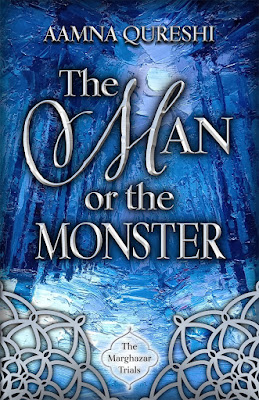
Sneak Peak: The Man or the Monster

Today, I've got a sneak peak at Aamna Qureshi's THE MAN OR THE MONSTER, provided by Rockstar Book Tours. This is the sequel to Qureshi's THE LADY OR THE LION, and features the continuation of Durkhanai's epic fantasy tale. 


About The Book:

Title: THE MAN OR THE MONSTER (The Marghazar Trials #2)

Author: Aamna Qureshi

Pub. Date: August 30, 2022

Publisher: CamCat Books

Formats: Hardcover, Paperback, eBook, Audiobook

Pages: 320

Find it: GoodreadsAmazon, Kindle, Audible, B&NiBooks, KoboTBD, Bookshop.org

Order a signed copy directly from Aamna!

She made her decision. Now she has to live with it.

Durkhanai Miangul sealed her lover’s fate when she sent him through a door where either a lady or a lion awaited him. But her decision was only the beginning of her troubles. Durkhanai worries that she might not be the queen her people need or deserve when conflict threatens her kingdom.

Her presumed-dead father comes back with a vengeance and wishes she join him in his cause. But her family’s denial of his revenge forces Durkhanai to take matters into her own hands and she must decide whether to follow the traditions of her forefathers or forge a new path on her own.

Excerpt from THE MAN OR THE MONSTER: 

Weeks passed. No one came to visit her, and she stopped waiting. As the weather around her chilled, she felt her heart frosting over. Faintly, she felt she had rid her system of him. Perhaps she would never feel a thing again.

But then, he came to her, while she was curled up in bed, crying. 

She didn’t know how he came to be there, just that one moment she was pushing tears back into her eyes, and the next there was a body beside hers. She didn’t need to open her eyes to know that it was him.

“Come, sit up,” he coaxed, and she did as she was told. He kneaded the tension from her shoulders with the hard curves of his palms.

“What worries you?” he asked. She sighed in response.

“I can’t bear it anymore.”

“You can,” he told her. “And you will.”

She turned to look at him and instantly fell into a hug against his chest. She was safe.

They stayed like that for some time. She strained her ear in search of his heartbeat. But he was calm. Sure. Solid.

She pulled back, looked up at him. Gently, his fingers cupped her face like wine—he tipped her chin forward to drink, but paused at the last whisper before skin met skin.

He waited.

And so, soft as sin, she pressed her warm lips against his. He tasted like a thousand stars bursting in her mouth. His fingers murmured across her skin, cold as ice, but everywhere he touched her felt like fire.

She kissed his cold cheek. He tasted like winter: pine-needle and frost, everything that freezes your nose but warms your soul. She was inexplicably warm and closed her eyes in comfort.

Instinctively, she reached for his lips once more—only to find they were not there. He was gone.


When she awoke from the dream, she felt unaligned. As though her soul had been roughly shoved back into her body. She was paralyzed, as she was when she awoke from nightmares, her body frozen with fear—yet this was the opposite, for when she awoke, her reality was the nightmare.

Slowly, the ice burned away. The pain was sudden and swift, knocking the breath from her lungs. Durkhanai began to cry. She loved him. The realization struck her.

She loved him. 

And there was nothing to be done.


About Aamna Qureshi:

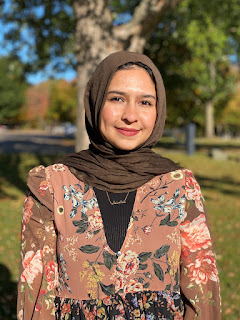
Aamna Qureshi is a Pakistani, Muslim American who adores words. She grew up in a very loud household, surrounded by English (for school), Urdu (for conversation), and Punjabi (for emotion). Through her writing, she wishes to inspire a love for the beautiful country and rich culture that informed much of her identity. When she's not writing, she loves to travel to new places where she can explore different cultures or to Pakistan where she can revitalize her roots. She also loves baking complicated desserts, drinking fancy teas and coffees, watching sappy rom-coms, and going for walks about the estate (her backyard). She currently lives in New York. Look for her on IG @aamna_qureshi and Twitter @aamnaqureshi_ and at her website aamnaqureshi.com

Website | Twitter | Instagram | Goodreads | Amazon | BookBub


Giveaway Details:

1 winner will receive a finished copy of THE MAN OR THE MONSTER, US Only.

Ends September 20th, midnight EST.

a Rafflecopter giveaway

Tour Schedule:

Week One:

8/22/2022

BookHounds YA

Guest Post/IG Post

8/23/2022

A Dream Within A Dream

GuestPost

8/24/2022

Sadie's Spotlight

Excerpt/IG Post

8/25/2022

Lisa-Queen of Random

Excerpt/IG Post

8/26/2022

Ya Books Central

Guest Post/IG Post

8/27/2022

Author Z. Knight’s Guild

Excerpt

Week Two:

8/28/2022

The Erudite Labyrinth

Review

8/29/2022

Epic Book Society

Review/IG Post

8/30/2022

Books and Kats

Excerpt

8/31/2022

Fire and Ice

Review

9/1/2022

@allyluvsbooksalatte

IG Spotlight

9/2/2022

Writer of Wrongs

Excerpt

9/3/2022

The Reading Life

Review/IG Post

Week Three:

9/4/2022

The Underground

Excerpt 

9/5/2022

Rajiv's Reviews

Review/IG Post

9/6/2022

@jodieangell_author

IG Review

9/7/2022

Laurenreads._

Review/IG Post

9/8/2022

@meetcuteromancebooks

IG Review

9/9/2022

Locks, Hooks and Books

Review

9/10/2022

Nagma | TakeALookAtMyBookshelf

IG Review

Week Four:

9/11/2022

One More Exclamation

Review/IG Post

9/12/2022

Book-Keeping

Review/IG Post

9/13/2022

@jacleomik33

IG Review

9/14/2022

The Momma Spot

Review/IG Post

9/15/2022

More Books Please blog

Review/IG Post

9/16/2022

GryffindorBookishNerd

IG Review

9/17/2022

@jypsylynn

IG Review


Wednesday, May 25, 2022

Identity Policing, Forced Outings, and my Thoughts on Coming Out in Publishing


Growing up as a queer kid in the 90s/00s in Canadian conservative country was, at the best of times, an incredibly isolating experience. There were no Gay Straight Alliances in my schools, many of my peers stayed in the closet longer for fear of rejection, and the bigoted jokes that played on loop across mainstream TV left the impression that I was a queer island in a sea of heteronormativity - separated from kin by thousands of miles. The only thing that helped bridge the seemingly endless distance was fiction - the few published books I could find featuring LGBTQ+ characters, as well as the budding online communities where queer folks could freely gather and share their stories.

I lived in those online queer spaces, but I kept going back to the bookstore, seeking out titles that maybe, just maybe, featured someone who felt like me. Whether the book was excellent or terrible, I found myself flipping to the author bios, searching for some evidence that the author was queer. I was always skeptical, and a little disappointed, when the author appeared to be straight and cis, or there was no indication as to their orientation. It felt like a sort of appropriation, and I was desperate to find the raw authenticity of queer stories told through an author's queer perspective. 

So I get it. I get the queer fans calling for writers to come out. I get the editors and agents who are seeking the security of marginalized authors who write in their lanes. With a limited number of books that can be published in a year, everyone with stock in the game wants to ensure the author they’re betting on is a safe gamble. Everyone wants authenticity. They wants to know: who are you to write this story? 

But do they have a right to know? 

When I entered the world of publishing in the late 2000s, young, bright-eyed and bushy-quilled, the

concept of author brands was gaining traction. As social media took hold, many in the industry quickly recognized the value in an author's "personal brand” and began pushing authors to develop loyal fanbases that would follow them from book to book. Today, this expectation is thrust on authors more than ever. Even when it’s not written directly in contracts, there’s an expectation that authors do a fair amount of their own promotion through social media, turning them into quasi-influencers. 

Over the last ten years, there's also been a growing cultural acceptance of and expectation for LGBTQ+ representation in media. As more queer kids grow up seeking queer stories, publishers quickly realized there was more money to be made appealing to the interests of queerdos than burying any mention of LGBTQ+ characters or themes under vague back jacket blurbs. All of this, in turn, changed how editors and agents evaluated potential clients and acquisitions. Industry professionals began looking for writers whose potential (or already constructed) author brand would align with the target audience's value system, reinforcing a parasocial relationship that would boost sales. #OwnVoices launched with the intention of supporting marginalized creators and connecting fans to the authenticity they were seeking, but was quickly co-opted by industry professionals into a catch-all branding term that identified more "marketable" clients. Fan and writer communities also weaponized the hashtag against marginalized creators to scrutinize their identities, histories, as well as gatekeep communities. (If you want to read more, BitchMedia wrote articles on the pressures on queer authors and authors being forcefully outed by the industry. R29 also wrote on the effects of #OwnVoices on books.)

Despite the retirement of #OwnVoices, this pattern of identity policing shows no signs of slowing down. On the one hand, readers aren't wrong to ask what an author's relationship is to the community they choose to write about. Young readers may do this as they attempt to find the same safety and solidarity from within the book in the real world, so it makes sense they would start with the author of the escapist fantasy that has already comforted them. On the other, the expectation that some of the most sensitive parts of our identity must be integrated into an author brand so we may be "allowed" to publish stories about marginalized communities feels ridiculously authoritarian. Not only does #OwnVoices not guarantee authenticity or credibility (as two people with the same identity may have vastly different experiences and perspectives), but the enforcement of authenticity above all harms and chases away marginalized creators, while limiting an author's career. An author’s consent in disclosing their identity should be prioritized above all, and silence should not be assumed to mean they don’t belong. I do hope more authors reveal more of who they are for the sake of representation, especially for YA and MG authors whose audience are likely looking up to them as role models, but no one should be pressured to build their entire brand—or identity—around a single diversity trait. Maybe by policing author brands, we'll catch the occasional con artist who seeks to insert themselves into marginalized communities to profit off them, but we'll harm a far greater numbers of allies, closeted people, and marginalized creators in the process. 

Cat Tax

As much as the idea of turning yourself into a 'product' still makes me uncomfy as all hell, I've seen a lot of value from building a brand that centers on you. I tend to be a bit of an oxymoron when it comes to self-disclosure. I don't like to talk about myself, but I wear everything on my sleeve, no secrets here. When considering my own brand, both as an author and a freelancer in the industry, I had to seriously consider how much of myself I wanted to place on the internet for public consideration. How to balance privacy and minority representation. How much I wanted to build a community centered around my LGBTQ+ identity vs other aspects of my personhood. How much of my career history I wanted to sacrifice to preserve my privacy. 

Some identities are easy to hide. Some aren't. Some minorities can walk into a room and blend, while others have it literally written on their skin. Being trans lets me exist in a strange reality where I'm both. At a certain point, I will pass enough that most people won't be able to tell that I'm from a minority group. Other times, it is painfully impossible to hide, and I have to put my safety in the hands of strangers in public spaces, hoping my identity doesn't upset those around me. But my personal brand grants me an opportunity: I could delete my blog, let go of my contacts and twitter, and essentially start my brand and business from scratch. It would completely disconnect me from my old name, gender, etc., yet I'd also sacrifice over ten years of work just to keep this part of myself hidden, while also surrendering a chance to provide representation for other transgender individuals. 

When put like that, the answer felt simple. At least for me.

So, hi. I'm Kyle, a transman. Nice to meet you. Come in, take a seat. I’ve got cookies around here

somewhere. 

I've been coming out slowly, tactically, in each new environment, like a solider behind enemy lines, and finally I've come to storm the online trenches. For me, being open about who I am and the changes I’m going through grants me the space to be a more authentic writer, which is why I’m choosing to publicize this change and my thoughts with this blog post, instead of quietly changing over my name and hoping no one notices. During my rebranding, I seriously considered whether I wanted a trans pride flag in my new banner, an easy way for other trans people to recognize the solidarity and connect, if they wanted to. Yet I hesitated, and ultimately chose not to include any identifiers in banners or bios, other than the vague title of "queerdo.” I know I’ll talk about it quite freely, so it will by no means be a secret, but I don’t want to advertise myself based on that feature and build an expectation with my audience that LGBTQ+ rights are a main focus of my art. Cause they are and they aren’t, and I don’t want to pigeon-hole myself artistically or have to publish under multiple pen-names, each with their own authorial branding. 

While coming out in this way works for me, the expectations of author transparency need to change. That disclosure of identity should be treated with respect – as the gift that it is, instead of something we’re entitled to. To help let go of this entitlement, the reigns need to be loosened on who "owns" what stories, and we need to let go of this desperate grab for an imaginary supreme authenticity. I believe very strongly in research, authenticity readers, and seeking to elevate representation of minority groups, but that can be achieved through criticizing the work, not the person. Somehow, in our push for more diversity, we expect marginalized individuals to act more alike than ever: conforming to single narratives about what it means to be gay, lesbian, Indigenous, an immigrant, etc. and labelling others as "bad rep" for not assimilating their own experiences into the dominant narrative. Author consent and autonomy needs to be central if we want to reverse the assimilation trajectory and get back to, you know, actually supporting and celebrating diversity. 

As Alanis Morissette would say, "Isn't it ironic..."