Showing posts with label nonfiction. Show all posts

Monday, May 8, 2023

Book Review: Book of Rhymes


Book Review: Book of Rhymes: The Poetics of Hip Hop by Adam Bradley 

Goodreads Description: If asked to list the greatest innovators of modern American poetry, few of us would think to include Jay-Z or Eminem in their number. And yet hip hop is the source of some of the most exciting developments in verse today. The media uproar in response to its controversial lyrical content has obscured hip hop's revolution of poetic craft and experience: Only in rap music can the beat of a song render poetic meter audible, allowing an MC's wordplay to move a club-full of eager listeners.

Examining rap history's most memorable lyricists and their inimitable techniques, literary scholar Adam Bradley argues that we must understand rap as poetry or miss the vanguard of poetry today. Book of Rhymes explores America's least understood poets, unpacking their surprisingly complex craft, and according rap poetry the respect it deserves. 

My Review: This book is Adam Bradley's love letter to rap, and what a letter it is. Despite being a nonfiction book set on teaching readers about the fundamentals of rap poetry, Bradley writes this book more like a memoir, centering his real-life experiences of studying and loving hip-hop. In this way, the book feels intimate and personal, while making solid arguments for the recognition of an art form that promotes community pride, encourages activism, and rebels against a system that has actively oppressed minorities since its inception. 

Bradley breaks down rap into six major elements and spends a chunk of the book looking into each element: rhythm, rhyme, wordplay, style, signifying, and storytelling. Bradley begins the book by digging into rap's influence on the world, its historical roots, role in black communities, and what separates it from other forms of poetry or music. He directly tackles difficult questions that have plagued rap for years and seeks to "explain without apologizing" when it comes to the genre's homophobic, misogynistic, or violent lyrics that appears antithesis to political activism. He does this by framing hip-hop within the socio-economic environment from which it grows, its lyrics therefore a reflection of the intergenerational trauma of black communities and their desire to be heard, to have a voice. As any troubled kid looking for attention will tell you, sometimes being unapologetically offensive is the best way to make society pay attention to what you have to say. Rap's authenticity resonates because it doesn't censor its expression; it just spits feeling onto the page and lets the dominos fall where they may. Unfortunately, that leads to some problematic lyrics now and again. 

Bradley splices in bits of history, interviews, and quotes from famous rappers, industry professionals, poets, English scholars, as well as plenty of rap lyrics, to illustrate hip-hop's place in the wider linguistic, poetic, and musical world. Bradley's writing is easy to read and engaging, and by centering his own passion for the subject in first person reflections, readers are able to easily connect to the subject matter through Bradley's enthusiasm. At times, his wordplay rivals the lyricists he is praising, ultimately leading to a delightful read obviously imbued with substantial passion for the art form. 

TL;DR: 3/5 stars. A well-written and passionate analysis of rap poetics. 

Sunday, February 7, 2021

Book Review: Whose Land is it Anyway? A Manual for Decolonization


Book Review: Whose Land is it Anyway? A Manual for Decolonization. Edited by Peter McFarlane and Nicole Schabus

Goodreads Description: Whose Land Is It Anyway? A Manual for Decolonization; inspired by a 2016 speaking tour by Arthur Manuel, less than a year before his untimely passing in January 2017. The book contains two essays from Manuel, described as the Nelson Mandela of Canada, and essays from renowned Indigenous writers Taiaiake Alfred, Glen Coulthard, Russell Diabo, Beverly Jacobs, Melina Laboucan-Massimo, Kanahus Manuel, Jeffrey McNeil-Seymour, Pamela Palmater, Shiri Pasternak, Nicole Schabus, Senator Murray Sinclair, and Sharon Venne. FPSE is honoured to support this publication. 


My Review: I know I don't often review non-fiction, but I found this manual to be really insightful and a joy to read, so I figured I would give it a boost. Every day it becomes more apparent why it's so important to live in an intersectional society where we not only look out for our own group's interests, but of our neighbour's as well. Living in Canada the last five years, I've watched the American political landscape shift like sands in a dessert, never leading itself to stability. It's hard not to get riled up watching the politics to the south, but I think it's especially important to apply that critical eye to the homeland, and try to stop the same patterns from emerging up here. 

Whose Land is it Anyway? features prominent Canadian voices advocating for Indigenous rights in Canada, most notably the right to land. This handbook doesn't bother itself with the nitty gritty details, like statistics and dates, and focuses more on the emotions of Indigenous people living in Canada and their arguments for why their struggles should be addressed. This handbook felt like it was written for average Canadians who may know about these issues, but have never heard about them from the perspective of Indigenous activists. The various essays tackle subjects like blockades, the savage narrative and the strategy to disenfranchise Indigenous peoples, grassroots activism and why chiefs are 'giving in' to the government, two-spirit people, violence against Indigenous women, the fight to keep culture alive, and on, and on. 

These perspectives were not only refreshing and enlightening, but very moving at the same time. They were written in a way that was fun, enjoyable to read, as well as super approachable and emotional. While the arguments for new ways of thinking and being were very strong, it was hearing about the individuals living as Indigenous in Canada, their struggles and their feelings on the matter, that really hit home the importance of these changes. Through the essays, the various writers were able to show the reality behind Indigenous peoples' suffering and thriving in Canada, and were able to argue for why changes are not only necessary, but will improve well-being for everyone. 

TL;DR: 4/5 stars. All in all, a great introductory book about Indigenous land claims from the perspective of Indigenous activists. 

Wednesday, April 3, 2019

Book Review: My Own Devices


Book Review: My Own Devices by Dessa 

Goodreads Description: Dessa defies category--she is an academic with an international rap career; a lyrical writer fascinated by behavioral science; and a funny, charismatic performer dogged by blue moods and a perseverant case of heartache. In "The Fool That Bets Against Me," Dessa wonders if the romantic anguish that's helped her write so many sad songs might be an insurable professional asset. To find out, she applies to Geico for coverage. "A Ringing in the Ears" tells the story of her father building an airplane in their backyard garage--a task that took him almost seven years. The essay titled "Congratulations" reflects on recording a song for The Hamilton Mixtape in a Minneapolis basement, straining for a high note and hoping for a break. The last piece in the collection, "Call off Your Ghost," relays the fascinating project Dessa undertook with a team of neuroscientists that employed fMRI technology and neurofeedback to try to clinically excise her romantic feelings for an old flame. 

Her onstage and backstage stories are offset by her varied fascinations--she studies sign language, algebra, neuroanatomy--and this collection is a prism of her intellectual life. Her writing is infused with fascinating bits of science and sociology, philosophical insights, and an abiding tenderness for the people she tours with and the people she leaves behind to do it.

My Review: "But I didn't want to conceptualize myself as a quicksand pit of changing variables. I wanted something permanent, stolid-- a cinder block of self. Would I be the same me if I couldn't sing? Yes, I think so. But what if I forgot how to read, forgot my name, forgot that I like whiskey, forgot that red is my favorite color? What am I subtracting from? Is there some part that can't be ruined by violence, or time, or fatigue? Is there an apple core at the center that stays fixed?"

Rapper Dessa's first book, My Own Devices, is a series of nonfiction essays about life, love, music, science, and family. Through 17 different essays, Dessa gives us a glimpse of her life, from how she ended up as a rapper touring with a crew of guys, to recording a song for the creator of Hamilton, to writing to Geico to try and insure her broken heart. All the essays stand alone as well as build towards a greater story where Dessa takes on a project with neuroscientists to attempt to make herself fall out of love with her longstanding ex, referred to as X. 

At it's core, My Own Devices is a love story, beginning with how Dessa falls in love with X as well as rap, detailing their on-agains and off-agains, and ultimately leading her to attempt to 'reprogram' her brain to fall out of love. Throughout the book are stories of life on the road, family-- both blood and bandmates-- as well as science, philosophy, and a bit of dry humour to keep the pages crackling. Dessa has a wisdom to share that she presents quite eloquently. Any attempt I make to try and explain how beautifully written this book is fails in comparison next to the real thing. Dessa infuses just enough scientific tidbits and philosophical wonderings into her real life observations to make the book feel both deeply personal while it asks some big questions. 

The truly fascinating part of the book (IMHO) is the project Dessa takes on with a team of scientists to reprogram her brain to fall out of love with X, the man sprinkled throughout her life and essays. If you want to know the results, I highly suggest you read the book (spoilers!), but I will say the results may surprise you. Dessa isn't afraid to dig her talons into science and math to find real answers, but also writes science in a way that's enjoyable, engaging, and even funny at times. Her perspective on the intersection of science and art is also fascinating, and all of it is delivered in lyrical, easy to read prose. 

TL;DR: 5/5 stars. Eloquently written essays on life, science, family, music, and love infused with dry wit and sharp observations. 

Tuesday, August 8, 2017

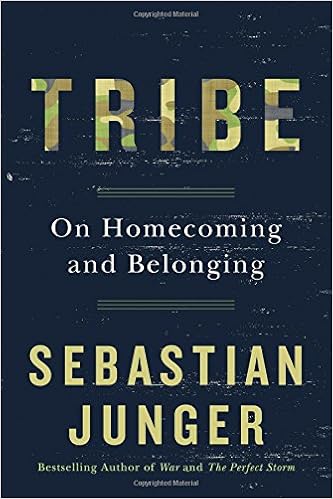
Book Review: Tribe: On Homecoming and Belonging


Book Review: Tribe: On Homecoming and Belonging by Sebastian Junger


Goodsreads Description: There are ancient tribal human behaviors-loyalty, inter-reliance, cooperation-that flare up in communities during times of turmoil and suffering. These are the very same behaviors that typify good soldiering and foster a sense of belonging among troops, whether they’re fighting on the front lines or engaged in non-combat activities away from the action. Drawing from history, psychology, and anthropology, bestselling author Sebastian Junger shows us just how at odds the structure of modern society is with our tribal instincts, arguing that the difficulties many veterans face upon returning home from war do not stem entirely from the trauma they’ve suffered, but also from the individualist societies they must reintegrate into.

A 2011 study by the Canadian Forces and Statistics Canada reveals that 78 percent of military suicides from 1972 to the end of 2006 involved veterans. Though these numbers present an implicit call to action, the government is only just taking steps now to address the problems veterans face when they return home. But can the government ever truly eliminate the challenges faced by returning veterans? Or is the problem deeper, woven into the very fabric of our modern existence? Perhaps our circumstances are not so bleak, and simply understanding that beneath our modern guises we all belong to one tribe or another would help us face not just the problems of our nation but of our individual lives as well.


My Review: Humans are more than pack animals; we're a community animal. In every facet of life, we rely on one another to not only survive, but grow and flourish. Yet somewhere along the evolutionary track we've been derailed, and now we find ourselves in a modern society with all the components of a utopia-- yet which is hurtling itself faster and faster towards dystopia. Sebastian Junger's Tribe takes a critical look at individualism in our modern society and how it conflicts with our tribal nature. 

During natural disasters, wars, and any breakdowns of civilization, Junger notes the emergence of primal tribal behaviours that are proven to improve mental health, reduce violent crimes, and curb crime against the collective such as fraud. Junger has spent many years as a journalist working on front lines from many different conflicts across the world.  He looks at tribal society vs 'civilized' society through a historical as well as anthropological lens that makes this book not only informative but fascinating.

The author's background in military has a palpable influence on the book. The book has a particular focus on PTSD in veterans, and comparing our modern soldiers to warriors passed. He argues that tribal societies were more effective at reintegrating warriors back into society after conflicts, thus why PTSD was not common in soldiers until modern times. The arguments were incredibly well-researched and supported, though most of the sources were cited in an appendix as opposed to in text, which some readers have said made it difficult to discern between fact and opinion. I found this method to be less disruptive and created a more seamless read for readers who may be intimidated by a textbook-like format. 

The focus in the book was particularly on wartime mentality, natural disaster responses, and the evolutionary support for tribal lifestyle, which was slightly limiting. From my own research into Native American culture, there is much more evidence for how tribal communities provide for people's spiritual, emotional, and social needs outside of conflict scenarios that wasn't even mentioned. In the prologue, Junger touches on a point that seems pivotal to the success of tribal society and yet was glossed over throughout the rest of the book. In discussing an experience he had backpacking, he states, "He'd been generous, yes, but lots of people are generous; what made him different was the fact that he'd taken responsibility for me." A centerpiece of tribal society--or any sort of successful community-- is not just caring for one another, but taking responsibility for one another--to ensure health and happiness, to protect from harm, to support, and to provide purpose and mastery. This shows through all the examples that Junger provides--from the survivors of the siege of Sarajevo to miners responding to a mine collapse-- that the responsibility that each member takes upon himself to ensure the well-being of the group is what creates that tribal environment. But the book itself doesn't look into how this sense of responsibility contributes to this communal environment, instead only focusing on examples of people banding together against a threat. 

The book begins with historical events and evidence from colonists' contact with Native American tribes. There is a fair bit of information conveyed in the opening pages, which may put some readers off or feel draggy. But the book quickly picks up and achieves a better balance between historical and anthropological evidence, as well as personal experience and current studies and statistics. The writing is easy to digest and flows well, aside from the boggy beginning. As someone working in mental health, I found the book especially interesting in how it related community to the process of healing, which is something supported in the practices employed where I work. It helps to bring some pieces together and suggests that the way to healing our society may lie in our tribal roots. 


TL;DR: 4/5 stars. An interesting look at the social, emotional, and mental benefits of tribal society with a focus on PTSD in veterans. 

Sunday, January 8, 2017

Book Review: How to Ruin Everything


Book Review: How to Ruin Everything by George Watsky 

Goodreads Description: Are you a sensible, universally competent individual? Are you tired of the crushing monotony of leaping gracefully from one lily pad of success to the next? Are you sick of doing everything right? 

In this brutally honest and humorous debut, musician and artist George Watsky chronicles the small triumphs over humiliation that make life bearable and how he has come to accept defeat as necessary to personal progress. The essays in How to Ruin Everything range from the absurd (how he became an international ivory smuggler) to the comical (his middle-school rap battle dominance) to the revelatory (his experiences with epilepsy), yet all are delivered with the type of linguistic dexterity and self-awareness that has won Watsky more than 765,000 YouTube subscribers. Alternately ribald and emotionally resonant, How to Ruin Everything announces a versatile writer with a promising career ahead.

My Review: "Taylor skips by the big rock arches, and a lump rises in my throat like the one Mom can't hide when she talks about her high school boyfriend-- emotion that forty short years can't dull, a tremor that makes me love my mother more because I understand her in those moments, relate to an ache that takes nothing away from our family but illuminates the million different lives each of us could have led if we'd washed up on different shores." 

How to Ruin Everything is a collection of essays written by George Watsky, who has spent over ten years as a spoken word poet and a musician. In this collection, Watsky steps into new territory with essays featuring his life and experiences, and explores how sometimes ruining things causes them to turn out for the best. I was of course drawn to the book as I am a fan of the author's spoken word and his music, and was excited to get a deeper look at his work. 

I'll admit, I haven't read too many essay collections, at least those with essays all written by the same author. The book reads largely as a memoir, as the author reminisces about his life, his experiences, and how they've helped to shape him into who he is. That said, I found the essays thematically unconnected, and were drawn together only because they focused on the same person. It would've been nice to get a bit more to each essay to help bond it back to the theme of ruining everything. Or at least some sort of timeline, as the stories came from all over his life-- and thus it was difficult to tell where in his life and thinking we were at. 

On their own, the essays were quite an enjoyable read. Especially the last several, I found them rather poignant and beautifully written. A poet at heart, Watsky really knows how to bring out the beauty in the mundane. He doesn't embellish the beauty or pain, nor does he understate it. He lays both out plainly, and lets the reader draw their own emotional conclusions. The quality of the writing helps carry the reader through the disjointed timelines and random subjects. The beautiful use of words as well as the clever observations make this book such a joy to read. The style is rambling and introspective, like a poet ran away with a keyboard, and nowhere near a "must read," but it still holds a quiet, special spot on my reading shelf. 

TL;DR: All in all, 3/5 stars. A series of disjointed essays with strength in beautiful writing and poignant observations. 

Friday, March 4, 2016

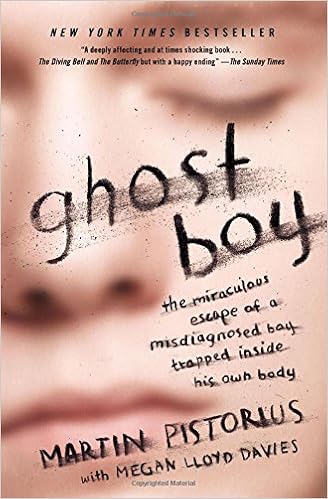
Book Review: Ghost Boy


Book Review: Ghost Boy by Martin Pistorius

Goodreads Description: They all thought he was gone. But he was alive and trapped inside his own body for ten years.

In January 1988 Martin Pistorius, aged twelve, fell inexplicably sick. First he lost his voice and stopped eating. Then he slept constantly and shunned human contact. Doctors were mystified. Within eighteen months he was mute and wheelchair-bound. Martin's parents were told an unknown degenerative disease left him with the mind of a baby and less than two years to live.

Martin was moved to care centers for severely disabled children. The stress and heartache shook his parents’ marriage and their family to the core. Their boy was gone. Or so they thought.

Ghost Boy is the heart-wrenching story of one boy’s return to life through the power of love and faith. In these pages, readers see a parent’s resilience, the consequences of misdiagnosis, abuse at the hands of cruel caretakers, and the unthinkable duration of Martin’s mental alertness betrayed by his lifeless body.

We also see a life reclaimed—a business created, a new love kindled—all from a wheelchair. Martin's emergence from his own darkness invites us to celebrate our own lives and fight for a better life for others.


My Review: At the heart of the story of the Ghost Boy lies a fear that lives within many people: being conscious but trapped, paralyzed in your own body. For Martin Pistorius, that fear was a reality for over ten years until caring people and his enormously devoted parents gave him the power to communicate again. The writing style in this book is simple but with an easy flow that keeps the reader emotionally engaged every step of the way. Martin's story isn't filled with long medical diagnoses or the step by step 'recovery' tale; it's how, given the opportunities and resources, a disabled person was able to live the life he'd always dreamed-- and then some. 

The part that drew me in was getting to see the perspective of someone who has to suffer in silence, like many people in our world still do. When someone can't speak, loved ones can spend hours wondering what's going on in their heads, and this book gives a glimpse of what it's like to be utterly at the mercy of those around you. The story highlights the best of humanity through those who loved and cared for Martin, and also touches on the dark sides only briefly, but with enough intensity to realize the importance of those good people. It is so easy, especially in overworked and underfunded medical and mental health services, for people like Martin to be forgotten. But when you face that possibility through Martin's eyes, the emotional impact is an intense blow. The narrative isn't preachy or depressing, it simply expresses a very real fear of getting left behind, and the hope for something more. 

The short chapters makes for an easy read. Though the story does leap around within the timeline, each chapter does well at establishing time a place, as well as Martin's level of functioning. The story progresses smoothly and doesn't linger on too much negativity. It is also interesting to see the perspective on communication from Martin as well. How he goes from ecstatic being able to communicate, to realizing that not everyone has the patience to wait while he spells things out using his devices, to finding those who don't care about that at all. 

All in all, the insights and perspectives this book has makes this a wonderful and engrossing read. For anyone working with those with disabilities, it is a definite keeper. 


TL;DR: 3/5 stars. A fascinating perspective with a simple and smooth writing style. 

Thursday, April 17, 2014

Book Review: Confessions of a Sociopath by M.E. Thomas


Book Review: Confessions of a Sociopath by M.E. Thomas

Goodreads Description: The first memoir of its kind, Confessions of a Sociopath is an engrossing, highly captivating narrative of the author's life as a diagnosed sociopath.

She is a charismatic charmer, an ambitious self-promoter, and a cunning and calculating liar. She can induce you to invest in her financial schemes, vote for her causes, and even join her in bed. Like a real-life Lisbeth Salander, she has her own system of ethics, and like Dexter, she thrives on bending and occasionally breaking the rules. She is a diagnosed, high-functioning, noncriminal sociopath, and this is her world from her point of view.

Drawn from the author's own experiences; her popular blog, Sociopathworld.com; and scientific literature, Confessions of a Sociopath is part confessional memoir, part primer for the curious. Written from the point of view of a diagnosed sociopath, it unveils for the very first time these people who are hiding in plain sight. The book confirms suspicions and debunks myths about sociopathy, providing a road map for dealing with the sociopath in your life.

My Review: To start here, I believe the issue most people have when reading this book is a dislike of the author and her voice as she goes through her narrative, and I think it really highlights the differences between sociopaths and what M.E. Thomas refers to as "empaths." There is nothing in this book that will make you like M.E., and I don't think that's purposeful, simply a result of her laying out how she views herself and the world in the plainest terms possible. She is very cutthroat about a lot of social situations, and at times I was disturbed by the flippancy in which she cared for the others around her. There is no "soft blow" language here, and what I mean by that is when most people talk about something bad they've done, they will justify it, soften the blow, lower the risk or lessen the severity of their own actions to seem more "human" or sympathetic to those listening to their story, but M.E. doesn't bother with such fluff. She doesn't try to endear her to you, doesn't justify her actions beyond the straight "I did it because I enjoyed it" or "I did it to get X result." Because of this, I can see many readers being put-off by her and shutting down anything she has to say on the subject, which is a big mistake, in my opinion.

If you intend to read Confessions of a Sociopath, you must do so with an open mind and the understanding that everything M.E. writes is through a warped view. She has some great arguments, but everything must be taken with a grain of salt. However, if you go in with the right mindset, this book is absolutely eye-opening.

Confessions of a Sociopath is part memoir, part psychological research. M.E. looks at the history of study done on sociopaths way back into the 1800s and presents it in a very wonderful and informative way. She illustrates the faults in our tools for finding sociopaths, showing that most research and testing is done on the prison population. While many sociopaths do end up in prison, this only highlights one thread of sociopathy, and neglects to look at successful sociopaths who manage to immerse themselves in an empathetic culture and stay above the law. Looking at sociopaths as all murderers or serial killers is no different than looking at all Mexicans as lazy or all black people as criminals-- it is just not reality. She goes on to show the study of the brain and that sociopaths have been proven to have a different brain make-up, and explains the theories and research behind why sociopaths are so unempathetic, looking at something such as inattention to be the cause of this lack of empathy.

M.E. builds a wonderful case for how a sociopath may be a "successful" member of society. She insists that sociopathy is not as much of a "mental illness" as a different brain structure or personality type. Her description of sociopathic thought processes certainly brought the 4% statistic into reality for me, took away the stereotype of the "serial killer" and illustrated a very real person, whose personality traits I could see in people around me. But the thing that made this book so wonderful was the argument she raised on what should be done with sociopaths. All books and journals and readings about sociopaths indicate a need to find them, expose them, and avoid them. But if we come to a place where we can identify sociopaths, what would we do with them? Would we ship them off to camps to be put to death, because they are "beyond saving" or "monsters"? How is this any different from the way Jews were treated in WW2?

Confessions of a Sociopath is a fascinating read, and really opens up this topic to another perspective. Are sociopaths really monsters, or are we the monsters for thinking of them in such a way? Are they not just another structure of the human form, like autistics or geniuses? Sociopaths, much of the time, thrive in our world. They are our CEOs, our lawyers, friends and coworkers. They are people who are doomed to repeat the same destructive cycles time and time again because they lack the ability for self-reflection and introspection, and would have to work to obtain any level of self-improvement. But when autistics need this outside help, does anyone say they should be "avoided" because of their differences? Do we toss them to the curb because of the way they were born?

If you are at all interested in sociopathy, mental illness and psychology, I highly suggest the read. However, I'd advise readers to calm that emotional knee-jerk response when reading, and reserve judgement. The experience will be so worth it. 

TL;DR: 4/5 Stars. If you can put aside your own judgements, it is such a fascinating ride. 

Follow my reviews on Goodreads here