Friday, December 18, 2015

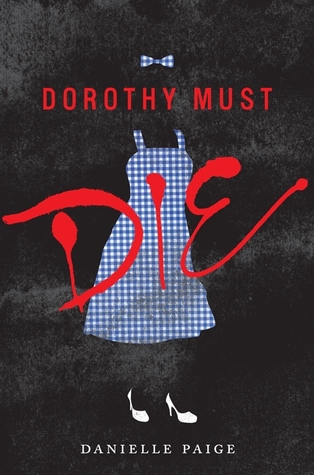
Book Review: Dorothy Must Die


Book Review: Dorothy Must Die by Danielle Paige


Goodreads Description: I didn't ask for any of this. I didn't ask to be some kind of hero.
But when your whole life gets swept up by a tornado - taking you with it - you have no choice but to go along, you know?

Sure, I've read the books. I've seen the movies. I know the song about the rainbow and the happy little bluebirds. But I never expected Oz to look like this. To be a place where Good Witches can't be trusted, Wicked Witches may just be the good guys, and winged monkeys can be executed for acts of rebellion. There's still a yellow brick road - but even that's crumbling.

What happened? Dorothy.

They say she found a way to come back to Oz. They say she seized power and the power went to her head. And now no one is safe.

My name is Amy Gumm - and I'm the other girl from Kansas.

I've been recruited by the Revolutionary Order of the Wicked.

I've been trained to fight.

And I have a mission.


My Review: I'm not going to lie, I definitely considered not even reviewing this book. I found nothing redeemable about it, and why should I spread word about a book I despised? Ultimately, I decided to write this review for the same reason that I chose to read Dorothy Must Die to the end-- in the hopes that I could learn something, AKA what not to do.

I was draw to DMD as soon as it came out, as it had a lovely cover and even a staff picks sticker at my local bookstore. Naturally, that boosted my confidence, and since I love re-tellings, I hoped it would be the thrilling adventure I'd been craving.

What I got, instead, was every possible cliche in the young adult handbook. I'm pretty sure the author just Google searched Most Overused Tropes in YA and then crammed all of them in. From the love triangle between the 'sweet' boy and the 'troubled' one, to our main character being ghosted away from her home to be the "chosen one" and the "only one who can stop Dorothy." After Amy, our main character, is dumped into this twisted version of Oz, she trots along and gets herself arrested and thrown in Dorothy's prison despite the numerous warnings and red flags around her that insist it wasn't so smart. She might as well have walked down the middle of the road and then acted surprised when a car hit her. As Amy orients herself into this new world, she learns little by little about the world and what happened since she heard the story of Oz and Dorothy. And I mean, LITTLE by LITTLE. Because every flipping character has to give her the same roundabout "I can't tell you that/I'll tell you later/You shouldn't have to know things" bull that comes up far too often. I read a great post recently about tension that summed up the failures of this book perfectly: When an author withholds important information in an attempt to generate "tension," it means they have no faith that the story and its plot will generate tension on its own. Sadly, if the author didn't spend so much of the book pussyfooting around and actually got to the point, the book would not only be more enjoyable, but the tension would be stronger. When withholding information from your reader that the characters know or should know, you are treating your readers like toddlers. Instead of building a story, it leaves the reader frustrated and in the dark. They're reading your book because they want to know what happens. Don't hold back from that.

Tension aside, each character within this book made me want to beat my head against a desk. Amy is possibly the only character with some small bit of development and personality, and that's only because we get to look into her history, her mom, how she deals and copes with it all. But because this had no effect whatsoever on her story (not even affecting her choices in OZ, for example) the whole thing felt out of place. Aside from this, every other character was about as flat as a pancake, the most pathetic of which included the love interests, specifically Nox. The entire romance between them was so, so painfully forced. There was NO chemistry between the characters, there was barely even an attempt. The adult characters pushed Nox and Amy together like they were trying to play matchmaker. There was nothing there to draw them together, especially since their relationship starts off rocky (of course), and the only thing that made Amy slightly like him was that he said she wasn't useless. I'm sorry, but Amy needs some way better standards. A kiss eventually comes too, but like I said, the forced romance coupled with zero chemistry left me rolling my eyes and moving on.

The only redeemable thing about this book has to be the re-imagined characters of Oz. I really enjoyed how the author reinvented each one, but that's where the enjoyment ends. Though they were creatively recaptured, their characters were just as flat, if not more so than any of the others. They were often defined by a single thing -- the Tinman's love for Dorothy, the Scarecrow being creepy -- and didn't ever expand or build on that. Moreso, Dorothy's character had been completely flipped to be a promiscuous, drunk, cruel little princess. The author touched briefly on some of Amy's fears-- will she end up just like Dorothy?-- but didn't go deep enough. Why was Dorothy like this? What about the magic drove her to be this way? And more importantly, how easily could Amy slip down the same road?

At the end of the day, this felt, aside from the copious swear words that again, seemed out of place, like it should have been a middle grade novel. The thought processes and ideas expressed were very black and white and didn't look any deeper than the surface, and I feel like it could have been re-tailored to a younger crowd and been more successful. As it was, the book itself felt like a little kid dressing in provocative clothing, swearing, and trying to insist they were all grown up, while its reliance on troupes and cliches left it really juvenile.

If you're looking for the same crap you could find in any fanfiction on the internet, if you find comfort in simple concepts and cardboard characters, then by all means take a gander. The only thing this book is good for is guilty pleasures. Or maybe a fire starter.

TL;DR: .5/5 stars. Goddamn this one made me embarrassed to write YA.

Monday, October 19, 2015

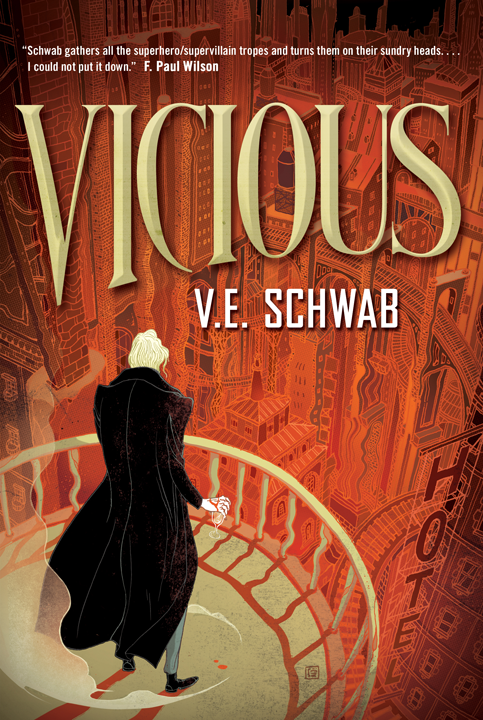
Book Review: Vicious


Book Review: Vicious by VE Schwab


Goodreads Description: Victor and Eli started out as college roommates—brilliant, arrogant, lonely boys who recognized the same sharpness and ambition in each other. In their senior year, a shared research interest in adrenaline, near-death experiences, and seemingly supernatural events reveals an intriguing possibility: that under the right conditions, someone could develop extraordinary abilities. But when their thesis moves from the academic to the experimental, things go horribly wrong. Ten years later, Victor breaks out of prison, determined to catch up to his old friend (now foe), aided by a young girl whose reserved nature obscures a stunning ability. Meanwhile, Eli is on a mission to eradicate every other super-powered person that he can find—aside from his sidekick, an enigmatic woman with an unbreakable will. Armed with terrible power on both sides, driven by the memory of betrayal and loss, the archnemeses have set a course for revenge—but who will be left alive at the end?


My Review: I've come to a place in my reading and reviewing of Victoria Schwab's books where I just want to smash my face into the keyboard like an overexcited puppy shouting, "SO GOOD. BOOK SO AWESOME. YOU WILL LOVE. BUY NOW. NAO." But somehow I don't think that gets my full point across, so I will try to put my OMFG into words. 

Vicious is everything I wanted in a superhero/villain story wrapped in beautiful prose. Though the story jumps around a lot in time, the narrative is clear and flows so smoothly that readers won't get confused and wonder where the hell they've jumped to next. The first part of the book focuses heavily on the characters' backstories, particularly Victor and Eli's "origin" story. The science and reasoning behind it left the book feeling very realistic, even with people summoning crazy powers. Because of the flip-flops in time, the pacing feels rather slow. But not for a moment did it drag, as the incredible characterization and the tension between finding out what happened as well as what will happen made me want to soak in every word.

And the characters, oh, the characters. I like to think that if I can predict how a character will react to or do in a situation, the character is fully developed. If I know enough about the character to know how they would act, then the author has done their job. Schwab's characters were so well developed that I could see how their beliefs and motivations converged to make them into the people they were, which was delightful. Another breath of fresh air is that few of the main characters were actually good people. They all did horrible things, but it's the devil in the details that determines why you side with Victor over Eli.

Overall, the way the story and plot came together left me unbelievably happy, especially the way the tension built over Victor's countdown to midnight. It did feel a tad Dues ex Machina when Dominic comes into the picture, as his ability lets Victor access and do things that would have otherwise been impossible. I was able to forgive this a tad in the sense that everything else about the book was marvelous. However, there is one part that truly sticks with me, but as it is spoiler-filled, I want to give a warning to skip the next paragraph if you're afraid of spoilers.

The only part that truly bothered me was after Victor's death, Dominic steals his body away. That scene ends on a solid note, however, the next scene with them has Sydney and Mitch digging up Victor's grave in order to revive him. If they already took back his body, probably to revive him anyway, why would they bury him to dig it up? So his 'corpse' could be used against Eli in trial? In which case, why did they take the body?

Alright, you're in the safe zone again. All in all, Vicious was incredible. It's another reason to love Victoria Schwab. If you consider yourself a fan of superheroes--or great writing in general-- be sure to get your hands on this.


TL;DR: Droolworthy. 5/5 stars.

Saturday, October 17, 2015

A Culture of Labels: Mental Health and Violence

Growing up in Canada, any kid in the ‘90s or early 00s could tell you about the commercials put out by Concerned Children’s Advertisers, a non-profit organization that puts out public service announcements aimed at kids to teach about bullying, drug use, self-esteem, etc. Even today when I turn on the kid’s channels, I may catch a newer version of one of these commercials. But the ones I watched when I was younger still ring in my head, sticking with me for reasons I never quite understood as a kid.

One in particular featured a young teenage girl on a track field, ready to leap into a sprint. And as she did, tiny labels were ripped off of her by the wind, words like whore, emo, lazy, stupid, all fell away, until it was just her, no labels holding her back.

I remember being confused by the message at the end: “Don’t Label Yourself.” What did that even mean? Surely labelling oneself had its benefits. How else did you know where you belonged? How else did you know who you were? In my young mind, things were better labelled and categorized, people were better labelled and categorized, so you knew what to expect when interacting with them.

(One of the CCA's commcericls. Their stuff is really good if you want to check it out.)

And it seems that other young people have thought this way as well. I saw the culture of labelling emerging as I was a young person not long ago, but it seems to have exploded in the years since then. Especially when it comes to mental health.

Just saying those words, mental health, people think Schizophrenia, bipolar disorder, depression, anxiety, etc. They think of the diagnoses, the illnesses in which people are classified as. And it seems these days that everyone wants to be labelled. Kids that come into our mental health treatment facility don’t want treatment, they want a diagnosis. They want a name to slap onto the crazy they feel, a name that comes with a list of dos and don’ts, or as it’s seen, list of what they can or can’t do. They’ve spent so long with all this buzzing energy within them and they want someone else to acknowledge, Yes, what you feel is legitimate. Here’s what we call it.

So, naturally, when people talk about mental health in connection to extreme acts of violence such as a school shooting, a lot of people, including those who work with mental health, are quick to say: But this isn’t a proper reflection of people with mental illness! Not everyone with a mental illness will become violent! Stop comparing mentally ill people to murderers!!

Ugh, hold up here. Are you people serious?

When someone becomes a danger to themselves or others, they are considered ‘mentally unwell.’ A person can become suicidal without needing to be diagnosed with depression. A person can go out of their way to hurt someone without qualifying for a diagnosis of ‘psychotic’ or ‘delusional.’ Just because these people aren’t diagnosed with something, DOES NOT MEAN THEY ARE MENTALLY WELL.

Mental health =/= mental illness.

Everyone has a state of mental wellness that they uphold. Some people have their wellness disrupted by mental illnesses that develop, i.e., someone finds it harder and harder to function in day-to-day life as they develop depression, exhibit symptoms, and that is the main reason they are unable to function. The reason we even have a diagnosis of “depression” is simply to say “When these symptoms line up, here are the steps to treatment we’ve found that works.” All the diagnosis of “depression” means then, is the cue to use a certain vein of treatment for that individual.


But what happens when something starts affecting a person’s ability to function, but they still don’t qualify for a mental illness? I had a psychiatrist, who has been working with youth with mental health issues for a long time now, come into my office and let out a deep sigh once. When I asked him what was wrong, he said that he couldn’t get a doctor to diagnose his client with bipolar disorder because she didn’t fit the guidelines of it, and he couldn’t access much help (like medication) for her unless he had that diagnosis. He said to me, “The thing is, she doesn’t meet enough of the qualifications to be diagnosed with bipolar disorder, but those mood swings are still there. They’re having a huge effect on her.” Because she didn’t fit the label, professionals all around her were pretending that the symptoms she had didn’t matter. When really, her symptoms and behaviours were severe enough to land her in an agency with Children’s Services.

So then what happens when we as a society decide, mental health discussions shouldn’t take place anywhere near discussions of violence or school shootings? What happens when we conveniently ignore the symptoms and behaviours of violent people because it doesn’t fit into our idea of what a mental illness should look like? I can tell you exactly what happens, because sadly I see it often in my line of work: the person and their issues are pushed to the back burner until they explode and do something that can no longer be ignored.

Do all violent people have mental illnesses? Of course not. But their mental state is jeopardized, where they don’t see the logic of how hurting others and themselves is extremely detrimental to their well-being. Many get wound up in these ideologies of “glory” and “fame” through violence, but where does that need for glory and violence come from? It stems from many places, but often builds up from feelings of hopelessness, feeling alone and isolated, projecting their anger onto other people and convincing themselves they are the cause of their problems. All are behaviours that anyone could exhibit. After all, haven’t we all wanted to blame someone else when we were angry, too emotional to see our own errors in judgement? But when those small things are left to fester within us, grow to a place where suddenly all we think are those negative thoughts, where our day-to-day functioning is impacted, then we are no longer in a state of mental wellness. We wouldn’t qualify for a diagnosis, but the condition of your thoughts doesn’t allow you to reach your full potential. You are mentally unwell and, in a lot of cases, are in need of help.

Mental health or gun control? What will keep our children safe? There’s no easy answer, but it definitely isn’t in turning a blind eye to mental health. Because we ALL have a mental health, we all contribute to it every day—weighing yourself down with stresses and taking the load off with exercise and time to reflect. It’s never a bad thing to seek help when things get out of control—or even when things are just tough, to keep things from getting out of control. After all, most people who fall into toxic thinking don’t even realize or acknowledge that they’re unhappy. They use that anger and bitterness to convince themselves they are happy, or that they’re above or smarter than the rest of the population for the way they see things.


Don’t underestimate the power of a walk outside on your mental well-being. Never underestimate how truly damaging stress can be. We deal with our mental health every day and so often we don’t even think about it, often letting our worldview fall into a “normal” and “crazy” spectrum, where we’re either one or the other. When really it’s a compounded interest of everything we think, do, and experience. It can seem far-fetched that something as simple as “toxic thoughts” could lead someone to walking into a school and killing as many innocent people as they could before taking their own life. After all, everyone has toxic thoughts from time to time. But the fact of the matter is those people who commit these horrific acts are often not mentally ill (since a lot of mentally ill people, the illnesses people think of as “the crazies,” wouldn’t even function well enough to follow through with a scheme of that scale). They are normal people whose toxic thinking led them to a place where they are very mentally unwell, often to a point they don’t realize it.

And I think that’s what frightens people the most. That’s why they use words like “crazy,” and “mentally ill,” and “psychotic,” when we refer to these people. Because we don’t want to think for even a second that those monsters could be anything like us.


Saturday, October 3, 2015

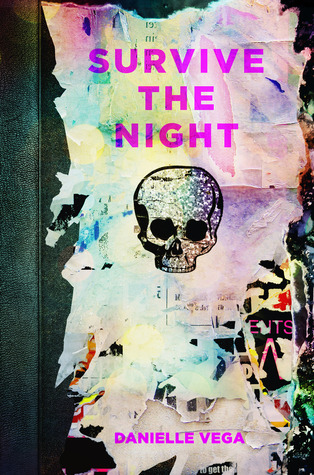
Book Review: Survive the Night


Book Review: Survive the Night by Danielle Vega 

Goodreads Description: We're all gonna die down here. . . .

Julie lies dead and disemboweled in a dank, black subway tunnel, red-eyed rats nibbling at her fingers. Her friends think she’s just off with some guy—no one could hear her getting torn apart over the sound of pulsing music.

In a tunnel nearby, Casey regrets coming to Survive the Night, the all-night underground rave in the New York City subway. Her best friend Shana talked her into it, even though Casey just got out of rehab. Alone and lost in the dark, creepy tunnels, Casey doesn’t think Survive the Night could get any worse . . .

. . . until she comes across Julie’s body, and the party turns deadly.

Desperate for help, Casey and her friends find themselves running through the putrid subway system, searching for a way out. But every manhole is sealed shut, and every noise echoes eerily in the dark, reminding them they’re not alone.

They’re being hunted.

My Review: Survive the Night has a strong opening hook, but afterwards it kind of trickles along slowly, taking a while to get to the rave itself, let alone any of the more severe conflicts taking place. Despite this, there's a lot of character interaction and mini tensions thrown in to keep your interest until the main event begins taking place. This helps to establish the characters before they're reduced to running, screaming balls of terror. It also allowed for me to connect with Julie much more before she is killed off. This, however, is where I was a little disappointed. I wish I didn't know which of her friends would die first going in-- as was spoiled in the back jacket I read before picking it up. It made it seem like Julie would die much sooner and also left me studying her character through the lens of "this character will be killed off." Which took away from the surprise and question of it all.

What initially interested me about the book was the talk of drug and rave culture, which is something not often talked about in YA. It was exciting to see the topics taken head on, but there were quite a few ways where it fell short. The main character, Casey, is a good girl dragged into the world of drugs by an eccentric friend. This is perfectly understandable, but I feel like Casey spent too much time establishing that she was "better now" since being to rehab. If Casey was to the point that she had been put into rehab (and Shana wasn't???), which also was shown as plausible through her dependence on her pain killers, she wouldn't be able to walk away from rehab with a smile and a skip in her step. Addiction is often a lifelong struggle, which was glossed over a little too much. This was probably in an attempt to make Casey more "relateable" or to show that drugs are super bad, mmkay.

If Casey was too much of a "good girl," then Shana was too much of a wild card. Yes, her behaviours seemed in line with some of the out of control kids I see at my work with at risk kids and teens. But she needed more explanation for her behaviours. There is a moment near the end where she tries to make Casey understand why she did what she did, but there wasn't enough of that. Why did Shana feel she needed to be out of control? Why did she go out of her way to put herself and friends in danger for a good time? It didn't go into her motivation for what she did besides "fun," which was really lacking. Even the most crazy and whacked out kids I see at work have a reason for doing what they do, even if it's as (unfortunately) trite as the excuse of "My parents beat me/I had to deal with x trauma" etc. But there's an emotional motivation for their desire to do these dangerous things. The beginnings of that was there, but there needed to be more of it.

Without going into the real thoughts and feelings behind their addiction, the whole rehab/drug subplot didn't have the full impact it could. In that same vein, the author attempted to use the effects of the drugs to create an unreliable narrator. Is she really seeing her friend dead in the subway? Or is she just tripping balls? It seemed like the author could have taken that vein straight through to the end, and it would have been interesting to leave it as a "was all that real?" kind of ending. (Which it kind of seemed like it tried, but the way it was laid out made it impossible.)

In the end, what really got me about the book was the thing that ended up hunting them. It was something I didn't really expect, especially because of how the book began, but I actually enjoyed it. Again, I wish more had been done with it, a bit more of an explanation, as well as something at the end that gave closure to its existence, even if it is an open-ended "It's always just below their feet," kind of ending. As it was, I looked at the final scene in the hospital and much of the end of the book as a metaphor for Casey and her addiction. The struggle in the hospital at the end, really, made me think of it as Casey finally putting an end to her dependence once and for all. Unfortunately, this was more of my interpenetration and a bit of a stretch, and I don't think a lot of readers would see it that way. Which is a shame.

In the end, it had the start of a lot of good ideas, and is definitely reminiscent of old slasher movies, but didn't quite measure up to what it could have been.

TL;DR: 3/5 stars. So much promise, not enough payoff. 

Sunday, September 27, 2015

Book Review: The Walled City


The Walled City by Ryan Graudin


Goodreads Description: 730. That's how many days I've been trapped.18. That's how many days I have left to find a way out.

DAI, trying to escape a haunting past, traffics drugs for the most ruthless kingpin in the Walled City. But in order to find the key to his freedom, he needs help from someone with the power to be invisible....

JIN hides under the radar, afraid the wild street gangs will discover her biggest secret: Jin passes as a boy to stay safe. Still, every chance she gets, she searches for her lost sister....

MEI YEE has been trapped in a brothel for the past two years, dreaming of getting out while watching the girls who try fail one by one. She's about to give up, when one day she sees an unexpected face at her window.....

My Review: The Walled City starts off by introducing us to our three main characters, Jin, Dai, and Mei Yee. Their first person POV chapters gives the reader a full view of the Walled City of Hak Nam. Though it's a dark book with a lot of edgy content, including human trafficking, forced drug torture, and prostitution, the underlying hope each character carries within them keeps it from feeling overwhelmingly depressing. Each character is exceedingly well crafted and their personalities shine through in a myriad of ways. Each one had motivations, dreams and a history that intersected perfectly and gave them sympathetic reasons for being in such a horrible city.

Aside from the character development, the other strength of this book is the author's ability to build tension and suspense. Though information is withheld from the reader about certain characters, it's not done in a way that feels annoying or intrusive to the story. As well, the three alternative POVs allows the reader to be privy to information that the characters haven't realized yet-- that Mei Yee is Jin's sister, that Dai is the strange boy Mei Yee sees in the window-- these little things leaves the reader-- or at least me-- squealing and bouncing in my seat, eager to see how the reveal will come, not to me, but to the characters.

The sense of place is incredibly strong within The Walled City. The city is based off a city that once existed in Hong Kong, but had since been torn down. Ryan Graudin creates an incredible setting by detailing the places and people who dwell within. Graudin keeps true to the Chinese history and keeps the culture rich within her own Walled City. The diversity was delightful to see, especially because the level of detail made me feel like I was standing in those cramped, dark streets.

Speaking of detail, the writing in this book is absolutely gorgeous. It flows and flowers without being overbearing, which I found to be absolutely delightful. The level of symbolism and metaphor as well is heavy and very well done-- from the dying flowers in Mei Yee's hotel room to the seashell and ocean representing her freedom-- the pages are lined with the type of writing that makes me heart sing.

I adored this book from start to finish. It drew me in and made me fall in love. At no point did I find something that annoyed me or I didn't enjoy, and at the end I shed a tear, not because the ending was sad, but because it was so good and I was happy with how things resolved.

If you want a beautiful story filled with rich Chinese culture, I suggest you pick this up. If you're worried about it too dark, don't let that stop you. The heart of the story keeps it hopeful.

TL;DR: 5/5 stars. So. Freaking. Beautiful.

Thursday, September 17, 2015

What's in a Number?

Just an average day at work
I work in a mental health office for kids and their families, but my immediate surroundings are filled with people at least twice my age, and most of my correspondence is with people who could probably be my grandparents, let alone my parents.

I'm 23 and work as the file manager in an institution filled with kids with severe mental health issues, Talk about inspiration for writing, am I right? I've been in this position a few years and worked very hard to get where I am, and in the last year or so I've encountered some prejudice from some of the people I work with. These are some of the most caring people in the world, those who devote themselves to trying to help people, who work non-profit, and yet I still encounter what you would call "micro aggressions" from them. All because of my age.

It's nothing rude, mind you. Just talking over me, talking to my boss or coworkers on issues and departments that I not only approach them on, but that I am the sole person working on. It's frustrating to be treated in a way that undermines all the work I do, simply because of my age. It reminds me of my teenage years, fists clenched, eyes blazing, demanding to be treated like an equal and not an idiot.

Back in those days, I wrote furiously. Every free moment (and during the classes I skipped), were filled with furious typing. Even back then I was obsessed with having an authentic voice. I was determined that as I grew older, I would never allow myself to resent kids and look down on them. But more so, I never wanted to forget what it felt like to be a teenager. I didn't want to turn into an adult that didn't think teenagers had opinions or issues or dreams.

I never wanted to become what I hated.

As I grew into a young adult, graduated high school, dabbled around in university, it all seemed too easy. It felt like growing up was impossible, but even then I knew my voice had shifted. What I wrote was and is so affected by my life because those issues and ideas are what's writing from my heart. I let my voice shift and experimented with new things, But I also kept writing YA, right up to when I got my job at the mental health agency and began a shift of focus in my life.

I began volunteering with the kids at the agency, those who lived on the campus where I worked, some who had undergone unspeakable tragedies, abuse, had lost their parents, were parents themselves, and on and on. Yet at the heart of it these were still just kids, and I saw a lot of myself from just a few years ago in them. I'm close enough in age to some of them that a kid will play a song that's on my iPod and I can't help but bust out a jam. Yet despite how close in age I am, there is a world of difference between me and them, between who I was and who I am. And it made me realize something.

Adults cannot write young adult fiction without having some contact with kids and teens. Whether you're a parent, a teacher, work in child care, have friends who have kids, volunteer with kids-- you cannot create an authentic voice and story for kids and teenagers without actually talking to some.

Yes, yes, we were all kids once. And that experience is vital to creating fiction for teens. But you also have to accept that you're looking at it all through the lens of an adult. Your experiences since you were 16 have vastly changed you and how you view the world. There is plenty of adult fiction out there starring teenagers-- it's not considered YA because it is written with an adult audience in mind and so touches on thoughts and experiences that teenagers won't relate to as much.

What makes YA, YA? The target audience.

A "positive thought" left in my Positive Thoughts Bowl at work, written by a teenage client. Sorry it's crappy quality.

It's great that so many adults read young adult fiction these days. Hell, I'm an adult that reads YA. But I'm not who it's written for. The voices and experiences it needs to reflect are for those teenagers out there looking for something to relate to. They want a reading experience that speaks to them, and that is the entire point of young adult. It's to give a voice to teenagers and children. And the only way to successfully do that is to talk to teenagers, interact with them in some way or another. Consider it research, a very important kind.

Yeah, I hear you. Sometimes teenagers suck, Especially the ones that roll their eyes at you, or call you a little c**t, or get charged with assault. But just reading other YA novels as research into the "current" teenage experience isn't enough. That's a dangerous way to create a circle-jerk of outdated or false information. If you don't actually take the time to relate to those you're actually trying to market to, you run the risk of talking over your audience instead of giving them a voice.

What does that look like? It looks like creating a 'moral' for your readers to take away. It's purposefully forging characters to be perfect role models instead of creating true to life people. It's minimizing what might be 'offensive' or 'inappropriate' or  what you 'don't think kids/teens can handle.' It's assuming you know what's best for them and undermining their intelligence. It's inauthentic and kids can always tell.

If you really want to inspire a lifelong love of reading and literature in kids and teenagers, you have to create authentic experiences they can relate to, and touch on ideas and emotions that will leave lasting impressions on them. If you only focus on imposing a moral or lesson on them, on speaking over them, then it feels too much like work or school or the rules they're used to at home. If they sense the catch, they will drop your book in a heartbeat and probably drop reading not long after, if every other book they read is the same experience.

When you start to think you know what's best for young readers, you take away their autonomy, which is so vital in a world where young people seem to have so little of it. It's such an easy thing to do, and I'm certain I'm guilty of looking down my nose at those younger than me at times. In order for me to keep my promise to my younger self, to keep my voice authentic and true to the teenage experience, I will get to know my target audience and do my best to always be the conduit to their voice, and not its silencer.

I hop you will too.

Monday, September 7, 2015

Book Review: The Unbound


Book Review: The Unbound by Victoria Schwab 

Goodreads Description: Last summer, Mackenzie Bishop, a Keeper tasked with stopping violent Histories from escaping the Archive, almost lost her life to one. Now, as she starts her junior year at Hyde School, she's struggling to get her life back. But moving on isn't easy -- not when her dreams are haunted by what happened. She knows the past is past, knows it cannot hurt her, but it feels so real, and when her nightmares begin to creep into her waking hours, she starts to wonder if she's really safe.
 
Meanwhile, people are vanishing without a trace, and the only thing they seem to have in common is Mackenzie. She's sure the Archive knows more than they are letting on, but before she can prove it, she becomes the prime suspect. And unless Mac can track down the real culprit, she'll lose everything, not only her role as Keeper, but her memories, and even her life. Can Mackenzie untangle the mystery before she herself unravels?

My Review: The sequel to the Archived starts off with Mac dealing with the events of the previous book-- her fight with Owen and the lasting scars. It's refreshing to see in a fantasy the main character actually be traumatized by the horrible things that happen to them. It's one thing to be upset by what happened, quite another to start breaking down and questioning your sanity. Mac is dealing with horrific nightmares that make it impossible to sleep and moments of blackness where she can't remember what she did, or at least has great trouble. She keeps a lot of her fears bottled up due to the very real threat that the Archive may find her unfit to be a Keeper if she's losing her mind. And so the nightmares get worse, and her paranoia grows...

This book blew me away. The beginning starts off very focused on Mac and her real life as she tries to get her life back to normal. Not easy with her brother's death still hanging over her family, let alone settling into a new school year. The opening is smooth and solid, bringing Mac into a new world with a new circle of friends. Questions quickly begin piling up-- why is Mac having black spots in her memory while out hunting? Why are people who come in contact with her disappearing? And why are Crew from the Archive following her? The best part of all these questions is the deeper one Mac keeps asking herself: is any of her suspicions of foul play real, or is it all in her head?

As the story progresses, that question only amps up to the max. Mac's breakdown is so beautifully written and articulated it had me crying while waiting in lines at a convention. Despite everything weighing against her and the very real possibility of losing everything-- her job as a Keeper, any chance with Wesley, and her relationship with her parents-- Mac continues to fight for what she thinks is right. You could almost call what Mac does a troupe-- refusing help and not confiding in the Archive about what's really going on-- but it is written in such a way that is not only justified perfectly, but that suits Mac's character and contributes to her breakdown. So when she turns around and keeps fighting with such a profound weight on her, it just felt so awe-inspiring and invigorating.

And the romance? Oh, god, the romance between Wesley and Mac is gorgeous. Mostly because it relies on their need for each other and the shared connection they have. Not to mention their shared way of "hearing" people-- Wesley's rock band noise and Mac's thunderstorms-- really adds a unique angle to their romance that left my toes tingling.

Story aside, the pacing is perfect and the writing itself is absolutely stunning without being overbearing. The plot fits together like a puzzle that does an excellent job of circumventing your expectations. I went into The Unbound expecting a decent story, as I really enjoyed the first, and came away absolutely inspired and in love. I couldn't find a single thing I didn't enjoy about it, and it has easily become one of my favourite books. I'm not usually one for rereading, but I can easily see myself going back for this one. It it something else.

TL;DR: 5/5 stars. If you buy one book this year, make it this one. This book is utter magic.