Monday, May 30, 2016

Falling in Love (With a Book)


You never expect to fall in love.

It always comes when you're not looking.

Or when you're not sure what you're looking for.

You're reaching blindly out into the dark, scratching at something, until a hand finally reaches back. All you intended for the day was a coffee, a bit of time out with the girls, when that striking someone catches your eye from across the room, jacket hugging them just right, all sleek and sharp. Attraction is undeniable, but you're not looking, just out for a good time.

Something tips your favor, and you decide to walk over, just to test the waters. An introduction isn't a commitment, after all. Something clicks, right from the start. It could be the entrancing art stamped on their jacket, or the swell of words and wisdom that spill forth once you get them to open up. Before you know it, an introduction becomes a fluttering of attraction and suddenly you can't walk away. Not that you can think of a single reason to anymore.

You spend hours together, pouring out words and sharing a connection you can't put a label to. There are ups and downs, tense moments, and times where you cry from sheer joy at knowing this someone was out there, just waiting for you. Inside the honeymoon phase with the two of you, it seems as though nothing could ever break up your happiness together.

Eventually, the firsts run out.

The last new words are spoken, and though you can replay the favorite stories again and again, you've grown comfortable in your knowledge of each other. So you bring your love to meet your friends, your family, and you know they will love them as much as you do. Your someone is perfection personified, and the people who know you best will recognize that.

Except they don't.

Because there are flaws in your special someone, in your perfect love. Some you don't want to admit to, some that don't bother you in the way they do others. And though you're disappointed-- how could people not see what you see?-- there's a small part of you that's relieved, because this is a love that is yours.

It's a love that makes you feel like the only one who matters in a crowded room.

A love that makes you the star of your own Hollywood happily ever after.

That piece of your heart clings to your words, to your love, because though they may not be perfect, something about them just syncs with you. All their jagged pieces fit your jagged pieces and you feel invincible. They press up against your back; a reassurance that you will never be alone. You can't describe why you're filled with such warmth, where this love for this flawed someone wrapped in an artist's jacket came from.

But you know it's magic. There's something otherworldly in the feeling.

You vibrate on the same frequency. Their words are your feelings.

They speak to something in you that you never knew could be communicated with words before.

You never expect to fall in love.

You never know when you'll find the book that seems like your soul personified on paper.

But when you do, you'll wonder how you ever did without it.

Book Review: Dreamers Often Lie


Book Review: Dreamers Often Lie by Jacqueline West 

Goodreads Description: Jaye wakes up from a skiing accident with a fractured skull, a blinding headache, and her grip on reality sliding into delusion. Determined to get back to her starring role in the school production of A Midsummer Night's Dream, Jaye lies to her sister, her mom, her doctors. She's fine, she says. She's fine. If anyone knew the truth - that hallucinations of Shakespeare and his characters have followed her from her hospital bed to the high school halls - it would all be over. She’s almost managing to pull off the act when Romeo shows up in her anatomy class. And it turns out that he's 100% real. Suddenly Jaye has to choose between lying to everyone else and lying to herself.

Troubled by the magnetic new kid, a long-lost friend turned recent love interest, and the darkest parts of her family's past, Jaye’s life tangles with Shakespeare's most famous plays until she can't tell where truth ends and pretending begins. Soon, secret meetings and dizzying first kisses give way to more dangerous things. How much is real, how much is in Jaye's head, and how much does it matter as she flies toward a fate over which she seems to have no control? 


My Review: Dreamers Often Lie is a delightfully tense mystery and a must-read for any fans of the Bard. After a skiing accident leaves her hallucinating Shakespeare characters, Jaye convinces everyone in her life she's fine in order to get back to her rehearsals for A Midsummer Night's Dream. Though the book is pitched as heavy on the Shakespeare hallucinations, the book's real story and strength laid in the mystery behind what happened to Faye’s family long before the book ever started. 

That’s not to say that the hallucinations and head injury don’t play an important part—they create an atmosphere where Faye doesn’t know if she can trust what she’s seeing to be real. Despite this, the story is actually light on the unreliable narrator aspect, in that the author doesn’t try to deliberately mislead the reader. In contrast to books like Liar by Justine Larbalestier, where the reader can’t trust the narrator, in Dreamers, the reader can trust Faye, but Faye doesn’t know if she can trust herself. Fans of the unreliable narrator may be disappointed, but for someone like me who finds unreliability just frustrating, I was very happy with the lighter touch. 

If you’ve read some of my other reviews, you’ll know I have a deep hatred for love triangles. Dreamers Often Lie is definitely the exception. It has a love triangle, and in some ways it goes the route of standard love triangles, right down to the two guys fighting over Faye. But it avoided the clichés and kept me engaged for several simple reasons: 1) the love triangle did not interfere with the story. In fantasy, the two guys fighting over the girl often takes away from the serious plot issues going on, which frustrates me. But the love triangle was the story here, so it didn’t distract from anything. 2) Each guy is their own person outside of Faye. Their reasons for wanting to be with her are not grandiose or out of character. 3) Both guys are shown to have a good time with Faye without romantic implications. So many books rush the romance that we don’t get to see WHY the characters like each other. 4) There is an evolution of attraction. Faye doesn’t immediately fall head over heels. There’s attraction, interest, and lust, and then once they get a chance to really talk, that attraction blooms into the fluttery in-love feeling. Those simple things made me fall in love with this romance in a way I haven’t in a long time. 

Aside from the romance, the handling of this book was very precise and deliberate. The prose was beautiful, complementing the Bard’s lines that were spliced throughout the book like sprinkles. They were used with purpose, often mirroring Jaye’s life and experiences with something or someone out of Shakespeare’s texts. It fit without feeling overbearing, doing the words and characters justice in their representation, which was absolutely essential to me, as someone who loves Shakespeare. 

Dreamers Often Lie wasn’t the dark, twisted thriller like the back cover pitches it to be. It was definitely a psychological thriller, though without any huge twists or turns. However, the lack of heart-pounding tension didn’t disappoint me, because the story behind the hallucination spin was solid on its own. The question of what’s real only added a delightful bit of flavour to an already excellent meal. 

TL;DR: 4/5 stars. A delightfully Shakespearean-flavoured tale. The power’s in the characters, not in the psych twist. 

Sunday, May 15, 2016

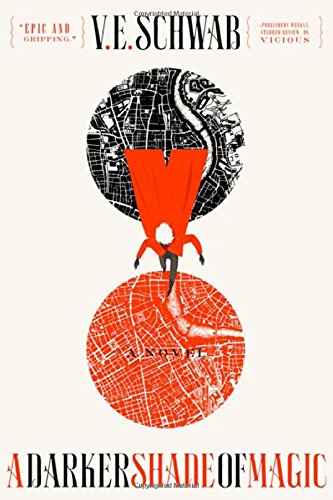
Book Review: A Darker Shade of Magic


Book Review: A Darker Shade of Magic by VE Schwab

Goodreads Description: Kell is one of the last Antari, a rare magician who can travel between parallel worlds: hopping from Grey London — dirty, boring, lacking magic, and ruled by mad King George — to Red London — where life and magic are revered, and the Maresh Dynasty presides over a flourishing empire — to White London — ruled by whoever has murdered their way to the throne, where people fight to control magic, and the magic fights back — and back, but never Black London, because traveling to Black London is forbidden and no one speaks of it now.

Officially, Kell is the personal ambassador and adopted Prince of Red London, carrying the monthly correspondences between the royals of each London. Unofficially, Kell smuggles for those willing to pay for even a glimpse of a world they’ll never see, and it is this dangerous hobby that sets him up for accidental treason. Fleeing into Grey London, Kell runs afoul of Delilah Bard, a cut-purse with lofty aspirations. She robs him, saves him from a dangerous enemy, then forces him to take her with him for her proper adventure.

But perilous magic is afoot, and treachery lurks at every turn. To save both his London and the others, Kell and Lila will first need to stay alive — a feat trickier than they hoped.


My Review: Normally when I sit down to write a review, I have a list of criticisms that I have collected through reading. Even when I supremely enjoy a book, I still have things to say about the pacing and tension, characters and their development, plot, and so on. I almost have a mental checklist that I go through when reading any book.

Victoria Schwab's books blow all that out of the water, and A Darker Shade of Magic was no exception. In fact, it far exceeded some of her previous novels in the sense that every part of the story-- tension, character development, relationships, everything-- fit together like a perfect puzzle, so seamlessly that you can barely FIND the seams.

ADSOM is not my favorite of her books, which comes down simply to personal preference, but it is probably one of the best executed novels yet. It has rendered me pretty much speechless. I can't find words for this other than 'wow,' which almost irritates me. It means Victoria Schwab has taken that next step into crafting novels, truly mastering the art of storytelling, which makes my job as a reviewer a hell of a lot harder, but my experience as a reader so much richer. I could not help but get swept away by the story every time I opened the pages. The truly amazing part was what brought me back when I had to put it down wasn't the story's tension, but the story itself. Yes, there was the perfect amount of tension to accent what was going on, but what kept bringing me back was just a pure love of the story on its own. Kell and Lila could have been picking daisies and going grocery shopping and it would still have me desperate to have more.

If you love magic, if you love adventure, if you love a damn good story, you've got to read this. It's not even a book I feel I have to scream about from rooftops because the book does that all its own. This book envelops you as completely as the Black London stone does to Kell. It's rich, intoxicating, and something incredibly special-- luckily for us, this book isn't about to turn our veins black. Then again, knowing Schwab...

TL;DR: 5/5 stars. Just... speechless.

Thursday, April 21, 2016

Book Review: The Masked Truth


Book Review: The Masked Truth by Kelley Armstrong


Goodreads Description: Riley Vasquez is haunted by the brutal murder of the couple she was babysitting for.

Max Cross is suffering under the shadow of a life-altering diagnosis he doesn’t dare reveal.

The last thing either of them wants is to spend a weekend away at a therapy camp alongside five other teens with “issues.” But that’s exactly where they are when three masked men burst in to take the group hostage.

The building has no windows. The exits are sealed shut. Their phones are gone. And their captors are on a killing spree.

Riley and Max know that if they can’t get out, they’ll be next—but they’re about to discover that even escape doesn’t equal freedom.


My Review: Kelley Armstrong’s The Masked Truth is a step away from her normal work in all the right ways. She steps into contemporary/thriller territory with the story of a therapy group held hostage by masked men. The ultimate strength of this book, and something that made me extremely happy, was the look at trauma, mental health, and mental illnesses. The main character, Riley, has undergone horrible trauma after losing her father and then being witness to the couple she baby sits for getting shot. Instead of sending her into a spiraling mess, the author does an excellent job in balancing Riley’s strength with her weaknesses. Yes, she is prone to panic attacks, flash backs, etc., but finds ways and reasons to stay strong and push through it. It’s such a delightful thing to see. Riley is a strong character, there’s no doubt about that, but you get to see she has to work for that strength. It creates a powerful message for any readers who may have undergone trauma themselves-- that strength is something you can cultivate through perseverance, and even when you feel you’re about to fall apart, those dark feelings can be overcome.

Through Max, the book’s secondary protagonist, we get to glimpse a little deeper down the rabbit hole. Max is diagnosed with Schizophrenia and takes medication for it. At times, he isn’t sure what’s real and what’s imagined, and it seriously affects his self-confidence. Near the beginning of the book, I felt that the author focused too much on the label of Schizophrenia. The beginning is very clinical in the way that it lists symptoms and goes through the checklist of what Max has and what he doesn’t, which distanced me from the disorder more than it made me understand it. Later on in the book, more through the middle and definitely at the end, the author goes into more detail about how Max’s diagnosis makes him feel, how that label interferes with his life, and the consequences of having to cope with this illness. I felt like the emotion behind it made a bigger impact than listing symptoms and throwing around the clinical side of it. The book could have had more power if the situation was reversed-- if we started with Max’s emotions and how he feels living with it, and then move more into the clinical side of explaining everything. That way, we would have experienced Max’s illness the same way that Riley had, which also would have built a stronger connection between Riley and the reader.

If you’re a sucker for tension, this book is a must read. It doesn’t take long at all to launch straight into the hostage situation, which instantly turns the tension up to the max. I couldn’t bring myself to peel away because even when I thought the author would slip into kidnapping/hostage tropes, the story turned in the opposite direction and threw me for a loop. A twist about mid-way through had me texting my friend with many swears and capital letters and general freaking out-ness. The plot and the way it was handled got me excited in true thriller fashion. As well, the romance between Max and Riley was developed in a believable and excellent way. It’s more than just being trapped together that pushes them together, it’s the strength and determination to survive that connects them. My biggest complaint with romance in YA is often the unbelievable relationships; sometimes love interests are drawn to the main character for literally no reason. But the author clearly shows the reasons that Riley falls in love with Max, which in turn makes me, as the reader, fall in love with him too.

As with many of Kelley Armstrong’s books, her writing style is thin on description. This allows for the action to move faster, but doesn’t give you a very real sense of setting. As Max and Riley spend a chunk of the book running through the warehouse their therapy group is in, the creepy factor could have been amped up by making the setting a character in its own right. As well, I had a problem with the focus on Riley. Within therapy before the tragedy starts, all the characters seem really fixated on Riley, how “brave” she was, the ethical implications of what happened (was she a coward or wasn’t she), and so on. Even after the horror starts, characters are still overly focused on Riley and her past trauma, and how she must be “holding up” through all this. I found this highly unrealistic. Most people only focus on themselves, and if these kids have big enough issues that they’re at an overnight therapy group, then they have more important things to focus on than a stranger’s problems. I could have excused this if more characters had the spotlight. Sure, we shine the therapy spotlight on a couple other characters for only a few moments, but it pales in comparison to the amount of time everyone else is discussing Riley, her well-being, how she should be one of the first ones out, etc. Made the whole narrative very MC-centered. If more time was spent discussing other character’s issues as well as Riley’s, it might have been more believable.

My final issue came with the ending. No spoilers, I promise. The plot itself wrapped up nicely, and I really enjoyed the ride. It was the note the author left off on that didn’t really sit right with me, as not only was it very heavily implied meta commentary, but it just didn’t fit with the rest of the book. The end leaves off with two characters discussing writing a story, where one talks about how he wants to end his story. He used Riley as a base for his protagonist and comments that the dark ending to stories just doesn’t do it for him, and he wants to make her happy. I understand the sweet note that the author attempted to leave off on, but I didn’t feel the writing analogy was properly presented throughout the story. It left the ending very out of place, and all I could see was the author commenting through her characters. It almost felt like a “moral of the story” ending. I wish that it had been something else, because the book was overall amazing, but that last chapter left me with a weird taste in my mouth that’s hard to shake.

TL;DR: All in all, 4/5 stars. An incredible plot and wicked tension plus awesome take on mental health equals a happy me.

Saturday, April 2, 2016

Four Ways to Spark Inspiration


As writers, we are often bombarded by ideas for books. Sometimes we have so many shiny WIP ideas we can't get a handle on the book we're writing. And that's great. But sometimes there aren't that many ideas. Sometimes there are NO ideas.

Sometimes it's writer's block. Sometimes there are family or emotional issues that keep you from coming up with anything. And sometimes you're just stuck.

Unfortunately, we can't wait around for inspiration. This doesn't just apply to writing, this applies to coming up with ideas, plotting, creating characters, all that jazz. Sometimes we have the luxury to wait around for another idea, but if you're a professional writer, people may be waiting for your next book. You may be under contract. The world won't wait for you to come up with an idea.

Here's a short list on ways to inspire inspiration. Four easy ways to kick your butt in gear.

1) Compile a list of the things you want to write. Go through your favorite books and write a list of everything you've always WANTED to write. Have you toyed with the idea of a western romance? Have you had a character lingering in the back of your mind you wanted to try writing? Write it down. Once you have a list, try and match some together. Pair the sci-fi with Chinese culture and add an OCD main character whose petrified of space ships. How many aspects can you weave together? Can you create a story from that?

2) Write from prompts. Tried and true, but it works. You can find prompt generators online, or you can even just ask the people around you for objects, situations, and locations for story ideas. Go to three separate people, ask one for a location, as one for a profession, ask the last for an object. Taking those three ideas, can you weave a story out of that? For a different approach, you can take word prompts and write short blurbs to timed sessions. Let the words unravel without planning anything out. If the ideas come, run with it.

3) People Watch. This is my favorite and the easiest. It's best done in public with strangers. Pick someone from the crowd and watch them. Study their clothes, their behavior, the way they talk or stand or walk. Then create a story for them. Create a name, create their family, create a backstory. Figure out why they are there, and be creative. Your character profiles can be mundane, or fantastical. That woman may be a spy from a British Academy waiting on orders from the US division. That man could be meeting with his wife to tell her the results of the chemo treatments. Create them as characters in your mind and build your story from there.

4) Bounce ideas. This one's difficult for me, but every time I do it, I'm always amazed and delighted at the results. Talking to other people, especially writers or heavy readers, is a great way to generate ideas. Even if the other person doesn't give you ideas, sometimes they ask questions that can get you thinking, and lead you to your own epiphany. This is definitely my favorite method, as it works wonderfully. Whenever I'm stuck, just a few hours with my beta and there's nothing we can't solve.

Happy Writing,

Thursday, March 31, 2016

Book Review: The Neverland Wars


Book Review: The Neverland Wars by Audrey Greathouse 

Goodreads Description: Magic can do a lot—give you flight, show you mermaids, help you taste the stars, and… solve the budget crisis? That's what the grown-ups will do with it if they ever make it to Neverland to steal its magic and bring their children home.

However, Gwen doesn't know this. She's just a sixteen-year-old girl with a place on the debate team and a powerful crush on Jay, the soon-to-be homecoming king. She doesn't know her little sister could actually run away with Peter Pan, or that she might have to chase after her to bring her home safe. Gwen will find out though—and when she does, she'll discover she's in the middle of a looming war between Neverland and reality.

She'll be out of place as a teenager in Neverland, but she won't be the only one. Peter Pan's constant treks back to the mainland have slowly aged him into adolescence as well. Soon, Gwen will have to decide whether she's going to join impish, playful Peter in his fight for eternal youth… or if she's going to scramble back to reality in time for the homecoming dance.


My Review: I received a review copy of The Neverland Wars from the author, Audrey Greathouse, in exchange for an honest review.

The Neverland Wars is a whimsical tale that takes us to the forests of Neverland in a familiar and yet entirely new way. 16-year-old Gwen chases after her younger sister when Peter Pan shows up at their bedroom window and offers to whisk them away. Gwen insists she's going to protect her sister, in order to bring her home, but soon finds herself swept up in the magic and wonder of Neverland. And who can blame her? The author creates such a peaceful and serene place that it felt like escape just reading about it. It brought back all that I loved about Peter Pan as a child. Through this world, the author explores the themes of what it means to grow up. I really liked the contrast between reality and 'Neverland,' though by the end it hints there might be more fictional characters brought to life, turning the Neverland Wars into the war between reality and story. There are so many exciting possibilities there, and definitely a strong point for the series. But only future books will tell how those ideas will be explored.

Gwen is at a transitional period in her life as a teenager, and the author does a great job illustrating her discomfort, both back in 'reality' and in Neverland. She isn't really a lost child, nor is she an adult, and she feels torn between both worlds, which was a nice conflict. All in all, Gwen's character was great. Right off the bat I felt connected to Gwen because of how she looked at the world. Sure, arguably she has a very mature way of looking at things for a teenager, but as I was exactly the same way at 16, it's hard to cite that as a fault. Rather that endeared me to Gwen's character and made me want to see more of her perspective. I wished I could've gotten a bit more of Gwen's inner monologue, since her character gets a bit eclipsed by the events going on. It would be nice to see more of her thoughts and personality mixed in with the action.

Gwen's maturity aside, I found the writing style in this book rather verbose. The narration itself was a bit mature and didn't have the same tone as a lot of other YA books out there, though this isn't a bad thing. I'm vehemently against 'dumbing' down books for kids, and it's nice to see a YA novel that sells it straight to the audience.

The only things that took away from the story was the shifting POV and a lack of stakes. It seems like an 'omniscient' POV was used for this book, and while I'll admit there are books out there who manage it, it is an extremely difficult POV to do well. It takes away from my experience as a reader, as I never know when we're going to shift into someone else's head and see what's going on with them. Though I wasn't lost by shifting heads, it still took me out of the story and kept distance between me and the characters. I wanted to be all in Gwen's head, not partly in everyone's, because this is Gwen's story. Plus, it takes away the mystery when the narrator informs me what certain characters are thinking or what's motivating them, while our main character never has the opportunity (or it isn't shown) to learn that information. It creates distance when the reader and the main character are on different pages.

As well, I had a problem with the lack of stakes, which contributed to an overall lack of tension. Though there were heavily implied stakes of what would happen if Gwen couldn't bring her sister home, of what would happen to Neverland if the adults found their way to it, etc., but it was at times too thin. You need to outline what's at risk, what could be lost, otherwise there's no tension and 'edge of your seat' moment. If there are no consequences to your characters losing their mission, then what does it matter if they win, either?

Despite that, the ending really left me feeling light. I promise, no spoilers; the sudden ending kinda jarred me, but only because it took a moment for it to settle what the ending had implied, what Gwen's decision had been. It left me with a glowing smile and that soft happy ending feel. And as much as there are a lot of unanswered questions left, there was something really satisfying about that ending.


TL;DR: All in all, 3/5 stars. Such a lovely, whimsical tale. Made my heart happy.

Wednesday, March 16, 2016

Self-Care in Publishing

Self-care is something that is often brushed under the rug in our society. Who has the time to stop and take care of yourself in our go, go, go world? I deal with it a lot in the context of my dayjob. With child protective services, it is a necessary component of the job, which makes sense when you're going up against troubled kids dealing with mental health and behavioural problems, as well as hostile parents who see CPS as the enemy. Every week it comes up, if not every other day, with "How are you taking care of yourself?" It can be a hard question to answer, especially when people in this industry are so used to putting other people ahead of them. Myself included.

CPS workers are far from the only ones who need to practice self-care. There are some scary misconceptions about publishing that can create a lot of tension between writers, editors, agents, and everyone else involved with the process. After all, you don't need to be screamed at every day to have stress and expectations mount on top of you. In publishing, there is a silent expectation that runs in the background of everyone involved: Work Faster. It's fueled by passion and excitement, the anticipation of an answer that could affect your entire career. But that expectation sits on the shoulders of everyone, whether they're waiting for a response or working to get one out. Though it may be an exciting kind of stress, it is still stress, which can still overwhelm you. It isn't about the severity of the stress, but how long you have to endure it.

It's like this: imagine holding a glass of water at shoulder height. Nothing too scary, right? Now, how heavy is that glass of water when you've been holding it for two, three weeks straight? Imagine this glass of water as the expectations of publishing: work faster, work harder, work passionately. Nothing too serious to carry, until you can't put it down.

Self-care is being able to put the glass down, take a breath, and rest. It is absolutely essential for anyone, whether you have to deal with attempted assaults from angry clients, or just impatient nudging emails from writers  hoping you've read their work. But self-care isn't as easy as setting down a glass of water. Often we have dozens of others in the industry hanging over us (or at least in our heads) waiting for that response. So how do you practice self-care in an industry where speed in an important factor?

Literary agent Laura Zats put it beautifully:


TS Ferguson, an editor over at Harlequin Teen also posted some great thoughts on burn out and self-care within the publishing industry. For the sake of length, I'll add in just a few (though he's an awesome person to follow on Twitter, so I suggest checking out his feed.)


Obviously, we have a problem here. The things that really jump out at me are the high turnover rate, and the fact that agents REQUIRE A BLOODY DAYJOB. It leads back to two significant needs that I face every day in CPS: high turnover in the industry means its employees require more support and self-care. There is a high turnover in CPS because of obvious reasons: not everyone can face child abuse day in and day out. There's only so much self-care you can do to handle it. But for publishing to have such a high turnover rate, when so many people claim that this is their dream job just doesn't make any sense. So why does it happen? Why do literary agents need a day job just to survive? How did we get to a place where the most passionate and driven people, who make books happen, have to struggle just to make end's meat?

So what do we do? How do we fix this broken system? Because our entire industry needs self-care, not just one or two of us. As a group, we need to learn how to put down that glass of water and understand what it means when we see others (agents, editors, writers) taking that time to rest their arm. But how do we get to that place, especially when we're all so anxious to hear back from each other?

Self-Care as a Group

  •  The first step has already been taken. We need to talk about it. This isn't a case of mental illness where a few people have a disorder and we should take the time to acknowledge it. This is about EVERYONE'S well-being. We need to acknowledge that we are all human, that we can all get overworked. No one here is slacking off just to take a paycheck from the big boss. We are all here because we want to be, because we're passionate about words. That means that when agents, editors, writers, whoever, wants to talk about what they're facing, we must let them. Laura Zats and TS Ferguson and everyone else out there neck deep in submissions should be able to say "I'm exhausted" without fearing for their careers. Part of having a community is the support that we're able to give each other.
  • We need to dispel the stereotypes already. In a world where we can log onto the net and find every answer we need at our fingertips, we can't keep perpetuating ideas about each other and the industry that simply aren't true. Such as, agents and editors being free to post on social media (we all need a brain dump after working non-stop) without fear of being seen as 'lazy', that agent and editors are merely 'gatekeepers' who want to keep people out (c'mon, let's get realistic), or that short form rejects are a personal attack. These ideas are all born out of an impatient and blinded mindset that comes from vulnerability. As writers, we make ourselves vulnerable by presenting our soul on paper. But you can't let fear of that vulnerability lead to angry or spiteful actions that will only destroy your career in the long run. Remember: always think of the person first, then their profession. 
  • We are running a marathon, not a sprint. This applies to everyone in the industry. For some people, it only takes a few hours to read through a book. For some, it will only take them a handful of weeks to pound out the first draft and start combing through with edits (I know a writer even who does marathon writing weekends, where he finishes a book in two days. Talk about a headache). But these people are the exceptions. It will take you a while to read through a requested manuscript, or to write out a first draft, or go through edits with a beta reader. IT. TAKES. TIME. I think all of us feel guilty knowing there are people waiting on us, knowing that we hold their heart and soul within bound pages. I know the weight of that guilt can push you to rush rush rush. I've felt it myself with publicists and authors waiting up on me for a review, and while I'm reading as fast as I can, it never seems to be fast enough. If you feel this way, YOU ARE NOT ALONE. This is one of those things that, as a group, we need to accept. We are running marathons, and that takes a little longer, but the prize waiting at the finish line is so worth every step, especially when you can take the time to appreciate the journey. 
  • Above all, kindness. Like I mentioned before, writers are often vulnerable due to the fact that they are turning their passion into a business. It can be taxing on the soul to wait and wait and wait only to be told no. Or you could be an agent or editor, tired of seeing the same rookie mistakes again and again. I think we're all smart enough (for the most part) not to air out our dirty laundry online and harass others in the business. However, I ask everyone to go one step further. The next time you find yourself annoyed by how long someone is taking to respond, or if you think they're tweeting too much, or you're overwhelmed by the urge to poke them with your very long pointy stick... just pause. Stop those thoughts in their tracks. Dialectal Behaviour Therapy is a strategy of therapy in which you acknowledge the patterns of behavior and do a complete 180 degree spin in the hopes of 'retraining' your thought patterns. So let's, all of us, start retraining our thinking. As much as business is competitive, we don't have to be. We have an incredible community that can allow us to achieve impossible things (like the #WeNeedDiverseBooks movement and #YASaves), but unless we band together and support each other, there won't be a community out there much longer. When we stop to ask each other how we're doing, remind each other that we're all doing the best we can, and grant each other kindness, patience, and understanding, we will be able to build an incredibly powerful community. One where people can thrive and see their dreams flourish. 

Of course, it's easy to say what we as a group can do, but a herd won't start charging until its members start moving. So what can you when at times this business can make us all feel so powerless and isolated? Everything starts small. How can you hope to check in with the well-being of those around, if you never stop to check in on your own well-being? As they say in CPS, the only way you'll be able to help anyone is to make sure you're strong and healthy first. Then you are best prepared to extend support to others. 

Self-Care as an Individual 
  •  Take care of yourself! Often the most overlooked self-care tip. Eat right, make sure you get enough sleep, and take time to exercise. They're such small things, and can seem so freakin' unimportant when you've got deadlines and people breathing down your neck, but it is crucial. If you run yourself down and get sick, it will only stress you out more, and odds are you'll end up further behind. You'll be able to handle more stress and more shit slinging if you take time to stop, get some restful sleep, and eat an apple. Give yourself energy that will last. Don't let sugar and junk food make you feel sluggish. 
  • UNPLUG! This is probably the second most important thing when it comes to publishing. We are all bound to our screens, yes, but we need to take time away. Staring at your email and refreshing it every five minutes will only serve to make you more anxious. Cyber stalking someone you're waiting on an answer from will also only add to your impatience and make the response take that much longer to get to you (or at least it feels that way). It may feel like it's helping when you're having a staring contest with your inbox, but the reality is, it just makes things worse. Think of an addict-- getting stoned doesn't get rid of the craving, and will only make the craving for it much worse, later. Schedule a time to go in and check your emails instead of sitting on it all day. You'll never get your mind off it while hitting refresh. 
  • Use sensory items to help relax. This is a form of therapy that we use on traumatized kids in our facility. By utilizing the senses, you can actually help to regulate your emotions and calm yourself. Anything that invokes the senses can help: bubble baths, baking cookies, playing with Play-Doh, listening to music, listening to a river or fountain, etc. Try to invoke as many sense as you can (e.g., use bath salts or nice smelling oils during a bath). Again, this is such a small thing that has a powerful and lasting effect on your overall mental health. 
  • Achieve something small! Some days, it can feel like you're paralyzed by your anxiety or depression or frustration with the industry as a whole. You can easily feel like you have no control, and in a lot of cases, you don't. But that's not the end of the world! There are things you can control and by stepping out and achieving things, you'll feel more confident in your ability to be patient. It's more than simply working on your next project-- it's about starting something small and being able to finish it to achieve a sense of accomplishment. That feeling  is addictive, and helps to keep the impatient demons at bay. 
  • Get down, get weird, get CRAZY! This is a business, and we're all professionals standing around the imaginary water cooler. Often it can be hard to hold your tongue when colleagues are pissing you off, or unplug when you have four people who need you RIGHT NOW. Bottling up all those emotions will wear you down as quickly as not sleeping or eating poorly. So let loose. Go out and run about, fall to the floor laughing at your own jokes, rant at friends until your face turns blue. Express yourself, because your thoughts and feelings matter! But, as my mother would say, you've got to have the right place and the right time.

At the end of the day, you know you best and have the final say in what works and what doesn't. For myself, unplugging is essential. Often I'll get overwhelmed by others' successes, and when that happens I know it's time to step back and breathe. I also find going out for walks along the water and listening to the fountain in my condo's lobby incredibly peaceful.

So, what are your best self-care tips? What do you do to stay a #healthywriter? I would love to hear it!