Showing posts with label mental health. Show all posts

Sunday, January 31, 2021

Bell.... Let's Talk


Yesterday was Bell Let’s Talk day here in Canada, so let’s talk, seriously, about Bell. 

The campaign began 10 years ago as a way to spread awareness about mental health, and while I have my criticisms, I will admit it has had a positive impact. A major corporation opening up a conversation about mental health was very helpful in breaking down some of the stigma and making it less taboo to talk about.

However. 

Bell has made it pretty clear over the last 10 years of this campaign that their allyship is strictly performative. Performative allyship is behaviour that pretends to support those in need, but never actually follows through on concrete actions that would actually, y’know, support people. They preform allyship only in the way that benefits them: more social status, being able to pat themselves on the back, and in the case of corporations, profit and advertising. Bell has proven they only care about performative support by putting out ad campaigns that are no more than feel-good advertisements, which come across as hypocritical to employees and tone-deaf to people struggling with mental illness. 

You only need look at their list of hypocrisies to see they’re not committed to their cause. 

While they boast about their campaigns for mental health, in recent years, employees have been fired for requesting mental health days, and the mental health struggles of employees are largely ignored or punished.  

Bell acknowledges in their Let’s Talk campaign that a lot of mental health stress is workplace related, but apparently that doesn’t apply to their own employees. Despite some programs put in place at Bell, the pressure to produce has employees taking stress leaves

And then there’s the… *checks notes* profiting off of vulnerable prison populations by making it more difficult and expensive to call friends and family while incarcerated, worsening their mental health. Very cool, Bell. 

So, yeah. It’s not hard to see that the company doesn’t really care, but I don’t feel like this paints the whole picture of what’s wrong with Bell Let’s Talk, so… let’s dive into their financials. 

While they like to tout about how much money is donated through their campaign each year, the real winner is always Bell, whose profits have tripled since beginning the campaign in 2011. And let’s be frank, the amount that Bell donates each year is rather minimal. To put it into context, Bell averages about 7 million in donations each year for the campaign (which the company writes off in taxes), but their CEO, George Cope, who stepped down in 2020, was receiving a 10 million dollar annual salary. (The Current CEO, Mirko Bibic is only taking home a little over 4 million a year. Talk about a deal!!) 

Bell is not even one of the biggest donators to mental health in the country, and yet they reap the most social reward. Oil companies knock Bell out of the park when it comes to donations. Cenovus just put up 50 million for housing for Indigenous communities, with a promise to double it in 5 years if it’s successful, which will go a lot farther to improving mental health than awareness campaigns. And that’s only one of many donations Cenovus has made. You may think it’s unfair to compare Bell to an oil company, but Cenovus only reported a net income of 2.2 billion in 2019, while in the same year Bell reported a net income of 3.25 billion. And you may be thinking, “Well that’s just the profit, not how much they sold.” And yet, in that same year, Cenovus reported a revenue of $21.35 billion while Bell scored an easy $23.96 billion. I may be brainwashed from growing up in oil town, but I’m staring at the numbers and I STILL CAN’T BELIVE IT. For a “leader” in campaigning for mental health, that 7 mil is starting to look pretty pathetic, especially since they only donate after consumers work as their advertisers. 

So, wow. Wow. WOW. (I still can’t get over those numbers). So we’ve got, company that doesn’t care? Check. Pennies for the poor? Check. But what about the campaign itself? 

Bell Let’s Talk has a wide reach with their campaign, but what is it exactly they’re saying? Join the conversation? That’s a great theme to start with, but ten years down the line, what exactly are we supposed to be talking about? Bell makes no attempt to actually initiate conversation about mental health or spread any actual awareness anymore, they simply expect consumers to do the work while they reap the advertising benefits for free. While I respect the people around the country having intelligent discussions about mental health because of this campaign, I can’t support Bell preforming allyship without actually doing the work to improve people’s lives. 

This YouTube video from an anonymous Bell employee illustrates, what I believe, is probably an average case of a worker struggling with mental health. 

 As the employee outlines, it’s the conditions of having to work ridiculous hours and still not being able to cover expenses that causes the most stress, which is not a problem only at Bell. Most employers in Canada do the things complained about in the video: abusing the PT/Freelance/Contractor laws that allow employers to hire people for FT hours but not give them any benefits, no raises, the lack of in-house resources, etc. etc. 

To be fair to Bell, they’re not a mental health agency and I don’t think they should try to be. An employer can’t be expected to fix all the problems of its employees. However, by opening up the conversation on mental health and committing to helping the cause, Bell needs to be prepared to hear what people have to say. When people point to the system keeping them in pain, and point out that Bell continues to perpetuate that system when they have the power to set an industry standard, that is a problem. They have the resources to solve some of the issues, such as providing benefits to all employees so they’re able to access mental health support, relaxing their sales tactics, and using this campaign to say something meaningful, and yet. And yet. 

Imagine if Bell’s “workplace initiative” involved training other organizations how to enhance employee mental health, if they built information packages and seminars, if they held conferences for other major corporations to learn how to maximize employee mental health. Imagine if they worked in tandem with the mental health agencies to build a comprehensive guide to workplace well-being. Imagine if Bell took steps to really change things.

Do I really think Bell will become a leader in mental health advocacy, quit their hypocrisy and make definitive changes? No. But I still think that criticism is important. If not for Bell, then for everyone out there exposed to this campaign and wondering what sort of effect it’s having. I hope that whenever you see the Bell Let’s Talk hashtag, remember that they are not the leader in donations to mental health, employees report feeling unsupported with their mental health, they exploit prisoners, and ultimately, Bell Let’s Talk is a large scale ad-campaign where the consumer advertises for the company, and pennies go to charities while the corporation rakes in billions. Next time you see one of these campaigns, next time you hear about a company taking steps to “help the community,” next time you hear about millions going to charity, ask yourself some serious questions. 

Who really benefits from this? 

What change does this bring?

Is this really helping? 

If this allyship authentic or performative?

Sunday, December 30, 2018

Book Review: OCDaniel


Book Review: OCDaniel by Wesley King 

Goodreads Description: Daniel is the back-up punter for the Erie Hills Elephants. Which really means he’s the water boy. He spends football practice perfectly arranging water cups—and hoping no one notices. Actually, he spends most of his time hoping no one notices his strange habits—he calls them Zaps: avoiding writing the number four, for example, or flipping a light switch on and off dozens of times over. He hopes no one notices that he’s crazy, especially his best friend Max, and Raya, the prettiest girl in school. His life gets weirder when another girl at school, who is unkindly nicknamed Psycho Sara, notices him for the first time. She doesn’t just notice him: she seems to peer through him.

Then Daniel gets a note: “I need your help,” it says, signed, Fellow Star Child—whatever that means. And suddenly Daniel, a total no one at school, is swept up in a mystery that might change everything for him.

My Review: Daniel knows he's not normal, from the Zaps to his nightly Routine to the Great Space and Collapses he sometimes experiences, but he doesn't know why. He only cares about keeping it all a secret in the hopes that he can learn how to be normal like his best friend, Max, or Raya, the girl he likes. Being normal becomes extremely difficult after Sara reaches out to him, a non-verbal girl with many disorders  at his school who asks for his help. Her father has gone missing and Sara suspects murder, she just needs Daniel's help to prove it. As they both learn more about each other, it becomes harder and harder for Daniel to keep his secret, and he soon finds, he may not want to keep it anymore after all. 

"I was always hiding, but someone had still seen me." - OCDaniel

Oh man, what a delight this book was. OCDaniel is the cute contemporary story of a boy named Daniel who struggles with OCD and tries to balance it between girls, football, family, writing, and a murder investigation. This story is so sweet and heartfelt while still looking at some big issues and emotions, which makes this book a powerful read. The characters are instantly people readers can fall in love with: Daniel is so sweet, Sara is spunky but with a huge heart, and all the other characters come across as very positive. Steve, Daniel's older brother, teases him a bit but is still shown to be a caring older brother. Even the supposed "villains" turn out to be good, misunderstood people, which leads to a wholesome feel throughout. Even the conflicts in the novel, though they are cloaked in dramatic scenarios, actually boils down to people learning to understand one another.

The representation for mental health was so spot on in this book. I don't have OCD so I can't speak to the accuracy of the representation, though the author King says the book is part autobiographical as he has OCD and went through a lot of the things Daniel goes through, so I assume it's a fairly accurate representation. Even the way that the emotions are explored and explained makes it really easy to understand and sympathize with Daniel's condition. I really enjoyed how the book illustrated his confusion and fear around his compulsions, and though I don't have OCD I do struggle with other mental health issues and I really found myself relating to Daniel's struggle for secrecy, normalcy, and inclusion. It's something I think a lot of young readers can relate to, mental illnesses or not. The book also explores all these emotions without going into really dark areas. We get to see the full struggle that Daniel goes through with his Routine, and all the pain that he keeps inside, but the overall tone of the book is still hugely positive which makes for a pleasant read.

Finally, the real hook, line, and sinker of this novel is just how purely pre-teen it is. Daniel is 13 and is just entering that age where people start developing crushes and get interested in relationships. It's not the kind of developed romance you'd see in YA, but a much more toned back game of "who likes who" that comes across as really sweet and innocent. I feel like it would really appeal to MG readers who may be interested in reading more romance but aren't quite ready for the dramas and perils of high school romance in YA. As well, the development of the potential relationship is based more on friendship and commonality than falling for looks (though the difference is explored a bit, which was great), and there's no kiss or a start of a relationship at the end, just the potential for one and the acknowledgement of feelings for each other.

All in all, this is just an adorable story with great mental health representation, lovable characters, and an emotional but positive message. A definite recommendation to young readers, especially pre-teens or those on the cusp of adolescence.

TL;DR: 5/5/ stars. An adorable and heartfelt story of a boy learning to manage his OCD along with friends, girls, writing, and football. 

Saturday, December 29, 2018

Book Review: A Heart in a Body in the World


Book Review: A Heart in a Body in the World by Deb Caletti

Goodreads Description: When everything has been taken from you, what else is there to do but run?

So that’s what Annabelle does—she runs from Seattle to Washington, DC, through mountain passes and suburban landscapes, from long lonely roads to college towns. She’s not ready to think about the why yet, just the how—muscles burning, heart pumping, feet pounding the earth. But no matter how hard she tries, she can’t outrun the tragedy from the past year, or the person—The Taker—that haunts her.

Followed by Grandpa Ed in his RV and backed by her brother and two friends (her self-appointed publicity team), Annabelle becomes a reluctant activist as people connect her journey to the trauma from her past. Her cross-country run gains media attention and she is cheered on as she crosses state borders, and is even thrown a block party and given gifts. The support would be nice, if Annabelle could escape the guilt and the shame from what happened back home. They say it isn’t her fault, but she can’t feel the truth of that.

Through welcome and unwelcome distractions, she just keeps running, to the destination that awaits her. There, she’ll finally face what lies behind her—the miles and love and loss…and what is to come.

My Review: I was given a copy of the book in exchange for an honest review. 

It's been almost a year since the crime that shook Annabelle Agnelli's life to the very core, yet she can't move on. The guilt and shame haunts her and time seems to be making things worse, not better, as it marches her towards the one year anniversary and a mysterious meeting in September. So one night in a fast food parking lot she snaps, and just starts running -- away from the past, away from the future, away from the things she did and didn't do. Joined by her grandfather in his RV, the two set out on a months-long marathon across the country, cheered on by her brother and friends, the unofficial campaign managers. But even with all the support in the world, Annabelle struggles to forgive herself for the part she played in the crime. If she hopes to make it to DC, or to the meeting in September, or to ever move on with her life, she has to push through and make sense of it all -- the run, the crime, the survivor's guilt, and the phantom image of The Taker that haunts her every day. 

“This is the problem with danger, isn't it? You can even be warned and ignore the warning. Danger can seem far away until the sky grows dark, and a bolt of fury heads straight toward you.” - A Heart in a Body in the World

Wow, this book is devastating. I am going to do my best to avoid anything relatively spoilery because the book relies heavily on the mystery of what happened to Annabelle as well as what will happen (with the upcoming September meeting) to drive the tension and keep readers engaged. I'm usually a little annoyed when books withhold information from the reader in an attempt to build tension, but it actually works fairly well in this book, mostly because the book isn't really about the crime itself, but all the emotions that came afterwards -- the survivor's guilt, the anxiety, PTSD symptoms, depression, and how to work through those emotions and continue going despite it all. So withholding the actual details of the crime wasn't frustrating, and definitely enough of a draw to keep me reading longer. 

Annabelle is also a reluctant protagonist in this story. She's not running with a big cause in mind, she didn't spend any time preparing or doing any marketing for fundraising -- she just runs because she's at the end of her rope and it's the only thing left she can do. She gets pushed into a position of activist by her brother and friends who use that angle in order to raise money for her travels, but she spends most of the book trying to wrap her head around her own feelings, let alone format a message to send out. The raw emotions in this book are what make it so powerful and this book just nails them every single time: Annabelle feeling responsible for other people's feelings, that anxious need to be the perfect everything to everyone, crushing down gut instincts because of guilt, let alone any of the mental health issues that come out after the crime. The way emotions and mental health were handled in this book was incredibly accurate and powerful and made me want to give a copy to every little girl. I loved how it addressed gut feelings girls may have about men, how they may ignore them because we're taught not to jump to conclusions, and how to trust in yourself. The book took a feminist approach to domestic violence and was organized into a powerful story that shows girls how -- and why-- it matters to trust in yourself. 

Though I'm not interested in running (I'm committed to the couch), it wasn't hard to get into the book or understand Annabelle's need to run. Much of the book involves just Annabelle and the road, but the focus is on her trauma and how she learns to reconcile all the pain and loss, and the running definitely takes a back seat to that. Annabelle at times uses the running to hurt herself as a way to atone, and so even when we see the injuries from her run or how she prepares herself, the focus is still on the struggle in her head. I was really interested in how the book handled "The Taker," who is a relatively nameless character who committed the crime and now haunts Annabelle wherever she goes. At first I wasn't sure how I liked the way The Taker was shown, as he is shown to be more of a faceless, nameless monster than a real person who committed a crime. Annabelle demonizes him in her head (rightfully so) to the point that the character is more of a monster than a human. Though this is very accurate to how many trauma victims react to their abuser, I wondered if it took away from the story by furthering that cognitive dissonance in many of us that violent criminals are somehow not human, or at least different from us, as opposed to just another person. The Taker is named at the end of the book, which I feel is super important for giving him a human face. Since the book was about Annabelle's emotions, not the crime or The Taker, I realized it was probably more effective to have him as a faceless monster, as that is more true to how a trauma victim would react. 

The writing style was really interesting in this book. It's third person, present tense, with a style that's similar to 3rd person limited perspective as we stay in Annabelle's head throughout, but the author doesn't take us fully inside Annabelle's thoughts and feelings as specifics of the crime are being withheld to create tension, so the point of view is somewhere between limited and a close omniscient. The way the story is written has a huge effect on the reader, as we get incredibly close to Annabelle yet there is still this distance between us and her that gives us the mystery - this is particularly evident after Annabelle witnesses a deer being hit by a car and we see the effect it has on her, without really knowing the exact thoughts circling in her head. 

The only thing that held me back from 5 starring this book was the unlikely cheesiness that came out at times. Annabelle gets a lot of support throughout the book, which is hugely important for someone dealing with PTSD, but the unanimous support was just a little too much, especially at the climax, pushing it from feeling unlikely to a little fake. That cheesiness also took me out of the story a bit, which was a shame since the rest of the book was so spot on. It's hard to judge a book for being "too positive" but it just seems too perfect to be true, which might say more about my life and experiences than the realism of the scene, but I don't think I'm the only reader who felt a little iffy on the happily ever after moments. 

TL;DR: 4/5 stars. An emotional journey about a girl learning to find her voice and her strength after a violent tragedy. 

Sunday, May 13, 2018

Book Review: What I Leave Behind


Book Review: What I Leave Behind by Alison McGhee 

Goodreads Description: After his dad commits suicide, Will tries to overcome his own misery by secretly helping the people around him in this story made up of one hundred chapters of one hundred words each.

Sixteen-year-old Will spends most of his days the same way: Working at the Dollar Only store, trying to replicate his late father’s famous cornbread recipe, and walking the streets of Los Angeles. Will started walking after his father committed suicide, and three years later he hasn’t stopped. But there are some places Will can’t walk by: The blessings store with the chest of 100 Chinese blessings in the back, the bridge on Fourth Street where his father died, and his childhood friend Playa’s house.

When Will learns Playa was raped at a party—a party he was at, where he saw Playa, and where he believes he could have stopped the worst from happening if he hadn’t left early—it spurs Will to stop being complacent in his own sadness and do some good in the world. He begins to leave small gifts for everyone in his life, from Superman the homeless guy he passes on his way to work, to the Little Butterfly Dude he walks by on the way home, to Playa herself. And it is through those acts of kindness that Will is finally able to push past his own trauma and truly begin to live his life again. Oh, and discover the truth about that cornbread. 

My Review: I was given a review copy from the publisher in exchange for an honest review. 

"Let your feet find the way. You'll know it when they do. Then let the day drain out of you." 

16-year-old Will copes with his father's suicide the only way he can: by walking out the days and spending his nights trying to recreate his father's famous cornbread. It almost feels like enough, until his best friend, Playa, is raped at a party, and Will decides to stop being complacent with his sadness.  He starts by leaving anonymous gifts for those in his life, like Playa, and the Little Butterfly Dude, his boss Major Tom, or even the dog of insanity, kept tied up on a chain all day barking. When Will stops walking past everyone in his life and starts finding ways to bring them happiness, he discovers a way to reconcile his own trauma and finally move on. 

What an incredible read! As the Goodreads description says, this book is comprised off one hundred chapters, each only one hundred words long. It makes for a short read, but the book still manages an intense emotional experience that lingers long after the last page. Perfect for reluctant readers, What I Leave Behind gives us a tiny peep-hole (the one-hundred word format) with which to view Will's world. It ensures each word is significant and makes the details of Will's life seem more poignant, since we're only offered a handful of them. This book deals with a lot of trauma, from Will's father's suicide to his best friend being raped at a party he was at, and looks boldly into those feelings, yet doesn't exaggerate or dramatize them. Will doesn't have a big breakdown or blow-up scene-- not to say those emotions aren't real, but they are rarer than media would let us believe. Instead, the book looks at the quieter sides of grief and sadness, through observations and showing the effect the emotions have on day-to-day life. In that way, the book creeps under the radar and quietly leaves a bundle of complex emotional truths at your feet, without the fanfare of a huge climax or staggering stakes. 

From start to finish, the book is incredibly heartfelt. Will is a quiet, sensitive boy who feels powerless against the trauma in his life. His father's suicide was completely out of control-- even if he feels responsible for how their last interaction went-- and Playa's rape is something he can't control as well-- he can't be a vigilante and go after the rapists, and he doesn't know how to be the unconditionally supportive best friend. It leaves him in a pretty powerless situation, which I found to be incredibly true to life, especially for a lot of teenagers. Trauma, in whatever form it takes, is a beast that can't be solved quickly or cleanly, even in situations where you do have power to change things. So when we can't change anything, we have to figure out what to do to address the emotions left behind. Will does this by doing anonymous good deeds for those in his life, which gives him mastery over his situation as well as connects him to those most important to him. 

As for writing, the book is simple, straightforward, and well-constructed. The writing was all very purposeful-- has to be, because of the format-- and uses a lot of showing to bring the reader to the emotional points. Instead of showing strong emotions-- having a scene be dominated by the character's emotion-- the author carefully draws up an image that focuses on the reader's emotions about that scene. The author does this by carefully avoiding telling us the characters' feelings, and then by having the narrator be vague about how these scenes make him feel, purposely adding in phrases like, "You know?" to make the reader feel that, no matter their interpretation, the narrator feels the same. It's truly the greatest example of how showing can allow your reader to connect more with your book. As mentioned before, the book doesn't have much for a climax, or stakes, or a lot of tension. What we get instead are these powerful emotional highs and lows that connect with the reader and keeps them reading. If you're easily put off by a lack of tension, stakes, or plot devices, you may not connect with this book as easily. 

All in all, this book is perfect for reluctant readers, or younger readers coping with trauma. I also strongly recommend everyone picking up this book, because it is such a beautiful look at trauma, what to do when you feel powerless in the world, and how to do more than just move forward. 

TL;DR: 5/5 stars. The beautiful story of teen boy learning to move on from his trauma through random acts of kindness.

Tuesday, December 5, 2017

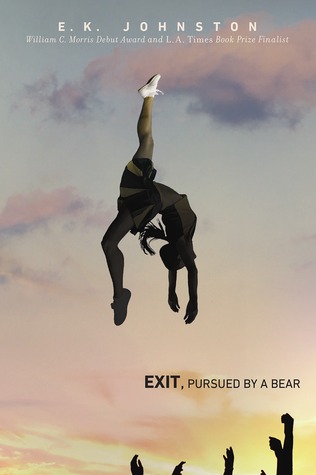
Book Review: Exit, Pursued by a Bear


Book Review: Exit, Pursued by a Bear by EK Johnston


Goodreads Description: Hermione Winters is captain of her cheerleading team, and in tiny Palermo Heights, this doesn’t mean what you think it means. At PHHS, the cheerleaders don't cheer for the sports teams; they are the sports team—the pride and joy of a tiny town. The team's summer training camp is Hermione's last and marks the beginning of the end of… she’s not sure what. She does know this season could make her a legend. But during a camp party, someone slips something in her drink. And it all goes black.

In every class, there's a star cheerleader and a pariah pregnant girl. They're never supposed to be the same person. Hermione struggles to regain the control she's always had and faces a wrenching decision about how to move on. The assault wasn't the beginning of Hermione Winter's story and she's not going to let it be the end. She won’t be anyone’s cautionary tale.


My Review: Senior year promised Hermione Winters a lot of changes and a lot of endings. Cheerleading, one of the pillars of her life, will come to an end at graduation, and she'll be moving on to college without her best friend, Polly, and possibly without her boyfriend, Leo. But she's ready for those changes, and is determined to make her senior year all it can be. Until the night of the dance at cheer camp, when someone drugs her drink, rapes her, and leaves her limp and bleeding in the lake. Though Hermione can't remember the incident, she's confronted with the brutal truths of her new reality: that rumors fly faster and farther than truth, that her boyfriend thinks she brought it on herself, and that Polly is the strongest person she knows.

One of the best things about Exit, Pursued by a Bear is how it begins by establishing Hermione, Polly, Leo, and the world well before the trauma. We get to see the Before, which allows us to understand how things are so fundamentally changed by the rape. The characters themselves are all really wonderfully done; each with strong internal motivations that makes their reactions so realistic. Hermione is a sympathetic character that wonderfully breaks the cheerleader stereotype. The trope of the snobby cheerleader is so overwrought that it's annoying more than boring, so this book was a wonderfully refreshing take. As well, Polly is such a champion throughout the whole book. I wish I had a Polly; hell, I wish everyone had a Polly. Having that kind of ride or die friend helps Hermione through the tough moments, but the nice thing is she doesn't completely lean on Polly either. Hermione has got her head in the right place and would've been find without her, which is nice as well. It's not a story of dependency, it's a story of friendship.

And, as you can tell by the description, this book tackles some pretty heavy things. Not only is Hermione attacked and brutalized, but she goes through a lot of the issues that women do when they're sexually assaulted. Her boyfriend implies that she wouldn't have been raped if she had been with him, where she was "supposed" to be. A teammate spreads some rumors about her having condoms at camp, which was taken out of context. A reporter asks her if she has advice for other girls on how to avoid rape. But on the other side of the coin, she has a lot of support from places that some real rape victims don't, like the police, parents, and the rest of the team. It's a really nice balance that made this a story unique to Hermione instead of just a series of awful things that happen to rape victims.

From the first page, the book engages the reader and makes you care. This book isn't dramatic, and it's a calmer, quieter tension that carries the reader through the book. It's also more realistic in a lot of ways. It's not a revenge fantasy or a tragedy, but a story of a girl going through a big trauma without defining herself by it. Because of that, the ending feels a little out of place and almost wish-fulfillment. It felt a tad rushed since everything happened within the last chapter and then it ends abruptly, with our characters shooting that metaphorical basket on the way out. If there had been a little bit more to ground the reader after that abrupt pivot, it might've been a better, at least in my opinion.

The only other concern I had is, and I'll be the first to admit it's petty, the title is a Shakespearean reference, as reinforced by the other Shakespeare quotes before each part. Yet the story itself had no reference to Shakespeare, which made it feel out of place to me. Although the title did tie in at the end when Polly and Hermione exit the field, as the "bears" (their team mascot) pursing the rapist. Still, it set me up to expect some sort of Shakespearean influence, so that kind of threw me.


TL;DR: All in all, 4/5 stars. A brave book about a girl refusing to be defined by her assault.

Thursday, April 21, 2016

Book Review: The Masked Truth


Book Review: The Masked Truth by Kelley Armstrong


Goodreads Description: Riley Vasquez is haunted by the brutal murder of the couple she was babysitting for.

Max Cross is suffering under the shadow of a life-altering diagnosis he doesn’t dare reveal.

The last thing either of them wants is to spend a weekend away at a therapy camp alongside five other teens with “issues.” But that’s exactly where they are when three masked men burst in to take the group hostage.

The building has no windows. The exits are sealed shut. Their phones are gone. And their captors are on a killing spree.

Riley and Max know that if they can’t get out, they’ll be next—but they’re about to discover that even escape doesn’t equal freedom.


My Review: Kelley Armstrong’s The Masked Truth is a step away from her normal work in all the right ways. She steps into contemporary/thriller territory with the story of a therapy group held hostage by masked men. The ultimate strength of this book, and something that made me extremely happy, was the look at trauma, mental health, and mental illnesses. The main character, Riley, has undergone horrible trauma after losing her father and then being witness to the couple she baby sits for getting shot. Instead of sending her into a spiraling mess, the author does an excellent job in balancing Riley’s strength with her weaknesses. Yes, she is prone to panic attacks, flash backs, etc., but finds ways and reasons to stay strong and push through it. It’s such a delightful thing to see. Riley is a strong character, there’s no doubt about that, but you get to see she has to work for that strength. It creates a powerful message for any readers who may have undergone trauma themselves-- that strength is something you can cultivate through perseverance, and even when you feel you’re about to fall apart, those dark feelings can be overcome.

Through Max, the book’s secondary protagonist, we get to glimpse a little deeper down the rabbit hole. Max is diagnosed with Schizophrenia and takes medication for it. At times, he isn’t sure what’s real and what’s imagined, and it seriously affects his self-confidence. Near the beginning of the book, I felt that the author focused too much on the label of Schizophrenia. The beginning is very clinical in the way that it lists symptoms and goes through the checklist of what Max has and what he doesn’t, which distanced me from the disorder more than it made me understand it. Later on in the book, more through the middle and definitely at the end, the author goes into more detail about how Max’s diagnosis makes him feel, how that label interferes with his life, and the consequences of having to cope with this illness. I felt like the emotion behind it made a bigger impact than listing symptoms and throwing around the clinical side of it. The book could have had more power if the situation was reversed-- if we started with Max’s emotions and how he feels living with it, and then move more into the clinical side of explaining everything. That way, we would have experienced Max’s illness the same way that Riley had, which also would have built a stronger connection between Riley and the reader.

If you’re a sucker for tension, this book is a must read. It doesn’t take long at all to launch straight into the hostage situation, which instantly turns the tension up to the max. I couldn’t bring myself to peel away because even when I thought the author would slip into kidnapping/hostage tropes, the story turned in the opposite direction and threw me for a loop. A twist about mid-way through had me texting my friend with many swears and capital letters and general freaking out-ness. The plot and the way it was handled got me excited in true thriller fashion. As well, the romance between Max and Riley was developed in a believable and excellent way. It’s more than just being trapped together that pushes them together, it’s the strength and determination to survive that connects them. My biggest complaint with romance in YA is often the unbelievable relationships; sometimes love interests are drawn to the main character for literally no reason. But the author clearly shows the reasons that Riley falls in love with Max, which in turn makes me, as the reader, fall in love with him too.

As with many of Kelley Armstrong’s books, her writing style is thin on description. This allows for the action to move faster, but doesn’t give you a very real sense of setting. As Max and Riley spend a chunk of the book running through the warehouse their therapy group is in, the creepy factor could have been amped up by making the setting a character in its own right. As well, I had a problem with the focus on Riley. Within therapy before the tragedy starts, all the characters seem really fixated on Riley, how “brave” she was, the ethical implications of what happened (was she a coward or wasn’t she), and so on. Even after the horror starts, characters are still overly focused on Riley and her past trauma, and how she must be “holding up” through all this. I found this highly unrealistic. Most people only focus on themselves, and if these kids have big enough issues that they’re at an overnight therapy group, then they have more important things to focus on than a stranger’s problems. I could have excused this if more characters had the spotlight. Sure, we shine the therapy spotlight on a couple other characters for only a few moments, but it pales in comparison to the amount of time everyone else is discussing Riley, her well-being, how she should be one of the first ones out, etc. Made the whole narrative very MC-centered. If more time was spent discussing other character’s issues as well as Riley’s, it might have been more believable.

My final issue came with the ending. No spoilers, I promise. The plot itself wrapped up nicely, and I really enjoyed the ride. It was the note the author left off on that didn’t really sit right with me, as not only was it very heavily implied meta commentary, but it just didn’t fit with the rest of the book. The end leaves off with two characters discussing writing a story, where one talks about how he wants to end his story. He used Riley as a base for his protagonist and comments that the dark ending to stories just doesn’t do it for him, and he wants to make her happy. I understand the sweet note that the author attempted to leave off on, but I didn’t feel the writing analogy was properly presented throughout the story. It left the ending very out of place, and all I could see was the author commenting through her characters. It almost felt like a “moral of the story” ending. I wish that it had been something else, because the book was overall amazing, but that last chapter left me with a weird taste in my mouth that’s hard to shake.

TL;DR: All in all, 4/5 stars. An incredible plot and wicked tension plus awesome take on mental health equals a happy me.

Wednesday, March 16, 2016

Self-Care in Publishing

Self-care is something that is often brushed under the rug in our society. Who has the time to stop and take care of yourself in our go, go, go world? I deal with it a lot in the context of my dayjob. With child protective services, it is a necessary component of the job, which makes sense when you're going up against troubled kids dealing with mental health and behavioural problems, as well as hostile parents who see CPS as the enemy. Every week it comes up, if not every other day, with "How are you taking care of yourself?" It can be a hard question to answer, especially when people in this industry are so used to putting other people ahead of them. Myself included.

CPS workers are far from the only ones who need to practice self-care. There are some scary misconceptions about publishing that can create a lot of tension between writers, editors, agents, and everyone else involved with the process. After all, you don't need to be screamed at every day to have stress and expectations mount on top of you. In publishing, there is a silent expectation that runs in the background of everyone involved: Work Faster. It's fueled by passion and excitement, the anticipation of an answer that could affect your entire career. But that expectation sits on the shoulders of everyone, whether they're waiting for a response or working to get one out. Though it may be an exciting kind of stress, it is still stress, which can still overwhelm you. It isn't about the severity of the stress, but how long you have to endure it.

It's like this: imagine holding a glass of water at shoulder height. Nothing too scary, right? Now, how heavy is that glass of water when you've been holding it for two, three weeks straight? Imagine this glass of water as the expectations of publishing: work faster, work harder, work passionately. Nothing too serious to carry, until you can't put it down.

Self-care is being able to put the glass down, take a breath, and rest. It is absolutely essential for anyone, whether you have to deal with attempted assaults from angry clients, or just impatient nudging emails from writers  hoping you've read their work. But self-care isn't as easy as setting down a glass of water. Often we have dozens of others in the industry hanging over us (or at least in our heads) waiting for that response. So how do you practice self-care in an industry where speed in an important factor?

Literary agent Laura Zats put it beautifully:


TS Ferguson, an editor over at Harlequin Teen also posted some great thoughts on burn out and self-care within the publishing industry. For the sake of length, I'll add in just a few (though he's an awesome person to follow on Twitter, so I suggest checking out his feed.)


Obviously, we have a problem here. The things that really jump out at me are the high turnover rate, and the fact that agents REQUIRE A BLOODY DAYJOB. It leads back to two significant needs that I face every day in CPS: high turnover in the industry means its employees require more support and self-care. There is a high turnover in CPS because of obvious reasons: not everyone can face child abuse day in and day out. There's only so much self-care you can do to handle it. But for publishing to have such a high turnover rate, when so many people claim that this is their dream job just doesn't make any sense. So why does it happen? Why do literary agents need a day job just to survive? How did we get to a place where the most passionate and driven people, who make books happen, have to struggle just to make end's meat?

So what do we do? How do we fix this broken system? Because our entire industry needs self-care, not just one or two of us. As a group, we need to learn how to put down that glass of water and understand what it means when we see others (agents, editors, writers) taking that time to rest their arm. But how do we get to that place, especially when we're all so anxious to hear back from each other?

Self-Care as a Group

  •  The first step has already been taken. We need to talk about it. This isn't a case of mental illness where a few people have a disorder and we should take the time to acknowledge it. This is about EVERYONE'S well-being. We need to acknowledge that we are all human, that we can all get overworked. No one here is slacking off just to take a paycheck from the big boss. We are all here because we want to be, because we're passionate about words. That means that when agents, editors, writers, whoever, wants to talk about what they're facing, we must let them. Laura Zats and TS Ferguson and everyone else out there neck deep in submissions should be able to say "I'm exhausted" without fearing for their careers. Part of having a community is the support that we're able to give each other.
  • We need to dispel the stereotypes already. In a world where we can log onto the net and find every answer we need at our fingertips, we can't keep perpetuating ideas about each other and the industry that simply aren't true. Such as, agents and editors being free to post on social media (we all need a brain dump after working non-stop) without fear of being seen as 'lazy', that agent and editors are merely 'gatekeepers' who want to keep people out (c'mon, let's get realistic), or that short form rejects are a personal attack. These ideas are all born out of an impatient and blinded mindset that comes from vulnerability. As writers, we make ourselves vulnerable by presenting our soul on paper. But you can't let fear of that vulnerability lead to angry or spiteful actions that will only destroy your career in the long run. Remember: always think of the person first, then their profession. 
  • We are running a marathon, not a sprint. This applies to everyone in the industry. For some people, it only takes a few hours to read through a book. For some, it will only take them a handful of weeks to pound out the first draft and start combing through with edits (I know a writer even who does marathon writing weekends, where he finishes a book in two days. Talk about a headache). But these people are the exceptions. It will take you a while to read through a requested manuscript, or to write out a first draft, or go through edits with a beta reader. IT. TAKES. TIME. I think all of us feel guilty knowing there are people waiting on us, knowing that we hold their heart and soul within bound pages. I know the weight of that guilt can push you to rush rush rush. I've felt it myself with publicists and authors waiting up on me for a review, and while I'm reading as fast as I can, it never seems to be fast enough. If you feel this way, YOU ARE NOT ALONE. This is one of those things that, as a group, we need to accept. We are running marathons, and that takes a little longer, but the prize waiting at the finish line is so worth every step, especially when you can take the time to appreciate the journey. 
  • Above all, kindness. Like I mentioned before, writers are often vulnerable due to the fact that they are turning their passion into a business. It can be taxing on the soul to wait and wait and wait only to be told no. Or you could be an agent or editor, tired of seeing the same rookie mistakes again and again. I think we're all smart enough (for the most part) not to air out our dirty laundry online and harass others in the business. However, I ask everyone to go one step further. The next time you find yourself annoyed by how long someone is taking to respond, or if you think they're tweeting too much, or you're overwhelmed by the urge to poke them with your very long pointy stick... just pause. Stop those thoughts in their tracks. Dialectal Behaviour Therapy is a strategy of therapy in which you acknowledge the patterns of behavior and do a complete 180 degree spin in the hopes of 'retraining' your thought patterns. So let's, all of us, start retraining our thinking. As much as business is competitive, we don't have to be. We have an incredible community that can allow us to achieve impossible things (like the #WeNeedDiverseBooks movement and #YASaves), but unless we band together and support each other, there won't be a community out there much longer. When we stop to ask each other how we're doing, remind each other that we're all doing the best we can, and grant each other kindness, patience, and understanding, we will be able to build an incredibly powerful community. One where people can thrive and see their dreams flourish. 

Of course, it's easy to say what we as a group can do, but a herd won't start charging until its members start moving. So what can you when at times this business can make us all feel so powerless and isolated? Everything starts small. How can you hope to check in with the well-being of those around, if you never stop to check in on your own well-being? As they say in CPS, the only way you'll be able to help anyone is to make sure you're strong and healthy first. Then you are best prepared to extend support to others. 

Self-Care as an Individual 
  •  Take care of yourself! Often the most overlooked self-care tip. Eat right, make sure you get enough sleep, and take time to exercise. They're such small things, and can seem so freakin' unimportant when you've got deadlines and people breathing down your neck, but it is crucial. If you run yourself down and get sick, it will only stress you out more, and odds are you'll end up further behind. You'll be able to handle more stress and more shit slinging if you take time to stop, get some restful sleep, and eat an apple. Give yourself energy that will last. Don't let sugar and junk food make you feel sluggish. 
  • UNPLUG! This is probably the second most important thing when it comes to publishing. We are all bound to our screens, yes, but we need to take time away. Staring at your email and refreshing it every five minutes will only serve to make you more anxious. Cyber stalking someone you're waiting on an answer from will also only add to your impatience and make the response take that much longer to get to you (or at least it feels that way). It may feel like it's helping when you're having a staring contest with your inbox, but the reality is, it just makes things worse. Think of an addict-- getting stoned doesn't get rid of the craving, and will only make the craving for it much worse, later. Schedule a time to go in and check your emails instead of sitting on it all day. You'll never get your mind off it while hitting refresh. 
  • Use sensory items to help relax. This is a form of therapy that we use on traumatized kids in our facility. By utilizing the senses, you can actually help to regulate your emotions and calm yourself. Anything that invokes the senses can help: bubble baths, baking cookies, playing with Play-Doh, listening to music, listening to a river or fountain, etc. Try to invoke as many sense as you can (e.g., use bath salts or nice smelling oils during a bath). Again, this is such a small thing that has a powerful and lasting effect on your overall mental health. 
  • Achieve something small! Some days, it can feel like you're paralyzed by your anxiety or depression or frustration with the industry as a whole. You can easily feel like you have no control, and in a lot of cases, you don't. But that's not the end of the world! There are things you can control and by stepping out and achieving things, you'll feel more confident in your ability to be patient. It's more than simply working on your next project-- it's about starting something small and being able to finish it to achieve a sense of accomplishment. That feeling  is addictive, and helps to keep the impatient demons at bay. 
  • Get down, get weird, get CRAZY! This is a business, and we're all professionals standing around the imaginary water cooler. Often it can be hard to hold your tongue when colleagues are pissing you off, or unplug when you have four people who need you RIGHT NOW. Bottling up all those emotions will wear you down as quickly as not sleeping or eating poorly. So let loose. Go out and run about, fall to the floor laughing at your own jokes, rant at friends until your face turns blue. Express yourself, because your thoughts and feelings matter! But, as my mother would say, you've got to have the right place and the right time.

At the end of the day, you know you best and have the final say in what works and what doesn't. For myself, unplugging is essential. Often I'll get overwhelmed by others' successes, and when that happens I know it's time to step back and breathe. I also find going out for walks along the water and listening to the fountain in my condo's lobby incredibly peaceful.

So, what are your best self-care tips? What do you do to stay a #healthywriter? I would love to hear it!

Saturday, October 17, 2015

A Culture of Labels: Mental Health and Violence

Growing up in Canada, any kid in the ‘90s or early 00s could tell you about the commercials put out by Concerned Children’s Advertisers, a non-profit organization that puts out public service announcements aimed at kids to teach about bullying, drug use, self-esteem, etc. Even today when I turn on the kid’s channels, I may catch a newer version of one of these commercials. But the ones I watched when I was younger still ring in my head, sticking with me for reasons I never quite understood as a kid.

One in particular featured a young teenage girl on a track field, ready to leap into a sprint. And as she did, tiny labels were ripped off of her by the wind, words like whore, emo, lazy, stupid, all fell away, until it was just her, no labels holding her back.

I remember being confused by the message at the end: “Don’t Label Yourself.” What did that even mean? Surely labelling oneself had its benefits. How else did you know where you belonged? How else did you know who you were? In my young mind, things were better labelled and categorized, people were better labelled and categorized, so you knew what to expect when interacting with them.

(One of the CCA's commcericls. Their stuff is really good if you want to check it out.)

And it seems that other young people have thought this way as well. I saw the culture of labelling emerging as I was a young person not long ago, but it seems to have exploded in the years since then. Especially when it comes to mental health.

Just saying those words, mental health, people think Schizophrenia, bipolar disorder, depression, anxiety, etc. They think of the diagnoses, the illnesses in which people are classified as. And it seems these days that everyone wants to be labelled. Kids that come into our mental health treatment facility don’t want treatment, they want a diagnosis. They want a name to slap onto the crazy they feel, a name that comes with a list of dos and don’ts, or as it’s seen, list of what they can or can’t do. They’ve spent so long with all this buzzing energy within them and they want someone else to acknowledge, Yes, what you feel is legitimate. Here’s what we call it.

So, naturally, when people talk about mental health in connection to extreme acts of violence such as a school shooting, a lot of people, including those who work with mental health, are quick to say: But this isn’t a proper reflection of people with mental illness! Not everyone with a mental illness will become violent! Stop comparing mentally ill people to murderers!!

Ugh, hold up here. Are you people serious?

When someone becomes a danger to themselves or others, they are considered ‘mentally unwell.’ A person can become suicidal without needing to be diagnosed with depression. A person can go out of their way to hurt someone without qualifying for a diagnosis of ‘psychotic’ or ‘delusional.’ Just because these people aren’t diagnosed with something, DOES NOT MEAN THEY ARE MENTALLY WELL.

Mental health =/= mental illness.

Everyone has a state of mental wellness that they uphold. Some people have their wellness disrupted by mental illnesses that develop, i.e., someone finds it harder and harder to function in day-to-day life as they develop depression, exhibit symptoms, and that is the main reason they are unable to function. The reason we even have a diagnosis of “depression” is simply to say “When these symptoms line up, here are the steps to treatment we’ve found that works.” All the diagnosis of “depression” means then, is the cue to use a certain vein of treatment for that individual.


But what happens when something starts affecting a person’s ability to function, but they still don’t qualify for a mental illness? I had a psychiatrist, who has been working with youth with mental health issues for a long time now, come into my office and let out a deep sigh once. When I asked him what was wrong, he said that he couldn’t get a doctor to diagnose his client with bipolar disorder because she didn’t fit the guidelines of it, and he couldn’t access much help (like medication) for her unless he had that diagnosis. He said to me, “The thing is, she doesn’t meet enough of the qualifications to be diagnosed with bipolar disorder, but those mood swings are still there. They’re having a huge effect on her.” Because she didn’t fit the label, professionals all around her were pretending that the symptoms she had didn’t matter. When really, her symptoms and behaviours were severe enough to land her in an agency with Children’s Services.

So then what happens when we as a society decide, mental health discussions shouldn’t take place anywhere near discussions of violence or school shootings? What happens when we conveniently ignore the symptoms and behaviours of violent people because it doesn’t fit into our idea of what a mental illness should look like? I can tell you exactly what happens, because sadly I see it often in my line of work: the person and their issues are pushed to the back burner until they explode and do something that can no longer be ignored.

Do all violent people have mental illnesses? Of course not. But their mental state is jeopardized, where they don’t see the logic of how hurting others and themselves is extremely detrimental to their well-being. Many get wound up in these ideologies of “glory” and “fame” through violence, but where does that need for glory and violence come from? It stems from many places, but often builds up from feelings of hopelessness, feeling alone and isolated, projecting their anger onto other people and convincing themselves they are the cause of their problems. All are behaviours that anyone could exhibit. After all, haven’t we all wanted to blame someone else when we were angry, too emotional to see our own errors in judgement? But when those small things are left to fester within us, grow to a place where suddenly all we think are those negative thoughts, where our day-to-day functioning is impacted, then we are no longer in a state of mental wellness. We wouldn’t qualify for a diagnosis, but the condition of your thoughts doesn’t allow you to reach your full potential. You are mentally unwell and, in a lot of cases, are in need of help.

Mental health or gun control? What will keep our children safe? There’s no easy answer, but it definitely isn’t in turning a blind eye to mental health. Because we ALL have a mental health, we all contribute to it every day—weighing yourself down with stresses and taking the load off with exercise and time to reflect. It’s never a bad thing to seek help when things get out of control—or even when things are just tough, to keep things from getting out of control. After all, most people who fall into toxic thinking don’t even realize or acknowledge that they’re unhappy. They use that anger and bitterness to convince themselves they are happy, or that they’re above or smarter than the rest of the population for the way they see things.


Don’t underestimate the power of a walk outside on your mental well-being. Never underestimate how truly damaging stress can be. We deal with our mental health every day and so often we don’t even think about it, often letting our worldview fall into a “normal” and “crazy” spectrum, where we’re either one or the other. When really it’s a compounded interest of everything we think, do, and experience. It can seem far-fetched that something as simple as “toxic thoughts” could lead someone to walking into a school and killing as many innocent people as they could before taking their own life. After all, everyone has toxic thoughts from time to time. But the fact of the matter is those people who commit these horrific acts are often not mentally ill (since a lot of mentally ill people, the illnesses people think of as “the crazies,” wouldn’t even function well enough to follow through with a scheme of that scale). They are normal people whose toxic thinking led them to a place where they are very mentally unwell, often to a point they don’t realize it.

And I think that’s what frightens people the most. That’s why they use words like “crazy,” and “mentally ill,” and “psychotic,” when we refer to these people. Because we don’t want to think for even a second that those monsters could be anything like us.


Monday, August 31, 2015

Art and Truth


There are bars on the window of my hotel room.

The room sits on the sixth floor of an older building, and the brass framed windows open large enough to slide through, without a screen to feign the idea of security. Three white bars stretch across only the opening, bolted to stone and porcelain, with a bold-type logo stretched across the bottom reading ‘Guardian Angel.’

The bars make me want to jump more than the inviting cement waiting at the bottom of the six-storey drop.

Not that I want to die, mind you. I actually enjoy my life and am quite happy with the way things go, most of the time. But it’s difficult to fight that urge to leap from a rooftop, to play chicken with a transit train and lose, or to pull the steering wheel and send my car into a tree. I think it’s that adrenaline of oncoming death, that brief moment before tragedy hits where everything seems to hang still, that I’m really aching for. Something beyond the mundane, the trivial conflicts and strife that do more to drag you down rather than make you feel alive.

Of course, it’s not something that I talk to many about. Urges of destruction are rarely a socially acceptable topic to entertain at tea time, and yet these impulses are very real, and very there. It joins the many other dark little secrets of mine that are not tea-time worthy, and despite the fact that I know others face similar demons and entertain morbid thoughts, we all keep them tucked away, out of sight and out of mind.

But things don’t stay buried. Not in the mind and not in the world. And when wild dogs dig up our skeletons, we have no choice but to answer for them. I believe the more frightening option, however, is that these skeletons stay buried, that we harbour them in secret until the day we die, and those we leave behind have no idea what really took place within us.

Unfortunately, or fortunately, I am not able to silence the demons for long, or keep these morbid thoughts from bleeding out. Most often these themes and ideas creep out into my art. Stories of war, racism, utter despair, and struggle are those that I’m drawn to write. I want to look into the abyss and see what looks back. I want to know what’s hiding beneath everyone’s tea-time demeanour. I don’t want those secrets to stay secrets.

And today, as I leaned against the bars of my hotel room, looking out over the gloomy downtown Seattle and imagining a moment of free falling, I realized: you can’t lie in art. It is pure truth, and the things you create are a reflection of all you are within, the nice things and the not so nice things. It is impossible to create art without truth. Whether that truth is a well-known and accepted one, like the love between a mother and child, or something not so talked about, like the daily struggle against depression, you cannot make art without a reflection of soul taking place.

And perhaps that’s where I’ve gone wrong for the last little while. It’s difficult as a writer to sometimes share your work with others, as that is a piece of raw, unprotected soul that you are offering to them. It can be crushing to have others dismiss or criticize it, and I believe as we grow older, it makes us more guarded and less willing to show those pieces of ourselves, whether in art or otherwise. Without realizing it, we quietly censor ourselves more and more as life goes on, until we are nothing more than our tea-time demeanour, our polite little masks. For me, it’s become more and more difficult to share and create my work, being so overwhelmed by the opinions and criticisms of others, not necessarily about me or my writing, but about what I’m actually trying to say.

Is my message too dark? Will people be offended if I talk about these subjects? How do I portray this in a way that doesn’t make people think that I’m a monster?

On a walk with my boyfriend the other night, we discussed art and what made something “real” art. He made the point that art wasn’t to be shared, that “real” art was something created by the artist, for the artist. And though I argued vehemently, (“Of course art should be shared! It can’t be locked up in a box and forgotten!”) I think there’s definitely some truth in there. When you become so overwhelmed by what everyone else wants, which is very common when getting into the business side of art, you can’t hear your own inner muse. You can’t find your truth, because it gets mixed up in everyone else’s truths. And when you lose your own truth, you either can’t produce anything, falling prey to the devil’s “writer’s block,” or you lose all love for the craft.

I like to think diversity in art isn’t just about the artists themselves, but what you’re really saying. I like to think that the stories and truths within need to be as individualized as the artists, and we should be mindful of looking over each other’s papers too much. When you have too many people trying to stick their thumbs in the pie, you only get a crust full of holes. Inspiration is great, but there’s always a balance to things, and too much outside influence dilutes your individual style.

So, at least for me, that’s what I need to do: write truthfully. Be honest about what I feel and experience as a human. There are always those out there who feel just the same, who need those stories or that art to make them feel connected to someone else. To make them feel not so alone.

At the end of the day, what keeps me from pulling the steering wheel, from taking a swan dive, from leaping to dark impulses, isn’t some stupid ‘guardian angel’, but the fact I know I’m not alone. I know there are others out there like me, because I’ve shared my art and they’ve shared theirs. I know the world is dark and morbid and so am I, but it’s also full of incredible people, whom I hope to understand and who can understand me.

So I’ll be honest, even when it’s not easy. I’ll try to remember the feeling of art as a child, when it felt like my skin was as thick as steel. Because, let’s face it: I will have zero control over my demise when the time comes. I could die tomorrow, and I couldn’t bear to leave anything left unsaid.

Sunday, October 7, 2012

Writer Anxiety

As writers, I think we all share a tendency for anxiety. After all, if you want to be published, there's a lot of waiting you'll have to do. Waiting on beta readers, waiting on agents, waiting on editors, waiting, waiting, waiting. With waiting comes a lot of time to think, and that is where the anxiety comes in.


Anxiety can affect a person in many different ways. At my child services agency, I get a glimpse of how anxiety can play out. Sometimes it's with physical/verbal assault, withdrawing, screaming, pacing, destroying property, lashing out at people-- it's incredible how many reports I get about the kids doing INSANE things, and the only explanation the report offers is "This client suffers from anxiety issues."

Sure, we may not be jumping people in the street (and yet as I write this, I remember, a writer did this recently...) but anxiety does still affect us, and can cause us to act without thought.

For example, anxiety may cause us to:

--> Respond to an unsavory review (Always a bad idea, even if you're trying to be civil.)

--> Prod a agent/editor for a response (Not always a bad plan, but if you're nudging a week after they got your manuscript, they may think you're not as well-versed in the industry as you should be.)

--> Jump to conclusions. (This is a big one. Anxiety can eat away at your thoughts, until you think, "So-and-so MUST think this, because it's been so long/hasn't been long enough/ect" This can cause us to act impulsively, which may reflect badly on our professionalism.)

--> Vent. (Venting is a good thing, but there is a TIME and PLACE for everything. Venting to friends and family? Go for it. Venting about an agent on a public forum? NOT SMART.)

--> Lash out. (Sometimes we get it in our heads that these gatekeepers in our way just want to crush our dreams. NOT TRUE, but thoughts can worm their way in when we least want them to, and this may cause us to send a hurtful email. Also a major career killer. Industry professionals talk, remember that.)

Even good writers make mistakes, and it's never a bad thing to take care of your own well-being. There's no sense in being miserable, so here are some tips to combat those nasty voices in the back of your head:

--> Do something else. Distracting yourself is the best way to get your mind off publishing issues. Write something else, work on your next project, or spend some time away from the writing world. Go for a walk, build a birdhouse-- do something productive. You get nothing done by worrying.

--> Kill those thoughts. Anxious thoughts can leak in at any time. I've found the best way to handle them is to shut them down immediately. Whenever I start to think, "Why hasn't my agent responded yet?" or the like, I immediately sweep them from my mind and tell myself, "This is something I have no control over." And I change my train of thought. I can drive myself mad if I don't change my thought process.

--> Relaxation techniques. Sometimes that tension worms its way into your muscles. Take some time to de-stress. Enjoy a bath, write in your journal, do something you enjoy that will not add any stress or anxiety.  If you're kinder to your mental health, it's easier to get back into that writing flow later.

--> Process through your worries. If you have some fear you cannot shake, start at the beginning and work through logically. Don't try to catastrophize the worst situation. Work it through and reassure yourself that patience is the best option (or perhaps it is time for a nudge-- just make sure you never send an impulse email.)

--> Educate yourself. The more you know about the publishing process, the less stress you'll face. Learn about wait times, etiquette, and the things agents/editors expect from you. That way, when you face a tough situation, you know how to handle it and you'll deal with less stress and anxiety in the long run.

What are your ways of dealing with writer anxiety?

Happy writing!

Peace,

-Katie