So, my blog pals, the other day I was in the bookstore with the beloved beta. We did our usual thing, we had lunch, I gave her my new ms, we slayed a dragon, rode on a pirate ship, talked about books we liked, she gave me books to read, and we saved Starbucks from a terrorist plot. All in a day's work. But she handed me Silence by Becca Fitzpatrick. Now, I'll admit I read Hush Hush. It was a guilty pleasure for a while. But I grew out of it. I bought Crescendo, but haven't been able to read it.
Why did the beta hand me this book? Because of the back blurb. It's a bit of text from inside the novel, not uncommon. What stopped me dead is that I saw the dreaded phrase, used in the context that makes me cringe:
"I was just trying to protect you."
Just typing out those words makes me cringe. Really, there's nothing wrong with that phrase, and many successful and excellent books use it. But I use it because it's an excellent example of how writers are justifying bad behavior.
I blogged on abuse in YA here, but I really wanted a chance to explain what about this phrase really grinds my gears.
I'm going to pick on the fantasy writers today, because I see it here most often.
When we write urban fantasy, straight fantasy, or any of its sub genres, we immediately have to adjust ourselves to the idea that, though we may be painting an image of our world, it's distorted somehow. If we create a world in which magic exists, we have to let go of the logic that says "that's not possible" and make it believable as well as interesting. This detachment from reality is fantasy's greatest strength, and it's greatest flaw.
If we write fantasy, we have to continually draw back to reality. We have to make the magic seem real. The beasts seem believable. The world building flawless. Because we detach that logical part of our brain, it's easy to drift off into cliches and stereotypes, because that's what's easy.
And this is what I believe is the problem with most UF/F relationships in young adult. Say we have a girl and a boy. The boy is a creature of some sort and the girl is being hunted by other creatures. The boy needs to protect her. There's nothing wrong with this, and this is the basic story line of many successful books. But somewhere along the line, I think many let the extravagance take them too far, and they drift too much into cliches. The action and danger of the plot bleeds into the romance to keep the tension up. Soon we have a situation where our creature boy is protecting our main character a little too much, and suddenly we're bordering on abusive behavior.
The main reason I hate this phrase so much, is as soon as one person NEEDS to protect another, you've created an unbalanced relationship, which is unhealthy. You have set a precedent and you have to work backwards to get out of that. Just because you're writing in a world that's distorted from out own, and your MC doesn't have all these SUPER SPECIAL AWESOME POWERS doesn't mean you NEED an unbalanced relationship.
Many writers use the excuse of the circumstances of the plot, the details of the fantasy realm, or the repercussions from whatever creature-problem the love interest has to justify their abusive situations. We tolerate a vampire physically abusing his girlfriend because he "needs to feed" or the werewolf boy being super jealous because werewolves by nature are "protective of their loved ones." The use of fantasy has detached the logical part of our brain, until suddenly we're tolerating something in fiction that we would normally be horrified at.
But as fantasy writers, we NEED to bring that bit of reality back in, especially within relationships. There's nothing wrong with having a twisted or abusive relationship, but be honest about it. Don't hide behind phrases like "I wanted to protect you." Just think about your main characters for a minute. If you were in their situation, would you tolerate what the love interest did to you?
Just because your MC is a human in a field of creatures doesn't mean she should be roped into an abusive relationship any normal girl would run from. If you want to create a twisted relationship-- great! Go do it! But if you want to create a relationship readers will sigh at, will tell their friends about, will dream about, then put effort in. Make it real. Make the characters want to be together, and connect on another level other than "OMG, we're gunna die." Just because he has fangs and hides a pair of wings under his jacket doesn't mean they can't have a normal, functioning relationship.
Peace,
-Katie

Tuesday, October 11, 2011


Tuesday, October 4, 2011
Epilogues: Yay or Nay?
Prologues are a common topic about writer and agent blogs. You can probably find a bazillion agent blog posts on prologues, what they want to see, what they don't want to see, ect. A the baseline, really, is that if you want to write a prologue, it should a) Have a purpose in the plot b) Not just be a cleverly disguised Chapter One c) be outside the realm of the characters that we will know at the beginning of the story.
Simple, right? Well, epilogues have similar guidelines.
Prologues and epilogues are not just the first and last chapter with fancy names to make us appear fancy. Like every other literary tool, it has to aid the story, and if it doesn't, it should be cut.
How do you use epilogues? I think I could flip this blog post on its head and use "prologues" in the place of "epilogues" because I believe the point is the same. There are two kinds of epilogues, what I will call the Chapter Thirty-Nine and Out of the Box.
What is a Chapter Thirty-Nine epilogue? It's an epilogue that shouldn't be there. It's an epilogue that begins after the climax and ties everything together. This shouldn't be called an epilogue, as it's the natural denouement for the book. There is nothing outside our realm of what we know of the world or the characters. The Chapter Thirty-Nine epilogue can also take the form of a "bow tie ending" where the author can go into detail about the character's life after the conflict is finished, and essentially gives them a "Happily ever after." JK Rowling did this at the end of Deathly Hallows, and I feel it really cheapens the book.
The point of an epilogue is to give us a GLIMPSE. That's right, ladies and gentlemen, just a glimpse. If we tell our readers everything that happens after the climax, how Billy became a carpenter and how Jane really did become a showgirl but Sally eventually married Tom and had kids. WE DON'T NEED TO KNOW THAT. Seriously, we don't. Ignore the fact that Chapter Thirty-Nine and "bow tie" epilogues can be found in published books. That doesn't make them right. Unanswered questions will leave your readers thinking about your story long after the book is finished. Did Billy ever make it out of that fire? Will Sally leave town after college? Will Jane ever fulfill her dreams?
Giving an "out of the box" epilogue can give readers a glimpse of the future and still leave them asking questions.
I've used the phrase "Out of the realm of understanding" when referring to prologues and epilogues. What I mean is that something in the world or the characters changes dramatically from the main bulk of the story and whatever time the epilogue takes place in.
This can mean, we get a glimpse of the villain (if this isn't a common occurrence in your book) we get a glimpse of the MC six months, two years, ten years later, perhaps we glimpse a new character from years before or years later. We get a small look outside the confines of your main character, their primary conflict, and their worldview.
What makes a really good book is staying power. You want your readers to think about your book long after they've put it down. You want them to keep thinking about it, you want it to keep them up at night, you want them to tell their friends about your book. To have that staying power, you cannot give away everything.
Show the ending, but don't tell them what happens next. Let the reader figure out what happens after THE END. After all, by the time the reader gets to the epilogue, it's not your book anymore. It's theirs.
Peace,
-Katie
Simple, right? Well, epilogues have similar guidelines.
Prologues and epilogues are not just the first and last chapter with fancy names to make us appear fancy. Like every other literary tool, it has to aid the story, and if it doesn't, it should be cut.
How do you use epilogues? I think I could flip this blog post on its head and use "prologues" in the place of "epilogues" because I believe the point is the same. There are two kinds of epilogues, what I will call the Chapter Thirty-Nine and Out of the Box.
What is a Chapter Thirty-Nine epilogue? It's an epilogue that shouldn't be there. It's an epilogue that begins after the climax and ties everything together. This shouldn't be called an epilogue, as it's the natural denouement for the book. There is nothing outside our realm of what we know of the world or the characters. The Chapter Thirty-Nine epilogue can also take the form of a "bow tie ending" where the author can go into detail about the character's life after the conflict is finished, and essentially gives them a "Happily ever after." JK Rowling did this at the end of Deathly Hallows, and I feel it really cheapens the book.
The point of an epilogue is to give us a GLIMPSE. That's right, ladies and gentlemen, just a glimpse. If we tell our readers everything that happens after the climax, how Billy became a carpenter and how Jane really did become a showgirl but Sally eventually married Tom and had kids. WE DON'T NEED TO KNOW THAT. Seriously, we don't. Ignore the fact that Chapter Thirty-Nine and "bow tie" epilogues can be found in published books. That doesn't make them right. Unanswered questions will leave your readers thinking about your story long after the book is finished. Did Billy ever make it out of that fire? Will Sally leave town after college? Will Jane ever fulfill her dreams?
Giving an "out of the box" epilogue can give readers a glimpse of the future and still leave them asking questions.
I've used the phrase "Out of the realm of understanding" when referring to prologues and epilogues. What I mean is that something in the world or the characters changes dramatically from the main bulk of the story and whatever time the epilogue takes place in.
This can mean, we get a glimpse of the villain (if this isn't a common occurrence in your book) we get a glimpse of the MC six months, two years, ten years later, perhaps we glimpse a new character from years before or years later. We get a small look outside the confines of your main character, their primary conflict, and their worldview.
What makes a really good book is staying power. You want your readers to think about your book long after they've put it down. You want them to keep thinking about it, you want it to keep them up at night, you want them to tell their friends about your book. To have that staying power, you cannot give away everything.
Show the ending, but don't tell them what happens next. Let the reader figure out what happens after THE END. After all, by the time the reader gets to the epilogue, it's not your book anymore. It's theirs.
Peace,
-Katie
Sunday, October 2, 2011
Word Count Experiment
YAY.
I'm so happy ZAP is finished. I love this story and can't wait to start sharing it with other people. So, as I finished it yesterday, there has been much:

and:
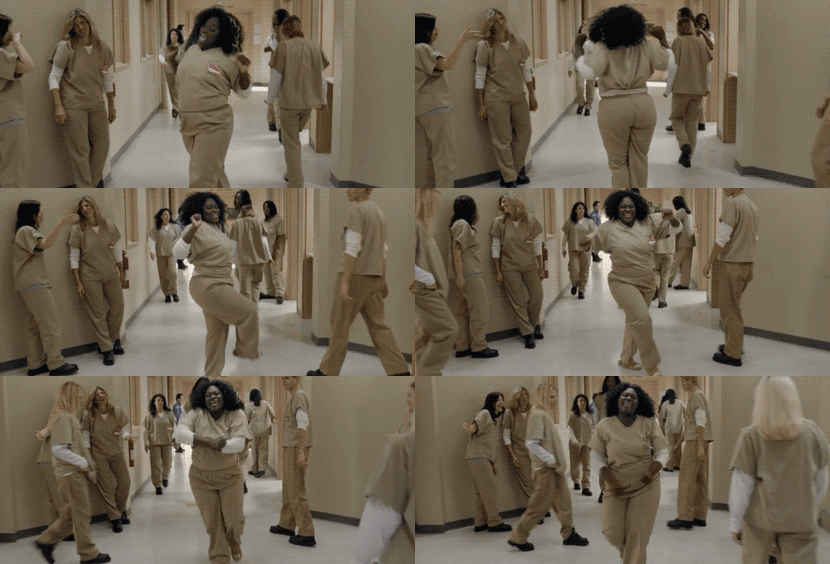
and of course:

But the point of having a blog post about it is I tried an experiment with this WIP. When I began, I wrote like most authors did-- with a sharp eye on my word count. But as I neared 60K and the end was nowhere in sight, I grew really nervous. I started entertaining horrible ideas of it turning out at 140K or 160K. I feared I'd have to cut my book in half. I was watching every thousand words go up, until I grew tired of it.
So I turned off my word count, and decided to write the rest of my first draft without looking at the word count.
For the first 10K, it was easy. I loved it. I wasn't worried about it anymore. But as I began explaining what I was doing to other writers, I got a similar shocked response: "Wow." and "I couldn't do that."
I started to understand what they were talking about. It was driving me mad, and I wanted badly to peak. I didn't, because I wanted to see what this effect would have on the length of my WIP. I began dreaming about my WIP coming out as 140K or 160K, and I was kinda back where I started.
I finished without peaking since 60K. My WIP turned out to be 119K words. Would it have been shorter if I'd been keeping a close eye on it? Probably not. I cut plot points that were in my notes because I didn't think they'd help. If I had written them in, it certainly would have been longer.
But what I did learn from all this was that writers are addicted to their word count. With good reason. It's how we communicate progress, it's used in publishing all the time, and there are restrictions. But with first drafts, I think its important if writers take time away from their word count. I admit, I did have the same fears, peaking or no, but there were times where I was finally able to let go. I didn't miss watching the numbers roll up one bit.
Try it. On your next book, turn off your word count. See how long your first draft comes out to be and compare it to your drafts you've had in the past.
Did you miss it?
Thursday, September 29, 2011
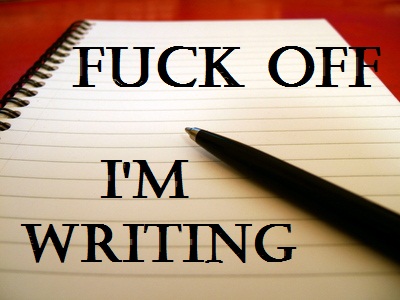
Fuck Off, I'm Writing
Have you ever had a really good book, a really awesomely good book, and you're at the climax and just want to read through, but life keeps GETTING IN THE WAY??
It's infuriating. All you can think about is finding out what happens but you're trapped getting milk or picking up the kids or making dinner or going to work or paying attention to your friends. LIFE is so intrusive to the writing process that sometimes I just want to throttle it.
It's bad being in the middle of a climax of a book you're reading, but I find when I'm working on the climax of MY OWN BOOK, it's SO MUCH WORSE OH GOD. Because it takes ten times longer to write a climax than to read one, and life just loves to butt its way in when it's not needed. It's like being stuck in a perpetual state of frustration, where everything is tense and you just DON'T HAVE ENOUGH TIME, and you want to scream and your relationships become strained at best.
(Friend: Hey, Katie, what's up?
Me: BOOK.
Friend: uuuuuuuuuuuhhhhhh....
Me: IT'S A BOOK. MADE OF PAPER. NOM NOM PAPER. NOM?
Friend: I'm good.
Me: Nom. *eats paper*
Friend: It was nice seeing you.
Me: IT'S A BOOK. *pedo stare* O_______________O** )
As writers, I think we put up with a lot. Our work is often placed in the background so we can tend to our day jobs or family and friends. And that's a good thing, we don't want to become hermits. We don't want to lose reality for a fantasy.
But sometimes, SOMETIMES, BLOG PEOPLE. sigh. Sometimes I want to shut myself up in my basement, lock my doors and not emerge until I see THE END. Of course, that's not possible, but it's a lovely fantasy, isn't it?
Just because you're not getting paid for it doesn't mean it doesn't have value in your life. Just because writing is a solitary thing that, at some points, may not see a profit doesn't mean it is any less important to those things that do. It's hard to justify taking time out of a day overstuffed with obligations to take an hour or two to write, but we have to. It's what we do. We're writers.
But remember: your writing does matter, whether you're published or searching for an agent. No matter what stage you're at, writers write! It's the only way we improve, and it's the only way we'll get any closer to our goals. And sometimes that means shutting yourself up in an office or a bedroom and ignoring everything else. Yes, ignore. As a writer, if you keep putting your craft in the back of your mind, and you don't take time out every day to work on it, how are you ever going to accomplish being published? Under deadline?
So, I've devised a clever little sign that should help writers everywhere. We need to stand up for ourselves! We need to ignore the rest of the world for once, because sometimes reality needs to come after fantasy. Sometimes we need to GET STUFF DONE.
So I made a sign that will help writers! Print it off, stick it on your door, tape it to the back of your head, leave it on your desk-- whatever. Just block out the world for a few hours and do what you love-- and do it in style!

AND ACT NOW. WE HAVE OUR BRITISH VERSION AVALIABLE AS WELL.

And one for the family lovers among you.

Oh, my paint skillz know no bounds. Spread the love, my lovelies.
I'm going to go write now. ;)
Peace,
-Katie
** I AM CREEPY AND UNCOMFORTABLE WHEN I NEAR THE END OF A PROJECT. NONE OF THIS WILL PROBABLY MAKE ANY SENSE BUT THAT'S OKAY BECAUSE THE BOOK'S ALMOST DONE AND SOON RAINBOW WILL RAIN DOWN FROM THE SKY AND MAKE CHOCOLATE MILK COFFEE.
It's infuriating. All you can think about is finding out what happens but you're trapped getting milk or picking up the kids or making dinner or going to work or paying attention to your friends. LIFE is so intrusive to the writing process that sometimes I just want to throttle it.
It's bad being in the middle of a climax of a book you're reading, but I find when I'm working on the climax of MY OWN BOOK, it's SO MUCH WORSE OH GOD. Because it takes ten times longer to write a climax than to read one, and life just loves to butt its way in when it's not needed. It's like being stuck in a perpetual state of frustration, where everything is tense and you just DON'T HAVE ENOUGH TIME, and you want to scream and your relationships become strained at best.
(Friend: Hey, Katie, what's up?
Me: BOOK.
Friend: uuuuuuuuuuuhhhhhh....
Me: IT'S A BOOK. MADE OF PAPER. NOM NOM PAPER. NOM?
Friend: I'm good.
Me: Nom. *eats paper*
Friend: It was nice seeing you.
Me: IT'S A BOOK. *pedo stare* O_______________O** )
As writers, I think we put up with a lot. Our work is often placed in the background so we can tend to our day jobs or family and friends. And that's a good thing, we don't want to become hermits. We don't want to lose reality for a fantasy.
But sometimes, SOMETIMES, BLOG PEOPLE. sigh. Sometimes I want to shut myself up in my basement, lock my doors and not emerge until I see THE END. Of course, that's not possible, but it's a lovely fantasy, isn't it?
Just because you're not getting paid for it doesn't mean it doesn't have value in your life. Just because writing is a solitary thing that, at some points, may not see a profit doesn't mean it is any less important to those things that do. It's hard to justify taking time out of a day overstuffed with obligations to take an hour or two to write, but we have to. It's what we do. We're writers.
But remember: your writing does matter, whether you're published or searching for an agent. No matter what stage you're at, writers write! It's the only way we improve, and it's the only way we'll get any closer to our goals. And sometimes that means shutting yourself up in an office or a bedroom and ignoring everything else. Yes, ignore. As a writer, if you keep putting your craft in the back of your mind, and you don't take time out every day to work on it, how are you ever going to accomplish being published? Under deadline?
So, I've devised a clever little sign that should help writers everywhere. We need to stand up for ourselves! We need to ignore the rest of the world for once, because sometimes reality needs to come after fantasy. Sometimes we need to GET STUFF DONE.
So I made a sign that will help writers! Print it off, stick it on your door, tape it to the back of your head, leave it on your desk-- whatever. Just block out the world for a few hours and do what you love-- and do it in style!
AND ACT NOW. WE HAVE OUR BRITISH VERSION AVALIABLE AS WELL.

And one for the family lovers among you.

Oh, my paint skillz know no bounds. Spread the love, my lovelies.
I'm going to go write now. ;)
Peace,
-Katie
** I AM CREEPY AND UNCOMFORTABLE WHEN I NEAR THE END OF A PROJECT. NONE OF THIS WILL PROBABLY MAKE ANY SENSE BUT THAT'S OKAY BECAUSE THE BOOK'S ALMOST DONE AND SOON RAINBOW WILL RAIN DOWN FROM THE SKY AND MAKE CHOCOLATE MILK COFFEE.
Wednesday, September 21, 2011
WIP Wednesday
I don't often do these, mostly because I'm convinced all my snippets of writing are MUCH better in context, but today I figured, what the hell.
Right now, my current project is a steampunk with dragons. (Yes, that is how I pitch it to everyone, why do you ask?) I pumped out three chapters today, and am debating whether I'm up for a fourth.
Here's the end to a scene. Charlotte has just won another round of the Steel Talon Tournament, where dragons face off against walkers.
Right now, my current project is a steampunk with dragons. (Yes, that is how I pitch it to everyone, why do you ask?) I pumped out three chapters today, and am debating whether I'm up for a fourth.
Here's the end to a scene. Charlotte has just won another round of the Steel Talon Tournament, where dragons face off against walkers.
Charlotte closed her eyes, and let victory wash over her.
There wasn’t any joy in it, she found. There was elation, a thrill, even pleasure in knowing that she made it one step closer to her goal.
But there was no joy in this.
Beatrice screamed over the cries of the crowd. “No! No! Let me go! I can put it out! I can put out the fire!”
A hand touched her arm and Charlotte turned, finding Riley at her side. His brow was creased in concern.
“Are you all right?” he asked.
Charlotte’s lips quivered, and she feared the answer would never again be ‘yes.’
She wrapped her arms around his middle and held him, tightly, as all around her the world burned.
Tuesday, September 13, 2011
Labeling Characters
Not long ago I was on Twitter, and the topic of conversation during a #GayYA chat was on labels. Are they good, are they bad, and whether you or your characters chose to use them. And it got me thinking. Labels affect more than just gay teens, so I wanted to open this up to discussion.
What are labels in fiction? Labels in fiction reflect labels in real life. Things that may not necessarily be negative, but define you in a very specific way. There is a difference between descriptors and labels. A descriptor is a very general way of describing someone. A label has a little different connotation. It usually comes with background stigmas or expectations from society.
To explain it a little better, a descriptor could be referring to another as a "redhead." This is general, and there's not much hidden meaning beneath the surface. But change that for a label such as "ginger" and you've got a different story. Calling someone a ginger is not necessarily a negative thing, but in the last 5-10 years there has been a growing stigma for people with red hair and freckles. Calling someone a ginger could have negative connotations depending on context. Though most uses of the word "ginger" to teens are used in jest, there's still a shift in the meaning of that word. Being called a redhead is not necessarily the same as being called a ginger.
All descriptors can be labels, but labels have a bit more specificity and background connotations to them, so we’ll focus on those for now.
What does it mean for an author or character to use labels? When an author uses labels in fiction, we see it used in narration, as opposed to if a character used it in dialogue. Both have subtle differences, but both do one thing: they set the reader's expectations. Not necessarily a bad thing, right? After all, sometimes it’s better not to beat around the book (Heh, keeping that typo.) about a character's ethnicity or gender identity or sexuality. Sometimes it's better to come out and say, "I'm Kenyan" or "He's Asian" or she's "Gayer than a fruitcake." It's a quick and easy way to establish a part of your character in the reader's mind.
Besides, sometimes there's no point to ignoring labels. Sometimes instead of saying "She had mocha skin and black hair" try "She's black." After all, how many ways can you describe a person's skin color before it gets dull? No, really, let's find out...
Using labels is often a good way of reclaiming them too. Instead of ignoring a label that most people may not understand, use it. Show them what it really means. For example, when you have a transgender character, it can work well to use labels. Show who your character is, show them that this is a transgendered person, and there's no reason they shouldn't understand this person.
When we have characters using labels in dialogue, we tend to get a lot of reclaiming. I remember one flamingly gay character who often called himself "Queer" or a "fairy" ect, ect. He used derogatory labels to reclaim them, because that was the kind of character he was. How characters use the labels, why they use the labels, even their avoidance to some labels really gives an insight into how the character views himself and those around him.
There's nothing wrong with using labels in dialogue and narrative. Sometimes, by using a label other people avoid, you can make a bold statement with only one word. But this is not always the case. Labels are not always sunshine and joy. To be honest, I don't use labels unless absolutely necessary. In Shell, I only openly mentioned that one of my characters was gay once, and it was only to gauge the reaction of another character to that word. (This was actually edited out during agent revisions.) I find labels very limiting. On the one hand, yes, great, you have an instant picture in the reader's mind. Unfortunately, people's definitions and ideas of labels are always different. I'm going to bet that many who read my point of redhead vs gingers didn't know that ginger could be a negative label. This is partly due to the evolution of language in different areas, slang, and of course, different age/wealth demographics.
In real life and in fiction, sometimes people have a hard time seeing past the label. Introducing a character who is schizophrenic, for example, could change a reader's entire perception on them. For many, schizophrenic is synonymous with crazy. Yes, in one way we can change or "reclaim" the meaning of that word in the reader's mind. But sometimes, I find that authors stray from simply reclaiming a word to making a point about people with schizophrenia or mental health in general. And trying to have a point or moral to the story will definitely turn readers off.
Is labeling necessary? After all, as writers, aren't we taught to show, rather than tell? Isn't telling readers that a character is gay or African or bipolar less effective than showing them? If you can easily show your readers who your character is rather than telling them, that will make for a more enjoyable read.
Can't figure out how to do it? Well, if you have a gay character, show the relationship. Show them with a member of the same sex. Show your readers an ethnic background. Perhaps your MC is Mexican and his mother is traditional? Mental illnesses, I'm half-and-half on. Is it necessary that your MC know that he has this illness? If not, keep the behavior, but drop the label. See if your readers catch that something's amiss. It could lead to interesting discussions of your character's psyche, instead of having readers write off the issues since it’s been “established.”
Whether you're for labels or against them, write how you want to. No editor or agent is going to tell you to add or take out labels unless it's absolutely necessary. Whether you choose to use them or not is dependent on your writing style and the type of story you're telling.
Of course, these are just my thoughts on labels used in everyday life. But what about not-so-nice terms? How would your character facing a derogatory label change your story? How about if your character used the derogatory label?
Leave me your thoughts to devour. Tasty, tasty thoughts.
Peace,
-Katie
What are labels in fiction? Labels in fiction reflect labels in real life. Things that may not necessarily be negative, but define you in a very specific way. There is a difference between descriptors and labels. A descriptor is a very general way of describing someone. A label has a little different connotation. It usually comes with background stigmas or expectations from society.
To explain it a little better, a descriptor could be referring to another as a "redhead." This is general, and there's not much hidden meaning beneath the surface. But change that for a label such as "ginger" and you've got a different story. Calling someone a ginger is not necessarily a negative thing, but in the last 5-10 years there has been a growing stigma for people with red hair and freckles. Calling someone a ginger could have negative connotations depending on context. Though most uses of the word "ginger" to teens are used in jest, there's still a shift in the meaning of that word. Being called a redhead is not necessarily the same as being called a ginger.
All descriptors can be labels, but labels have a bit more specificity and background connotations to them, so we’ll focus on those for now.
What does it mean for an author or character to use labels? When an author uses labels in fiction, we see it used in narration, as opposed to if a character used it in dialogue. Both have subtle differences, but both do one thing: they set the reader's expectations. Not necessarily a bad thing, right? After all, sometimes it’s better not to beat around the book (Heh, keeping that typo.) about a character's ethnicity or gender identity or sexuality. Sometimes it's better to come out and say, "I'm Kenyan" or "He's Asian" or she's "Gayer than a fruitcake." It's a quick and easy way to establish a part of your character in the reader's mind.
Besides, sometimes there's no point to ignoring labels. Sometimes instead of saying "She had mocha skin and black hair" try "She's black." After all, how many ways can you describe a person's skin color before it gets dull? No, really, let's find out...
Using labels is often a good way of reclaiming them too. Instead of ignoring a label that most people may not understand, use it. Show them what it really means. For example, when you have a transgender character, it can work well to use labels. Show who your character is, show them that this is a transgendered person, and there's no reason they shouldn't understand this person.
When we have characters using labels in dialogue, we tend to get a lot of reclaiming. I remember one flamingly gay character who often called himself "Queer" or a "fairy" ect, ect. He used derogatory labels to reclaim them, because that was the kind of character he was. How characters use the labels, why they use the labels, even their avoidance to some labels really gives an insight into how the character views himself and those around him.
There's nothing wrong with using labels in dialogue and narrative. Sometimes, by using a label other people avoid, you can make a bold statement with only one word. But this is not always the case. Labels are not always sunshine and joy. To be honest, I don't use labels unless absolutely necessary. In Shell, I only openly mentioned that one of my characters was gay once, and it was only to gauge the reaction of another character to that word. (This was actually edited out during agent revisions.) I find labels very limiting. On the one hand, yes, great, you have an instant picture in the reader's mind. Unfortunately, people's definitions and ideas of labels are always different. I'm going to bet that many who read my point of redhead vs gingers didn't know that ginger could be a negative label. This is partly due to the evolution of language in different areas, slang, and of course, different age/wealth demographics.
In real life and in fiction, sometimes people have a hard time seeing past the label. Introducing a character who is schizophrenic, for example, could change a reader's entire perception on them. For many, schizophrenic is synonymous with crazy. Yes, in one way we can change or "reclaim" the meaning of that word in the reader's mind. But sometimes, I find that authors stray from simply reclaiming a word to making a point about people with schizophrenia or mental health in general. And trying to have a point or moral to the story will definitely turn readers off.
Is labeling necessary? After all, as writers, aren't we taught to show, rather than tell? Isn't telling readers that a character is gay or African or bipolar less effective than showing them? If you can easily show your readers who your character is rather than telling them, that will make for a more enjoyable read.
Can't figure out how to do it? Well, if you have a gay character, show the relationship. Show them with a member of the same sex. Show your readers an ethnic background. Perhaps your MC is Mexican and his mother is traditional? Mental illnesses, I'm half-and-half on. Is it necessary that your MC know that he has this illness? If not, keep the behavior, but drop the label. See if your readers catch that something's amiss. It could lead to interesting discussions of your character's psyche, instead of having readers write off the issues since it’s been “established.”
Whether you're for labels or against them, write how you want to. No editor or agent is going to tell you to add or take out labels unless it's absolutely necessary. Whether you choose to use them or not is dependent on your writing style and the type of story you're telling.
Of course, these are just my thoughts on labels used in everyday life. But what about not-so-nice terms? How would your character facing a derogatory label change your story? How about if your character used the derogatory label?
Leave me your thoughts to devour. Tasty, tasty thoughts.
Peace,
-Katie
Thursday, September 1, 2011
Book Review: Shut Out

Book Review: Shut Out by Kody Keplinger
I had been eagerly awaiting this book for several months, since about the time that I read The DUFF. So when I found an early copy at Chapters, you know I didn't hesitate to grab it and crack it open ASAP.
As usual, what immediately drew me into the story was the main character's voice, Lissa. Lissa is a little more reserved, a little more "virginal" than I expected, and honestly I was glad for the surprise. It made her sometimes seem younger than some of the guys, but it also brought a real sense of sincerity to everything she did. Another aspect that immediately drew me in and held on tight were the cast of characters and the way they interacted. Every character in Shut Out was fully developed, with their own quips and quirks, wants and needs. Because of the way this book is oriented, we stay mostly on the female POV of some of the issues addressed, but Keplinger doesn't hesitate to let her boys shine at the right moments.
The book was a fast-paced, absorbing read. Keplinger has a real gift for voice and characters who are so genuine they might as well be real people. This book also addresses a lot of issues with teen sex, especially when it comes to girls and sex. What's expected of them, what's not expected of them, invisible guidelines that society puts up. Nobody talks about them, but for some reason they're there.
I enjoyed the points that Keplinger made in Shut Out, and for the most part I thought they were well integrated with the story. But I could definitely understand if some readers saw it as a bit preachy at times.
Another thing I wish we saw more of was Cash. I wish Cash and Lissa had been able to have more conversations, a deeper meaning to a lot of their interactions. Because of plot details, this would have been impossible. I still wish it could have happened, because Cash is a sweet, understanding boy who is the type of love interest that makes me melt, and I wish we saw more of them as opposed to the "bad boy" that treats the heroine like shit. The lack of Cash was more my own desire as a fan than as a fault in the book.
What can I say? A book with a battle of the sexes? A book with issues involving sex, including hypocrisies and using sex as a weapon? A fabulous story with evolving characters, a moving storyline, and an awesomely wicked message?
What more reasons could you need to read this book?
This one's getting 5/5 stars from me. You don't want to miss it.
Subscribe to:
Posts (Atom)
-
 (If you're just here for the contest and don't want to hear my ramblings, scroll down until you see a giant sparkly "CONTEST....
 -
 Book Review: Tilly and the Crazy Eights by Monique Gray Smith Goodreads Description: When Tilly receives an invitation to help drive eight...
 -
Book Review: The Girl From Everywhere by Heidi Heilig Goodreads Description: Nix has spent her entire life aboard her father’s s...


