Friday, September 29, 2023

Book Review: Firekeeper's Daughter


Book Review: Firekeeper's Daughter by Angeline Boulley 

Goodreads Description: As a biracial, unenrolled tribal member and the product of a scandal, Daunis Fontaine has never quite fit in—both in her hometown and on the nearby Ojibwe reservation. When her family is struck by tragedy, Daunis puts her dreams on hold to care for her fragile mother. The only bright spot is meeting Jamie, the charming new recruit on her brother’s hockey team.

After Daunis witnesses a shocking murder that thrusts her into a criminal investigation, she agrees to go undercover. But the deceptions—and deaths—keep piling up and soon the threat strikes too close to home. How far will she go to protect her community if it means tearing apart the only world she’s ever known?

My Review: Alright, peeps, I've got a good one for you today. This was, hands down, the best YA novel I've read in years. Every element was expertly handled, from the characters, to the plot, to its believability, all the way to its spectacular ending. Best of all, it doesn't reinvent the wheel when it comes to YA fiction - it honours many well-loved tropes while also breathing new life into these plot elements through a fresh Anishinaabe perspective.

Firekeeper's Daughter is a crime story done right. Many YA crime novels struggle with believability and don't fully justify why teenagers are the leads in criminal investigations when the police are RIGHT THERE. Why would an adult put a child in danger when there are so many other options they could take? For this story, it's the isolation and insular Ojibway community that justifies Daunis' involvement in the undercover case. The police have already introduced an Indigenous undercover cop pretending to be a teenager to get into the crime ring, but due to the community's culture, the police can't get close enough to the suspects to gather evidence. Daunis, however, is someone who can get them in - not only is she Indigenous with direct ties to the community, but she also has direct ties to the suspects, the land, and is well-versed in chemistry. The plot kicks off with the murder of Daunis' best friend, which reveals that on Daunis' reserve, someone has built a drug trafficking ring that stretches across multiple states. A group has been synthesizing powerful meth with an unknown compound, likely a plant that grows around the reservation, and it's the intersection of culture, intelligence, and her social positioning in the community that gives Daunis the edge in solving the case. I loved that this book took the labour out of my suspension of disbelief. 

Daunis has become one of my favourite YA heroines, possibly ever. She's got a distinct personality that resists falling into the "good girl/good student" trope that plagues many YA heroines. Daunis may be smart and more or less on the straight and narrow, but she resists black and white binaries -- she drinks and parties with her friends, she isn't scared of the meth users in her community, even if she doesn't partake, and she has no guilt over using prescription pain medications to cope with hard times. The book doesn't problematize her substance use or riskier behaviours, and instead treats them as a couple of dots on the diverse pointillism painting that is Daunis. Many YA novels seem preoccupied with "right" and "wrong" behaviours, especially from the main character, and end up pushing puritans ideals of the Madonna-whore complex, even if they don't mean to. Most often, they lean towards the "good girl" trope, where the MC wouldn't dream of drinking or drugs, though some protagonists do lean into their problematic behaviours and the narrative is quick to reinforce these behaviours as wrong, dangerous, or shameful. Firekeeper's Daughter avoids all of that moralizing by showing that these points of Daunis' character, whether it's something "good" like her intelligence or "bad" like her substance use, never end up defining her.

Boulley's masterful character crafting skills go beyond her main character -- everyone in this book was so realistic and well-rounded, but they also engage with character tropes in fascinating ways. Boulley is also quite subtle about this character depth, introducing small moments that don't stand out, but add layers to the roles we're used to seeing. Lily, the best friend with the big personality, becomes more than just the side-kick. Boulley contrasts the strong parts of her personality with gentler moments and circumstances while still honouring the original trope. Lily is loud but small, protector but also victim, and the wise one whose always getting into trouble. Jamie, the new love interest in town, also engages with traditional tropes in an interesting way. He is very much the Bland Boyfriend trope - a seemingly perfect man with no personality outside of the protagonist, yet Boulley gives us plot reasons for why he's like this. The fact that he's largely disconnected from his roots also becomes a major point in their relationship later in the story, which is a fascinating twist on what's usually just lazy writing. The Fake Boyfriend trope also plays a part in the story, but unlike most versions of this trope, it doesn't feel contrived, which is saying something for a trope that's best described as, "There were a thousand other ways out of this situation, why did you pick this one?" 

All in all, a really riveting book that takes what's familiar and beloved about YA and elevates it to new levels. The writing is crisp, clear, and beautiful, with many lines oozing wisdom and maturity. The way plot elements collide with aspects of Indigenous culture and spirituality is proof that you can take a story that's been done a thousand times and completely transform it with a diverse setting and perspective. If you only pick up one book this year, make it this one. I can't recommend it enough. 

TL;DR: 5/5 stars. The best YA crime novel out there. Period. 

Thursday, September 7, 2023

Book Review: This Dark Endeavour


Book Review: This Dark Endevour by Kenneth Oppel 

Goodreads Description: Victor Frankenstein leads a charmed life. He and his twin brother, Konrad, and their beautiful cousin Elizabeth take lessons at home and spend their spare time fencing and horseback riding. Along with their friend Henry, they have explored all the hidden passageways and secret rooms of the palatial Frankenstein chateau. Except one.

The Dark Library contains ancient tomes written in strange languages and filled with forbidden knowledge. Their father makes them promise never to visit the library, but when Konrad becomes deathly ill, Victor knows he must find the book that contains the recipe for the legendary Elixir of Life.

The elixir needs only three ingredients. But impossible odds, dangerous alchemy and a bitter love triangle threaten their quest at every turn.

Victor knows he must not fail. Yet his success depends on how far he is willing to push the boundaries of nature, science and love—and how much he is willing to sacrifice.


My Review: Kenneth Oppel has had a special place in my heart since I was a kid, when his bat-tastic Silverwing series swooped into my life and made my oddball ass feel less alone. So, years ago, when I spotted a Frankenstein prequel by Kenneth Oppel, I was quick to snatch it up, but the book languished on my TBR shelf the last few years as more pressing titles jumped the queue. I finally found the time to pick it up, and to say I was disappointed would have been an understatement. This Dark Endevour is DULL. It's predictable. It's more than forgettable, it's why-bother-reading-able. The book's greatest weakness is that it's a Frankenstein prequel; its saving grace the target audience, who likely have not read the original Frankenstein and can't compare Oppel's changes to the original text. Yet even then, the book falls flat: the story is uninspired, the romantic and plot twists are contrived, lacking any sense of stakes, and the characters feel ripped out of the wrong time period. 

Slapping Frankenstein on this book leads to natural comparisons between the texts, but ironically, knowing the basics of Frankenstein makes the plot and twist ending of This Dark Endevour painfully obvious. Oppel introduces readers to his Frankenstein twins: Victor Frankenstein, the savant scientist that science-fiction knows all too well, and Oppel's creation, Konrad - the virtuous mirror-inversion of Victor, whose flaws have been bent backwards into much a nobler configuration. Konrad is sweet, he's compassionate, he's sensitive and gentle, but also brave, just, and level-headed - often the voice of reason, reigning Victor in when his lofty ideals pull them off the moral path. Yet this inversion of Victor's traits also reveals that Oppel either dislikes or doesn't understand the nuance within Shelley's Victor Frankenstein, as Oppel emphasizes Victor's negative traits - greed, ambition, stubbornness, solipsism - and crafts Konrad as the opposite of that, making both characters feel partly artificial and casting them in 'angel' and 'devil' roles. In the original text, Victor spent much of his time reigning himself back in, and the balance between doing wrong and trying to correct course is what made him so fascinating. Oppel's Victor feels more akin to the mad-scientist representations of Victor Frankenstein that pop-culture is more familiar with. 

Early in the book, Konrad falls deathly ill, motivating Victor and his friends Elizabeth and Henry to seek out alchemic knowledge that would lead them to the Elixir of Life to safe Konrad's life. At this point, the fact that this is a Frankenstein tale immediately gave away the ending. This is, after all, Victor Frankenstein, the man known for bringing back the dead, not for saving the living, so before I'd even opened the book (as Konrad's illness is spelled out on the back cover), it was painfully obvious that despite all efforts, Konrad wasn't going to make it. Oppel tries to combat this by drawing out the tension of Konrad's illness and faking out the reader in regards to his recovery, but the efforts fall painfully flat.  

The overall plot is organized around a three-point fetch quest that quickly became predictable and dull. Victor and his friends connect with an alchemist who tasks them with collecting the three ingredients needed to save Konrad, and holy crap was this boring. No amount of cool glow-in-the-dark moss, demon fish, or wolf's eye alchemy could distract from the terrifyingly predictable arcs of find thing - attacked by monsters - barely escape with item. This formula repeats again at the finale as trusted characters turn on each other and the actual creation of the Elixir becomes yet another fetch mission. The story could have worked if it was in a video game, where the agency of players could have mitigated some of the boredom from the plot's predictability. Instead, the reader is dragged along, beat by expected beat, without anything to change up the formula.

Finally, the characters. As I already mentioned, Victor and Konrad are two-dimensional representations of the "good" and "bad" twin, although thankfully this becomes less pronounced as Konrad becomes bedridden and less of an active character. Elizabeth was also difficult to stomach through much of the text. Many times, she asserts her equality to the boys by declaring that she's braver, stronger, and more tenacious than others (certainly Henry). The characters often have a "Don't You Know, Bob?" moment where they recount when Elizabeth bested the boys, was braver than them, or, GASP - wore trousers. These conversations feel so contrived, like Elizabeth is arguing against someone that isn't even there, asserting her autonomy and independence when no one was questioning it (other characters, narrative, even audience). I can't help but wonder why Oppel felt the need to assure audiences of Elizabeth's Girl Power! and can only assume it's because of the time period the book is set in. Finally, Oppel establishes an interesting romantic conflict between Victor, Elizabeth, and Konrad, but introduces this too late (so it feels like it comes out of nowhere, when this romantic tension could and should have been underlying their interactions from the beginning). This tension also doesn't lead to much besides some simmering resentment and moments of will-they-won't-they. I wish this romantic tension was better defined, upped the stakes, and actually lead to consequences in their relationship. It would have been nice to see that simmering resentment actually pitch up to a boil. 

All in all, this book isn't worth the read. Even as a fun, dumb pulp read, there's nothing really fun about it. With how predictable the whole plotline was, it would have been smarter to start the plot at book 2, where Konrad is already dead and build to how Victor plans to bring him back, even if that would have had its own complications. That concept at least has some creative possibilities within in, but this book left such a bad taste in my mouth that I don't care to see where Oppel takes this concept. It's dead in the water if you ask me, and not worth the lightning for its resurrection. 

TL;DR: 2/5 stars. Boring and uninspired. 

Sunday, August 27, 2023

Book Review: Their Eyes Were Watching God


Book Review: Their Eyes Were Watching God by Zora Neale Hurston 

Goodreads Description: Fair and long-legged, independent and articulate, Janie Crawford sets out to be her own person—no mean feat for a black woman in the '30s. Janie's quest for identity takes her through three marriages and into a journey back to her roots.

My Review: When it was originally released in 1937, Their Eyes Were Watching God drew considerable backlash for its depiction of "average" black Americans, especially from other prominent writers of the Harlem Renaissance. The authors of this movement used art to argue for social change by depicting black people as educated, artistic, and activist - bucking against long-held racist beliefs that black people were intellectually or culturally inferior. However, these authors were largely trapped within, and often conformed to, white standards of success in order to gain equality and approval in America. Zora Neale Hurtson's book took a completely different approach. Hurston worked as an anthropologist as well as a writer, and was more interested in examining what made black communities unique. She depicted "average" black Americans without judgement -- reveling in various accents and speaking habits, depicted communal storytelling and humour that some might consider Vaudeville-esque -- and even critiqued the educated black characters within her text for their condescension and arrogance. This drew a fair bit of backlash from other black writers who argued that the book resembled caricaturesque minstrel shows, however, this feels like a grave misunderstanding of the nuance within Hurston's book. When analyzed today, we can see how Hurston's book is a celebration of black culture in America, with its insistence to see these people fully realized, with all their jokes, language, and culture accepted as is. While respectability politics has had its uses throughout civil rights movements, Hurston's book reminds us that if people of colour only measure their success through white standards, it ultimately leaves them isolated from themselves and their community. In that way, Their Eyes feels ahead of its time, pushing for a radical acceptance of people as they are rather than purposing an ideal for what they should be. 

As you can tell from the short summary, it's difficult to pin down the exact plot of Their Eyes. This book is a lot of things. It's a love story, a coming-of-age tale, it's a feminist text, a story of self-actualization, it's an anthropologic and linguistic exploration of black culture, with a profoundly optimistic look on race relations. It focuses on Janie Crawford as she grows up through her three marriages, coming to understand the meaning of love, marriage, and agency. As many coming of age stories are, the book is slow paced, focusing on slow-burning character arcs and mundane plot events over dramatic twists. Over the course of the book, Janie subtly moves away from the expectations of white culture and finds self-actualization and agency through embracing "blackness." Janie's first husband unquestioningly follows white culture and heteronormativity, expecting Janie to fall into her "wifely" role. Despite living in a black community, her second husband pushes both himself and Janie towards classist elitism that pits "respectable blackness" against the "common folk," and ends up isolating Janie from her community and culture. Janie resists this influence, and through her third husband, connects with the black community and finds more happiness, passion, equality, and agency, despite living closer to poverty and instability. In this way, Hurston bucks against respectability politics and shows that if black people "behaved like whites wanted them to," it would leave them isolated from each other, their culture, and themselves. 

Hurston's novel also showcases a profound optimism when it comes to race relations - focusing very little on racism and instead showing black people living their lives, largely unhindered by oppression. She features the town of Eatonville as a major setting, which was a real town and the first self-governing all-black municipality in the United States (incorporated in 1887). Eatonville in the book faces no trouble from white people and exists unremarkably. Hurston doesn't fluff up the town's importance or incite any racist drama, it's just another setting. The book still features racism in pieces, such as when one of Janie's husbands is forced by the Red Cross to do manual labor and he has to run from gunfire to escape, but the book doesn't linger on these moments, giving it a strange sort of optimism and freedom, despite the time period it's set in. 

The book features a lot of heavy accents, phonetic spelling, and slang to really capture the "language" these communities spoke, and don't get me wrong, Hurston does an excellent job with these accents. She captures their mannerisms and culture in a way that feels rich, realistic, and nuanced, but every character speaks with a heavy accent. Every. One. Not to mention, this book is very dialogue heavy. There are whole pages where two or more characters are talking, wherein the conversation is lobbed between two speakers without much to break it up. Even white characters, when they appear, speak in their own heavy, difficult-to-read accents. While this dialogue is fascinating from an anthropological/sociological/linguistic point of view, I really hated reading it. Just trying to decode what characters are actually saying, with all the dropped letters, creative spelling, and phonetic sounds was a nightmare. I read this book at a snail's pace and all the decoding left little energy to actually enjoy the story. Many words had to be sounded out aloud, because they were spelled to recreate a sound, rather than a real word. "Ah" is used almost exclusively instead of "I," for example. Despite that, I have a hard time imagining this book without the accents. It feels like something would be lost without them, which reminds me of the saying, "it's not about the destination, it's about the journey." For these characters, it's not so much what they say, but how they say it. 

Aside from the heavily accented dialogue, the narrative is written in gorgeous prose that's littered with wise insights on the world, love, marriage, and growing up. Hurston especially has a lot to say about the intersection of race and gender (and to a lesser extent, class), commenting often on how oppression affects black men versus black women, while also exploring the power dynamics between married couples. The book culminates in a storm and legal trial that tests Janie's beliefs about love and marriage, both in personal and legal frameworks, and pushes her to establish agency and self-advocacy. The climax feels believable but dramatic. It fits in well with the humdrum normalcy of married life, but also instills the larger-than-life, once-in-a-lifetime type of conflict that elevates the text to the next level - pushing Janie to fully embody what she's learned about love, marriage, and agency in order to survive and thrive going forward. 

TL;DR: 3/5 stars. A fascinating text that analyzes the intersection of race, gender, and class from a black feminist perspective.

Saturday, August 5, 2023

Book Review: The Weary Blues


Book Review: The Weary Blues by Langston Hughes 

Goodreads Description: The Weary Blues is Langston Hughes's first published collection of poems, immediately celebrated as a tour de force upon its release. Over ninety years after its publication, it remains a critically acclaimed literary work and still evokes a fresh, contemporary feeling and offers a powerful reflection of the Black experience. From the title poem "The Weary Blues," echoing the sounds of the blues, to "Dream Variation," ringing with joyfulness, to the "Epilogue" that mimics Walt Whitman in its opening line, "I, too, sing America," Hughes writes clearly and colorfully, and his words remain prophetic and relevant today.

My Review: Nearly 100 years ago, Langston Hughes published his first poetry collection, The Weary Blues, a modern classic that propelled him to the top of the literary scene in Harlem in the 1930s. The Weary Blues takes us on a wide journey through various aspects of Hughes' life, introducing us to Harlem in its heyday, the impact of the Blues, and the beauty and strength of the black community. Hughes combines familiar contemporary language with classical poetry forms, structures, and allusions to give his poetry a sense of timelessness, which makes it accessible to a wide variety of readers. Hughes' collection constantly brings together opposing dichotomies on the page to demonstrate their ultimate similarity: ugliness and beauty, black and white, joy and suffering. In this way, The Weary Blues draws on multiple aspects of the human experience to create a rich image of life as a black man in 1920s America. 

Langston Hughes is known for his involvement with the Harlem Renaissance, a period of cultural revival for black art during the 1920-30s, which laid the groundwork for civil rights movements and the Black Arts Movement of the 1960-70s. Throughout his poems, Hughes plays with major ideas that shaped the Harlem Renaissance - such as art as propaganda to support black civil rights movements, and double consciousness - the idea that black people experience two separate 'consciousnesses': life as a black person and an American. Hughes utilizes his poems as a form of propaganda to fight back against white oppression by showcasing blackness and black people as divinely beautiful, while highlighting the suffering and disconnect that comes from systematic oppression. In that way, many of his works are extremely powerful, and when taking the collection in whole, it's hard not see the outpouring of love that Hughes has for his community, his heritage, his country, and ultimately himself. It's this self-love and self-respect that allows Hughes' art to advocate for his community while refusing to submit to a lesser station in society to earn acceptance. His poetry loudly states: we are beautiful, we are strong, and we are capable of greatness, so why don't we deserve a seat at the table? It's a message that never gets old. 

The influence of Blues music remains strong throughout the entire collection. Hughes had a deep understanding of rhythm and infused this into the bones of his poems. The titular poem, "The Weary Blues" does an excellent job at recreating the sound of a Blues song, but it's "The Cat and the Saxophone" that really captures this Blusey feeling for me. The poem feels a bit all over the place, with people talking over a Blues song, but the use of caps, line breaks, rhythms, and stresses expertly recreates the sound of a swinging trumpet and its long soulful notes. The parts of the collection that are less focused on music, such as the sailor arc, utilize different rhythms that emphasize silence (think calming ocean white noise) which sharply contrast with the Blues pieces. This is what makes the Blusey pieces really pop, as readers can hear the difference between the various rhythms. The collection utilizes classical poetry forms throughout, while also mixing in more expressive free verse poems that capture the lack of structure during certain parts of Hughes' life (his sea-faring poems are largely freeverse). This change of form and style gives a refreshing diversity to the pieces in this collection, however, Hughes largely sticks to simple page arrangements while constructing his poems, leaving little for the eye to feast on besides the meat of the stanzas themselves. Many of the poems are short, some even only three lines long, and while his short pieces are meaningful, it feels like a potential is missed out on by not experimenting more with the white space. This may be an unfair criticism, since concrete poetry and experiments in white space didn't really kick off until the 1950s, but I did find myself really missing the aesthetic arrangement, especially for those really short, powerful pieces. 

All in all, Langston Hughes' first poetry collection is filled with joy, pain, music, and wisdom, all packed within tight little stanzas. Even after 100 years, his astute observations and use of language resonates with readers of any background and makes The Weary Blues an excellent addition to any poetry collection. 

TL;DR: 3/5 stars. A modern classic that celebrates the beauty and majesty of the black community. 

Friday, June 16, 2023

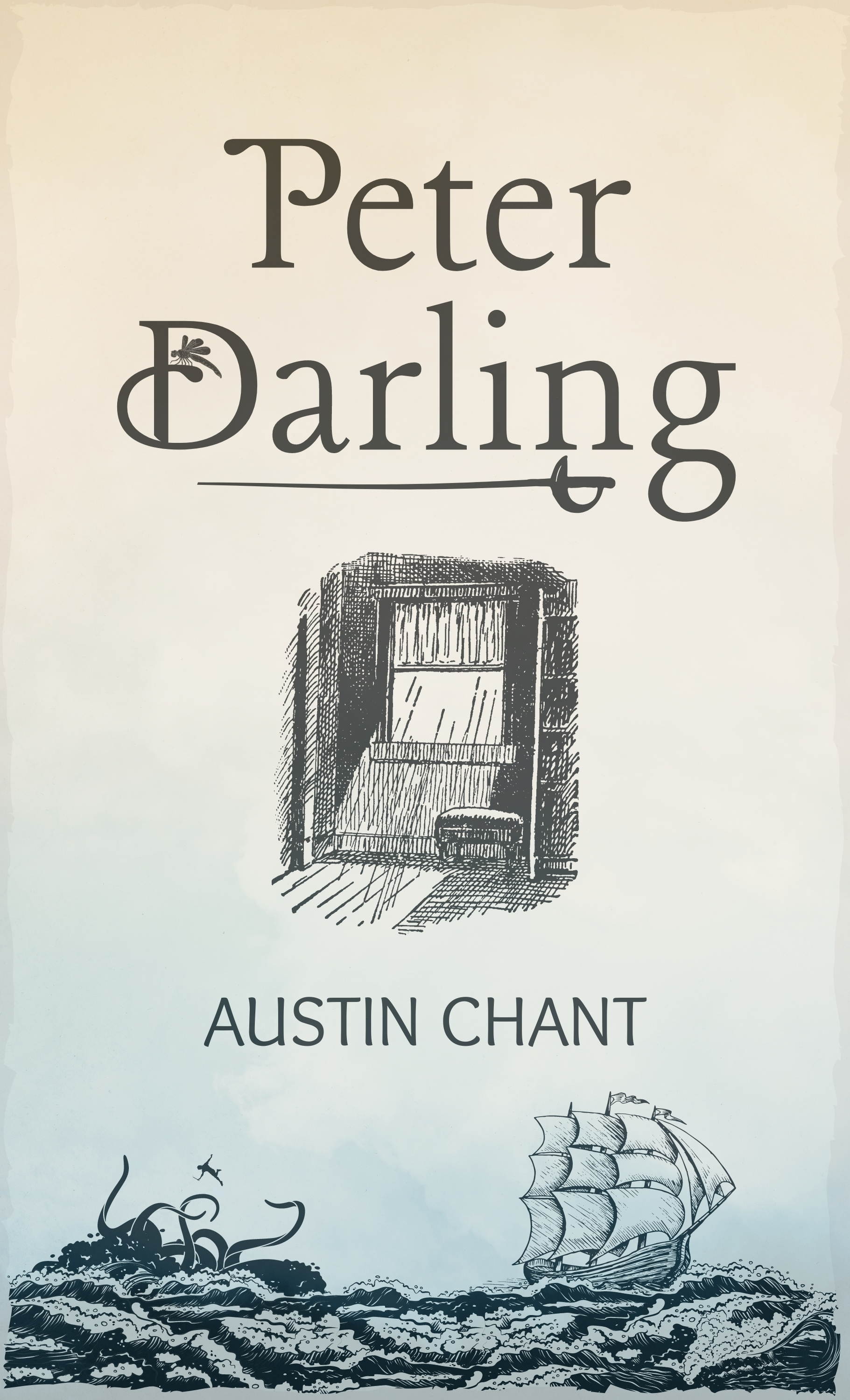
Book Review: Peter Darling


Book Review: Peter Darling by Austin Chant 

Goodreads Description: The Lost Boys say that Peter Pan went back to England because of Wendy Darling, but Wendy is just an old life he left behind. Neverland is his real home. So when Peter returns to it after ten years in the real world, he’s surprised to find a Neverland that no longer seems to need him.

The only person who truly missed Peter is Captain James Hook, who is delighted to have his old rival back. But when a new war ignites between the Lost Boys and Hook’s pirates, the ensuing bloodshed becomes all too real – and Peter’s rivalry with Hook starts to blur into something far more complicated, sensual, and deadly.


My Review: This review contains minor spoilers. 

Peter Darling is an interesting blend of contradictions. I first stumbled across the book while killing time on trans subreddits, where fans were raving about its trans and mlm representation. The book has apparently found its online niche-- its Goodreads page has over 8k ratings and 2k reviews, with over 70% of those ratings at either 4 or 5 stars, and fans are singing its praises across online networks. If this book had come to me about 15 years ago, I'd likely be another diehard fan hailing it as a triumph, because the book does have some solid emotionally-resonate moments of representation. Yet on the whole, it fails to achieve a cohesive narrative due to inconsistent character motivations, poor characterization, and enough head-hopping to make someone motion sick. 

Let's start with the positives. This book won the 2017 Rainbow Award for Best Cover, Best Debut Transgender Book, and Best Transgender Sci-fi/Fantasy, and was a runner up for Best Transgender Book, mainly for its female-to-male trans representation. I can see why this book was on the radar, as it does more than present a trans man's circumstances -- rather it pierces right into the heart of what it feels like to be a trans man. Capturing some of the emotionality of what it means to be trans is what gives this book its power. As well, Chant builds solid tension through the slow reveal of Peter's "secret" by blending it into Neverland lore - why did Peter disappear to for so long? Why did he come back? And who really is Peter 'Pan', anyway? This evolving tension connects well with the setting (Neverland as an escapist fantasy from a transphobic world), the themes of the text (forging identity through story), and Peter and James' struggles to assert themselves against the world. 

Most of the book is the 'trapped together' trope, which may not be to everyone's taste, but for those who do enjoy it, the story fully embraces the trope without edging too far into sappy territory. Chant's writing is also quite beautiful at times. There were many lines that I highlighted for their lyrical composition as well as their wisdom. As demonstrated in the prologue, Chant can set a decent atmosphere that draws in reader interest, but sadly underutilizes atmosphere and scene-setting throughout the rest of the book. 

The author is obviously familiar with JM Barrie's original Peter and Wendy novel, as many characters and references from Barrie's text pop up in Peter Darling. While these references were a great addition to fill out Chant's story, they also draw a direct connection to Barrie's work, which made the shortcomings of Peter Darling all the more obvious. Barrie's original text idealized childhood as a time of wonder and wildness, as different but on equal footing with adult experiences. Through Peter Pan, Barrie represents childhood as a Romantic would nature - beautiful, powerful, chaotic, illogical, yet also whole, idyllic, life-giving, unknowable, and awe-inspiring. Barrie represented children as holding a unique perspective and wisdom towards the world that is lost once we transition to adulthood. Chant's text doesn't engage with this conception of childhood and instead reduces Peter's violence and illogical reasoning to something 'childish' that is lesser than the 'adult' treaties and peace negotiations that have taken place across Neverland since his departure. Chant even differentiates adult and child war, implying that people die in adult wars and thus they are far more serious, something Barrie never did. It strikes me as strange for Chant to disregard childhood as somehow lesser when Barrie went out of his way to idealize childhood - warts and all - and put it on equal footing with adult experiences, which is what made the untamable image of Peter Pan so enticing. 

Overall, my main struggles with Peter Darling were the inconsistent characterizations and motivations that made it difficult to understand why anyone did anything. Peter begins the book with a vague, ill-defined memory loss that is never explained. He quickly regains his memories, but his morals and perspective are so unclear that his actions often come across as contradictory. It's clear that Peter is supposed to act more like Barrie's iteration in the beginning - irrational, violent, uncaring of people around him - slowly realize his 'childish' ways are selfish and hurting people, and ultimately grow up into a more compassionate individual. However, Peter's motivation before and after the change are not clearly communicated, so it's hard to understand why he makes those changes, or why he was attached to his original perspective in the first place. Even when these changes happen, they're half-assed in a way that makes it unclear if any change has actually occurred. Even after Peter sees the Lost Boys as more than just disposable soldiers, the narrative undermines this by revealing that everyone except himself and Hook are imaginary, and thus not worth caring about as 'real' people. This gives Peter permission to go back to being a compassionless jerk and ignore the found family he was trying to build relationships with so he can focus on his own selfish romantic pursuits. This inconsistent motivation translated to other characters - mostly Hook, as he's the only other 'real' character for much of the book. Hook's motivation for pirating and being Captain Hook are largely unexplored outside of his drive for treasure. We could assume he doesn't need motivation for being a pirate outside of treasure and joy for the lifestyle, yet when Peter returns and challenges him to war games (as they had done before his disappearance), Hook rejects him and then chides Peter for his childish desire for violence. Because of that, it's hard to understand how this Captain Hook is the same one from Barrie's story, who reveled in violence and piracy, yet we also get no explanation for why he's changed. Chant appears to want his cake and eat it too -- he flip flops between honouring Barrie's characters and criticizing them without any clear statement or conclusion, leading to a jumbled mess of characterization. 

It's a real shame, because there's a lot to like about this book. If you're looking for a simple mlm romance with great trans representation that builds off long-loved fanfiction tropes, then this is the book for you. However, the inconsistent motivations did disrupt my enjoyment on even that factor, so if you do choose to dive in, make sure to turn your brain all the way off for full enjoyment. 

TL;DR: 2/5 stars. A trans retelling of Peter Pan with great prose but aggravating characterization. 

Friday, May 12, 2023

Book Review: The Hidden Oracle


Book Review: The Hidden Oracle by Rick Riordan 

Goodreads Description: How do you punish an immortal?

By making him human.

After angering his father Zeus, the god Apollo is cast down from Olympus. Weak and disorientated, he lands in New York City as a regular teenage boy. Now, without his godly powers, the four-thousand-year-old deity must learn to survive in the modern world until he can somehow find a way to regain Zeus's favour.

But Apollo has many enemies—gods, monsters and mortals who would love to see the former Olympian permanently destroyed. Apollo needs help, and he can think of only one place to go... an enclave of modern demigods known as Camp Half-Blood.

My Review: Spoilers ahead for the book's main twist. Proceed with caution. 

Here we are again, back with another Riordan book. I was expecting the usual delightful romp through the Percy Jackson universe, but was surprised to find The Hidden Oracle has a completely different vibe than previous installments, both in good and bad ways. 

As punishment for indirectly aiding Gaea and the giants in their war against the Gods in the previous series, Apollo is cast down to Earth in mortal form and must reclaim the five Oracles that have gone mysteriously silent. Due to his circumstances, Apollo is not the jovial or wide-eyed protagonist that usually appears in the Riordanverse: he's irritable, arrogant, cowardly, and most importantly, an adult. While his memories are hazy enough that "Lester" is able to embody a somewhat juvenile perspective on the world, Apollo's characterization still feels like a bored adult being forced to endure this magical childlike adventure, and his cynicism at times brought me out of the fun of the story. It's hard to say if it's me, or Riordan, or his choice of protagonist (perhaps all of the above), but this book felt like it was bored of its own formula. It constantly tries to buck against its universe's well-cemented formula with differing levels of effectiveness, with Apollo's characterization being the most difficult change to climatize to. He does transform over the book, as well as the series, and his more grating traits are sanded down as he learns and grows. I have read the third book in this series (you can find my review for it here) and Apollo's arrogance, cowardice, and his negative attitude towards the quest are toned down to a much more tolerable degree by that point in the series. In this book, though, it can be a bit much. However, there's still a lot to like about this protagonist. Apollo, as a lover-not-a-fighter God, often tries to avoid solving conflicts with force, like previous demigod protagonists, and is often using music to overwhelm his enemies or advance his quest. As much as Apollo's attitude can be somewhat grating, it was refreshing to follow a pacifist character who will wander off in hilarious directions to avoid a fist fight, and whose creative approach to problem solving breathes new life into a series that has largely solved problems through finding different flavours of how to hit someone. 

Apollo's characterization is far from the biggest formula shake-up. Historically, Riordanverse villains have been large, mythical beasts and creatures, and while The Trials of Apollo still features the existentialist monsters we know and love from Greek myth, the new series features a host of "god-emperors" to join the cast of baddies - real historical figures that have ascended to legend status due to their stories being told again and again. While previous Riordan books have featured humans or demigods working alongside the primordial baddies, the god-emperors from this series are "bosses" while previous humans and even demigods like Luke were treated and behaved more like disposable "peons" or "soldiers." These god-emperors are not only part of the problem, they are leading the problem, and this creates room to question the goodness of humans, the evil within monsters, and everything in between. 

The book raises questions about the capacity of good and evil not only in its villains, but also in its protagonists. Meg, daughter of Demeter, is presented like no other demigod up until this point. Her story doesn't follow the typical pipeline of discovering powers-traveling to Camp Half-Blood-being claimed-establish self at camp-define oneself through questing. When Apollo meets her early on in the book, she already knows how to fight of monsters, has some conception of her powers and origin, and is content to survive in the urban jungles on her own than journey to a camp to be trained like a traditional hero. Meg presents as neurodivergent throughout the novel, from her antisocial tendencies, her lack of concern for hygiene, poor social skills, and odd behaviour, including behaviours that could be considered "stimming." Because she isn't a high-functioning charismatic attractive teenager, Apollo clearly doesn't like her and is even grossed out by her, but as time passes he grows to see past her presentation and comes to care for her compassion, tenacity, and resilience. Because she presents so differently than most other characters, Meg gives readers who may be neurodivergent themselves, or who may feel like the 'weird outcast,' a character they can really connect to. Many of Riordan's character, like Percy himself, are larger than life - a little too charismatic, a little too friendly and patient, a little too eloquent, a little too perfect. While these characters can be excellent aspiration models, it can be intimidating to compare your messy human self to a character so perfect. Meg's imperfections felt like a release of tension in comparison. It also creates a bit of mystery, as Meg doesn't always communicate her thoughts with Apollo or the reader, opening space to question her motivations by the time she comes to betray Apollo to Nero, one of the god-emperors. It's revealed that Meg was actually working alongside Nero throughout the entire book and her betrayal leaves the ending uncertain, a sort of cliff hanger that allows readers to wonder in what capacity Meg will return -- as a villain, as someone who needs rescuing, or as someone who need redemption? Only time, and pages, will tell. 

All in all, I enjoyed The Hidden Oracle for what it was. I enjoyed the change-ups to the formula, and the honest attempt to scratch at good and evil while staying within the bounds of a middle grade formulaic novel, but these change ups both helped and hurt in many ways. Ultimately, it was Apollo's negativity and bitterness that dragged the vibe down and made it hard to enjoy the mythical romp. 

TL;DR: 3/5 stars. A solid Riordan romp that changes up the formula to open up conversations on villains and heroes, good and evil. 


Monday, May 8, 2023

Book Review: Book of Rhymes


Book Review: Book of Rhymes: The Poetics of Hip Hop by Adam Bradley 

Goodreads Description: If asked to list the greatest innovators of modern American poetry, few of us would think to include Jay-Z or Eminem in their number. And yet hip hop is the source of some of the most exciting developments in verse today. The media uproar in response to its controversial lyrical content has obscured hip hop's revolution of poetic craft and experience: Only in rap music can the beat of a song render poetic meter audible, allowing an MC's wordplay to move a club-full of eager listeners.

Examining rap history's most memorable lyricists and their inimitable techniques, literary scholar Adam Bradley argues that we must understand rap as poetry or miss the vanguard of poetry today. Book of Rhymes explores America's least understood poets, unpacking their surprisingly complex craft, and according rap poetry the respect it deserves. 

My Review: This book is Adam Bradley's love letter to rap, and what a letter it is. Despite being a nonfiction book set on teaching readers about the fundamentals of rap poetry, Bradley writes this book more like a memoir, centering his real-life experiences of studying and loving hip-hop. In this way, the book feels intimate and personal, while making solid arguments for the recognition of an art form that promotes community pride, encourages activism, and rebels against a system that has actively oppressed minorities since its inception. 

Bradley breaks down rap into six major elements and spends a chunk of the book looking into each element: rhythm, rhyme, wordplay, style, signifying, and storytelling. Bradley begins the book by digging into rap's influence on the world, its historical roots, role in black communities, and what separates it from other forms of poetry or music. He directly tackles difficult questions that have plagued rap for years and seeks to "explain without apologizing" when it comes to the genre's homophobic, misogynistic, or violent lyrics that appears antithesis to political activism. He does this by framing hip-hop within the socio-economic environment from which it grows, its lyrics therefore a reflection of the intergenerational trauma of black communities and their desire to be heard, to have a voice. As any troubled kid looking for attention will tell you, sometimes being unapologetically offensive is the best way to make society pay attention to what you have to say. Rap's authenticity resonates because it doesn't censor its expression; it just spits feeling onto the page and lets the dominos fall where they may. Unfortunately, that leads to some problematic lyrics now and again. 

Bradley splices in bits of history, interviews, and quotes from famous rappers, industry professionals, poets, English scholars, as well as plenty of rap lyrics, to illustrate hip-hop's place in the wider linguistic, poetic, and musical world. Bradley's writing is easy to read and engaging, and by centering his own passion for the subject in first person reflections, readers are able to easily connect to the subject matter through Bradley's enthusiasm. At times, his wordplay rivals the lyricists he is praising, ultimately leading to a delightful read obviously imbued with substantial passion for the art form. 

TL;DR: 3/5 stars. A well-written and passionate analysis of rap poetics.